Hawaii DUI License Reinstatement (2026): Suspension, Steps and Fees
How do you get your license back after a first DUI in Hawaii?
A first OVUII conviction in Hawaii carries a court-ordered license revocation of no less than 1 year and no more than 18 months, with mandatory ignition interlock installation on every vehicle the person drives for the entire revocation period. A separate administrative revocation from the Administrative Driver's License Revocation Office (ADLRO) can take effect within about 30 days of arrest, independent of the criminal case and runs 1 year for a first offense with no alcohol or drug enforcement contact in the preceding 10 years. Reinstatement requires completing the revocation period, a minimum 14 hour substance abuse program and a certified compliance statement from ADLRO before the county DMV issues a new license.
Hawaii runs two tracks after a DUI arrest. The Administrative Driver's License Revocation Office handles the license through its own administrative process, with 3 days to request a review hearing, while the court case runs separately on its own calendar. The page below lays out both tracks and the order the pieces come in, so the whole path is visible before any single deadline is due.
An ignition interlock is part of every first-offense path here. The insurance step uses the state's own certificate rather than the standard SR-22 form. The education or treatment step comes before reinstatement and runs 14 hours minimum. Each piece has its own section below, with the official source beside it.
The parts Hawaii drivers most often miss are the 3-day hearing-request deadline, which runs from the arrest or notice date and the order of the steps, since several gate the ones after them. The sections below take them in order.
How long is your license suspended after a first DUI in Hawaii?
The first-offense term and how the administrative and court tracks interact in Hawaii.
| Item | Hawaii rule |
|---|---|
| First-offense suspension | Court conviction (HRS 291E-61): revocation of no less than 1 year and no more than 18 months. Separate administrative revocation (HRS 291E-41): 1 year for a first offense with no alcohol or drug enforcement contact in the preceding 10 years. |
| Administrative vs court | Hawaii runs two separate revocation tracks. ADLRO issues an administrative revocation shortly after arrest (as fast as about 30 days), independent of the criminal case. A first-offense conviction in court under HRS 291E-61 separately imposes its own 1 year to 18 month revocation plus mandatory ignition interlock installation for that period. |
| Worth knowing | Refusing a breath, blood or urine test doubles the administrative revocation period (2 years for a first-offense refusal under HRS 291E-41). The 'alcohol enforcement contact' / 'drug enforcement contact' lookback used to determine first-offense status is 10 years. |
Confirm the exact term for your case with the Administrative Driver's License Revocation Office; the figure can shift with the test result and the case details.
The hearing clock: how long you have to act in Hawaii
The deadline to request the administrative review of the license suspension. It runs from the arrest or notice date, not from the court date.
| Item | Hawaii rule |
|---|---|
| Request window | 3 days |
| How it works | A driver has 3 calendar days from the notice of administrative revocation (NOAR) issued at arrest to submit written information to ADLRO stating why the license should not be revoked. ADLRO generally issues a review decision within 8 calendar days. If that review is unfavorable, the driver has 6 calendar days from the review decision to request a full evidentiary hearing (which must reach ADLRO within 60 calendar days of the NOAR) and the hearing is then scheduled within about 25 days for an alcohol-related offense. The hearing request carries a non-refundable $30 fee, waivable on request. Requesting a hearing does not delay the start of the administrative revocation. |
The path back: the Hawaii reinstatement steps in order
Several of these steps gate the ones after them, so the order matters as much as the list.
- Complete the applicable revocation period (administrative and/or court-ordered)
- Complete the required substance abuse rehabilitation program (minimum 14 hours)
- Install and maintain an ignition interlock device on every vehicle operated for the revocation period
- Obtain qualifying motor vehicle insurance under HRS 431:10C-104/105 to support the interlock permit
- Furnish and maintain proof of financial responsibility (certificate of insurance under HRS 287-22) for 3 years from the conviction, per HRS 287-20 and HRS 287-40
- Pay all fines, surcharges and fees imposed by the court and by ADLRO
- Obtain a certified statement of compliance from ADLRO
- Present the certified statement to the county Division of Motor Vehicles and Licensing to complete new-license requirements under HRS chapter 286
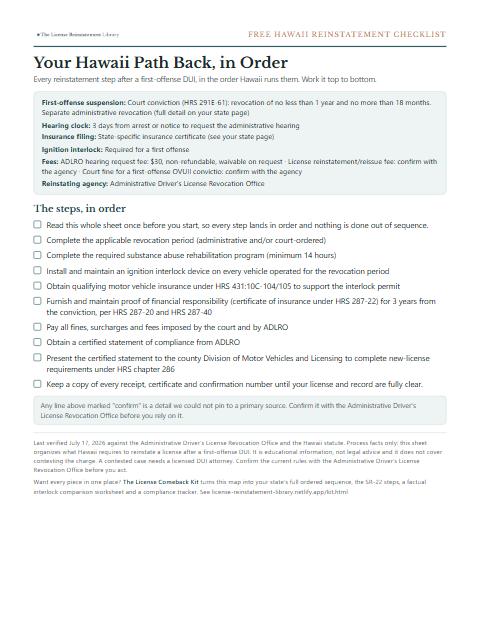
Get the free Hawaii reinstatement checklist
The one-page map of the Hawaii steps, in the order Hawaii runs them.
Instant download, plus Hawaii rule-change alerts. Unsubscribe anytime.
Ignition interlock rules in Hawaii
Whether the device is required for a first offense, for how long and where the state lists its certified providers.
| Item | Hawaii rule |
|---|---|
| Required for a first offense? | Yes, mandatory for a first offense |
| First-offense duration | Installed and maintained on every vehicle operated by the person for the full length of the revocation period (1 year to 18 months on a first-offense conviction) |
| BAC trigger | all convictions (mandatory regardless of BAC level as a first-offense sentencing element under HRS 291E-61(b)) |
| Approved providers | Administered through the ADLRO ignition interlock permit process; ADLRO, American Savings Bank Tower, 1001 Bishop Street Suite 500, Honolulu (courts.state.hi.us/courts/administrative/adlro) |
| Worth knowing | A driver who wants to drive during the administrative revocation (before or separate from a conviction) may voluntarily install an interlock and apply to ADLRO for an ignition interlock permit (IIP) without requesting a hearing. On a first-offense criminal conviction, interlock installation for the revocation period is a mandatory sentencing element, not optional. A separate employee driver's permit (without interlock) is available in limited employment-driving circumstances. |
Do you need SR-22 insurance in Hawaii?
The financial-responsibility filing your insurer makes with the state, where Hawaii requires one.
| Item | Hawaii rule |
|---|---|
| Required after a first DUI? | Yes |
| The form | Certificate of insurance under HRS 287-22 (a written certificate from an authorized insurance carrier proving an active motor vehicle liability policy). Hawaii statute does not use the term 'SR-22' by name, but this certificate is the functionally equivalent financial-responsibility filing that insurers commonly process as a standard SR-22 form |
| How long it must stay in force | 3 years from the date the proof was first required, confirmed by HRS 287-40 (the administrator may cancel the proof requirement after 3 years if no further qualifying conviction occurred in that period) |
| Worth knowing | RESOLVED during independent verification (2026-07-17), correcting the prior 'unverifiable' status. Direct review of HRS chapter 287 (Motor Vehicle Safety Responsibility Act) found HRS 287-20 requires proof of financial responsibility upon conviction under part III of chapter 291E, which covers OVUII offenses including the first-offense statute HRS 291E-61. HRS 287-22 specifies the proof is furnished as a written certificate of insurance from an authorized carrier and HRS 287-40 sets the duration at 3 years. Hawaii's own statute text does not use the label 'SR-22', so an insurer's specific paperwork should still be confirmed directly with DCCA or an insurance carrier, but the underlying 3-year financial-responsibility-certificate requirement itself is confirmed from primary statute text (law.justia.com mirror of HRS 287-20, 287-22 and 287-40). |
Driving before full reinstatement in Hawaii
The limited license, if any, that lets a first offender drive during the suspension.
| Item | Hawaii rule |
|---|---|
| Available for a first offense? | Yes |
| What Hawaii calls it | Ignition interlock permit (IIP), issued by ADLRO; a separate employee driver's permit is available for limited employment driving without interlock |
| Waiting period | No stated waiting period; a driver can apply to ADLRO for the IIP once an approved interlock device is installed and qualifying insurance is in place, without needing to request a hearing |
| Worth knowing | ADLRO will not issue an IIP if the driver is under 18, has a license expired/suspended/revoked for an unrelated reason, did not hold a valid license at the time of arrest, holds only a learner's/instruction permit, or holds a category-4 or commercial license (unless restricted to a category 1-3 license). The alternative employee driver's permit requires sworn statements from both the driver and employer and restricts driving to employment purposes, up to 12 hours a day. |
The DUI program, the fees and the lookback
The DUI program. A minimum 14 hour substance abuse rehabilitation program including education and counseling, or another program the court deems comparable, required as part of a first-offense OVUII sentence Length: 14 hours minimum.
The lookback period. 10 years (the 'alcohol enforcement contact' / 'drug enforcement contact' lookback window under HRS 291E-41 used to determine whether an offense counts as a first offense for administrative revocation length). This is the window over which a prior offense counts toward repeat-offense treatment.
The costs a Hawaii driver can expect on the way back.
| Item | Cost |
|---|---|
| ADLRO hearing request fee | $30, non-refundable, waivable on request |
| License reinstatement/reissue fee | varies by county; a commonly cited figure is around $20, not confirmed against a single official statewide fee schedule |
| Court fine for a first-offense OVUII conviction | $250 to $1,000, plus a $25 neurotrauma special fund surcharge and up to $25 discretionary trauma system special fund surcharge |
Not published as one current figure. Confirm the exact amount with the Administrative Driver's License Revocation Office before you pay.