Getting Your License Back After a DUI, Explained in Plain Language
The road back runs differently in every state. This lays out yours, step by step.
Popular: California Texas Florida SR-22 explained

Start with your state
The suspension length, the hearing deadline, the interlock rule, the insurance filing and the fees all shift at the state line. Open yours for the current rules and the official source behind each one.
All 50 states and DC are live. 15 are fully verified against a primary source; the rest are published with any unconfirmed detail flagged on the page.
Suspension length by state, at a glance
A first-offense suspension runs from a few weeks to a year and many states set it case by case. Here is the shape of it, with every state and DC in the table below the chart.
Copper marks the shortest and the longest charted length. Bars are each state's leading first-offense figure; the Basis column below names whether that is the administrative clock or the court clock, because a short administrative suspension is not the same thing as a full court revocation.
23 states set the length case by case or in multiple tiers with no single figure to chart. They are listed in the table below.
† corroborated, not yet confirmed against a primary source; the state page links its source.
Every state and DC, including the ones set case by case that the chart groups. This is the full, cited read.
| State | First-offense length | Basis | Confidence |
|---|---|---|---|
| Alabama | 90 days administrative per-se suspension (no prior alcohol/drug-related enforcement contact in the preceding 10 years, per Ala. Code 32-5A-304 as amended by Act 2018-546); entirely stayed if the driver installs an ignition interlock device | Administrative | Verified |
| Alaska | 90 days revocation | Administrative | Verified |
| Arizona | 90 days administrative per-se suspension, reducible to 30 days full suspension plus 60 days restricted driving with no prior conviction in 84 months and completed alcohol/drug screening | Administrative | Verified |
| Arkansas | 6 months (180 days) | Administrative | Partial |
| California | 4-month Administrative Per Se (APS) suspension where a chemical test showed 0.08 or higher (Veh. Code 13353.2). A first refusal is a different action and a longer one: Veh. Code 13353(a)(1) suspends the driving privilege for one year | Administrative | Verified |
| Colorado | 9 months administrative revocation under the Express Consent law | Administrative | Partial |
| Connecticut | 45 days administrative per se suspension | Administrative | Partial |
| Delaware | 3 months administrative revocation for probable cause; court-ordered revocation on a first-offense conviction runs 12 months at a standard BAC, 18 months at 0.15-0.19 BAC, or 24 months at 0.20+ BAC or on a refusal, under 21 Del. C. § 4177A (confirmed 2026-07-17 via independent statute search, resolving the prior 'commonly cited around 1 year' approximation) | Varies or court-set | Partial |
| District of Columbia | 6 months administrative revocation for a first offense, at any BAC. 12 months applies to a first test refusal only, under D.C. Code 50-1905(a)(2)(A). No DC primary source tiers the revocation by BAC: the 0.20, 0.25 and 0.30 figures in D.C. Code 50-2206.13(a) set mandatory minimum jail time rather than a longer revocation | Varies or court-set | Verified |
| Florida | 6 months to 1 year revocation, effective on the conviction date | Court | Verified |
| Georgia | 12 months (1 year) suspension for a first DUI conviction within a 5 year lookback; early reinstatement is available after serving 120 days if program completion, SR-22 filing and fees are in place | Court | Partial |
| Hawaii | Court conviction (HRS 291E-61): revocation of no less than 1 year and no more than 18 months. Separate administrative revocation (HRS 291E-41): 1 year for a first offense with no alcohol or drug enforcement contact in the preceding 10 years. | Varies or court-set | Partial |
| Idaho | Administrative License Suspension (civil, pre-conviction): 90 days total, with the first 30 days an absolute no-driving suspension and the remaining 60 days eligible for a restricted permit. Court suspension upon a standard first-offense DUI conviction (BAC under 0.20): 90 days, extendable up to 180 days at the court's discretion (30 days absolute, up to 150 days restricted-eligible). | Varies or court-set | Verified |
| Illinois | Statutory summary suspension (civil, pre-conviction): 6 months for failing a chemical test, 12 months for refusing testing, starting 46 days after notice. DUI conviction: an indefinite revocation, with a minimum 1 year before a driver may even apply for reinstatement. | Varies or court-set | Verified |
| Indiana | Court-ordered suspension upon a first OWI conviction: a discretionary ceiling rather than a range. Under IC 9-30-16-1(c) a court may suspend driving privileges for a period up to the maximum allowable period of incarceration for the offense, with no statutory minimum, so the cap is 60 days for a Class C misdemeanor first OWI (0.08 to under 0.15) and 1 year for a Class A (0.15 or above). Separate pre-trial administrative suspension: up to 180 days or until the case is disposed of, whichever occurs first, for a failed test; 1 year for a first refusal (2 years for a subsequent refusal). | Varies or court-set | Partial |
| Iowa | 180 days for a first-time failed chemical test (BAC 0.08 or higher, or presence of a controlled substance) with no previous revocation. 1 year for a first-time refusal (2 years with a previous revocation). | Administrative | Verified |
| Kansas | 30 day suspension for a standard first occurrence (test failure or DUI conviction, BAC under 0.15), followed by a mandatory 180 day ignition-interlock-restricted period. For a BAC of 0.15 or higher on a first occurrence: 1 year suspension, followed by 1 year of mandatory ignition-interlock-restricted driving. | Varies or court-set | Verified |
| Kentucky | 6 months standard upon conviction under KRS 189A.070, reducible to 4 months if the driver is issued an ignition interlock license under KRS 189A.340 and completes 90 consecutive violation-free days within the first 4 months of that license (otherwise the interlock track continues until the 90-day requirement is met or 6 months total, whichever is shorter) | Varies or court-set | Partial |
| Louisiana | Administrative suspension (at arrest, per se, La. R.S. 32:667): 180 days for a BAC of 0.08 to 0.14 percent; 2 years for a BAC of 0.15 percent or higher; 1 year for a refusal. Post-conviction suspension (DWI 1st, La. R.S. 32:414, conviction on or after August 15, 2007): 365 days (2 years if the conviction-level BAC was 0.20 percent or higher, per the OMV's own suspension chart). | Varies or court-set | Partial |
| Maine | 150 days for a standard first offense with no aggravating circumstances (administrative suspension); 275 days if the driver refused the chemical test. Reducible to a 30 day hard-suspension period if the driver installs an approved ignition interlock device and maintains it for the remainder of the 150 day term. | Administrative | Partial |
| Maryland | 180 days administrative suspension for BAC 0.08-0.14. BAC 0.15 or higher also carries a 180-day suspension, but the only restricted-driving path during that period is 1-year mandatory Ignition Interlock Program participation. A test refusal carries a longer 270-day administrative suspension. The interlock duration is what differs. | Administrative | Partial |
| Massachusetts | 1 year on a first OUI conviction, which is the default: MGL c.90 s.24(1)(c)(1) bars restoration until one year after the date of conviction and the RMV's suspension table publishes the same figure. 45 to 90 days as ordered by the court where the driver consents to assignment to the 24D program, which is an alternative disposition rather than an automatic one. 30 days for the immediate chemical-test-failure administrative suspension. 180 days for a chemical test refusal by a driver over 21 with no prior OUIs. | Court | Partial |
| Michigan | 30 days hard suspension followed by 150 days restricted for a standard first-offense OWI conviction (180 days total); 45 days hard suspension followed by 320 days restricted with mandatory interlock for a High BAC (0.17+) first-offense conviction (365 days total) | Varies or court-set | Partial |
| Minnesota | 90 days for a BAC under 0.16 (often cited as reducible to 30 days on a guilty plea, though this specific reduction was not independently located in statute text); 1 year for a BAC of 0.16 or higher or a test refusal; a child under 16 in the vehicle (more than 36 months younger than the driver) is a separate aggravating factor that also escalates the revocation | Varies or court-set | Partial |
| Mississippi | 120 days for a chemical test (BAC) failure; 90 days for a chemical test refusal | Administrative | Partial |
| Missouri | 90 days for a first-time DWI or BAC-related administrative action; or 30 days full suspension followed by 60 days on a Restricted Driving Privilege (RDP) for a driver with no prior alcohol convictions; a 90-day RDP is available immediately if an approved ignition interlock device is installed | Administrative | Verified |
| Montana | 6 months, imposed by MVD upon receiving the report of a first-offense DUI conviction | Court | Partial |
| Nebraska | 180 days (ALR, pre-conviction, chemical test failure) or 1 year (ALR, refusal); the court-ordered revocation on conviction is 6 months for a standard first offense or 1 year for BAC .15+ or a refusal, generally running concurrent with or credited against the ALR period | Administrative | Partial |
| Nevada | minimum 185 days | Varies or court-set | Verified |
| New Hampshire | not less than 9 months, extendable up to 2 years at the court's discretion; up to 6 months of this may be suspended for timely IDCMP compliance | Varies or court-set | Partial |
| New Jersey | No fixed suspension for BAC 0.08% to under 0.15%, interlock installation substitutes for suspension. BAC 0.15% or higher: a 3-month forfeiture following interlock installation, plus an additional 12 to 15 months of interlock afterward. Refusal or drug-impaired driving: 7 months to 1 year forfeiture, followed by mandatory interlock. | Varies or court-set | Verified |
| New Mexico | Administrative implied-consent revocation: 6 months for a first test failure (BAC 0.08% or above, age 21+), 1 year for a refusal. Separate criminal-conviction revocation for a first offense: 1 year. | Administrative | Verified |
| New York | DWAI (lesser charge): 90-day suspension. DWI (driving while intoxicated): revocation of at least 6 months. | Varies or court-set | Partial |
| North Carolina | At least 1 year revocation for a first-offense DWI conviction (court-imposed), separate from the immediate 30-day pretrial civil revocation that begins at arrest for a BAC of 0.08% or higher. | Varies or court-set | Partial |
| North Dakota | 91 days (BAC under 0.18%) or 180 days (BAC 0.18% or higher) | Administrative | Partial |
| Ohio | ALS (administrative, immediate): 90 days to 5 years for a failed test, 1 to 5 years for refusal. Court (upon conviction): a definite period of one to three years for a first offense, under R.C. 4511.19(G)(1)(a)(iv), which requires it in all cases and sets no six-month floor and no class-based range. | Varies or court-set | Verified |
| Oklahoma | 180 days (6 months) revocation. Under 47 O.S. 6-205.1(A)(1) it runs for no less than that period and until the person completes the Impaired Driver Accountability Program | Court | Partial |
| Oregon | Implied consent: 90 days for a failed breath test, 1 year for a refusal (ORS 813.420). Conviction: one year for a first offense, under ORS 813.400 read with Schedule II of ORS 809.428(2)(a) | Administrative | Partial |
| Pennsylvania | General Impairment (BAC 0.08%-0.099%), test submitted: no suspension. High Rate (0.10%-0.159%): 12 months. Highest Rate (0.16%+) or refusal: 12 months. ARD admission (in lieu of conviction): commonly 30-60 days depending on BAC and county. | Varies or court-set | Partial |
| Rhode Island | Three statutory tiers under R.I. Gen. Laws 31-27-2(d)(1) for a first violation: 30 days to 180 days where the blood alcohol concentration was 0.08 to under 0.10, 3 months to 12 months at 0.10 to under 0.15 and 3 months to 18 months at 0.15 or above or with drugs. The judge sets the exact figure inside the applicable tier. A chemical test refusal is handled separately under 31-27-2.1. | Varies or court-set | Partial |
| South Carolina | 6 months minimum under Section 56-5-2990, but for violations on or after May 19, 2024 the statute directs a first offender to enroll in the Ignition Interlock Device Program under Section 56-5-2941, end the suspension and obtain an ignition interlock restricted license; the suspension effectively runs until the driver completes a minimum 6-month interlock term (or the remainder of the suspension if longer), so the mechanism is interlock-conditioned rather than a flat calendar wait | Varies or court-set | Partial |
| South Dakota | Not less than 30 days (court-ordered under SDCL 32-23-2); the court may extend revocation or impose restrictions for up to 1 additional year at its discretion | Varies or court-set | Partial |
| Tennessee | 1 year (Tenn. Code Ann. Section 55-10-404(a)(1)) | Court | Partial |
| Texas | ALR (administrative): 90 days for a failed breath/blood test per Transportation Code Sec. 524.022 (adult with no alcohol-related or drug-related enforcement contact in the preceding 10 years), 180 days for a refusal per Sec. 724.035. Court (conviction-based): 90 days to 1 year, set by the judge. The 90/180-day figures were re-derived directly from the statute text at statutes.capitol.texas.gov. | Administrative | Partial |
| Utah | 120 days (age 21 and older) | Administrative | Partial |
| Vermont | 90 days for a test failure (23 V.S.A. 1205(a)(2)); 6 months for a first refusal (23 V.S.A. 1205(a)(1)). Both require compliance with 23 V.S.A. 1209a before reinstatement. | Administrative | Partial |
| Virginia | 1-year revocation on conviction (Va. Code Section 18.2-271(A): one year from the date of judgment), preceded by an immediate 7-day administrative suspension at arrest | Court | Partial |
| Washington | Administrative (implied consent, RCW 46.20.3101): 90 days for a first-offense test failure at 0.08 BAC or higher; 1 year for a first refusal. Conviction-based (RCW 46.61.5055(9)(a)), three branches: (i) 90-day suspension where the alcohol concentration was under 0.15, or where for reasons other than refusal there is no test result, never fewer than 2 days and reducible through a 90-day period of 24/7 sobriety program monitoring; (ii) 1-year revocation where the alcohol concentration was 0.15 or more, never fewer than 4 days and reducible through a 120-day period of monitoring; (iii) 2-year revocation where there is no test result by reason of the person's refusal to take a test offered under RCW 46.20.308. Note the deliberate asymmetry on refusal: one year administratively under 46.20.3101, two years on conviction. | Varies or court-set | Partial |
| West Virginia | Two tiers, split by the reading. Under 0.15: a 6-month revocation under W. Va. Code 17C-5-2(e), with reissuance available under 17C-5A-3(g)(1) after at least 90 days actually served plus Safety and Treatment Program completion and costs paid. At 0.15% or more: a one-year revocation under 17C-5-2(f), where 17C-5A-3(g)(2) allows reissuance only after at least one half of the period has elapsed, so six months rather than 90 days. Neither subsection carries a first-offense limiter, the prior-conviction enhancement sitting separately in 17C-5-2(l). Electing the Test and Lock Program shortens the actual off-road time to 15 days (BAC under 0.15) or 45 days (BAC 0.15 or higher) before interlock-conditioned driving resumes. | Varies or court-set | Partial |
| Wisconsin | 6 to 9 months, primary-confirmed against Wis. Stat. 343.30(1q)(b)2 (shall revoke the operating privilege for not less than 6 months nor more than 9 months) | Court | Partial |
| Wyoming | 90 days, keyed by W.S. 31-6-102(e) to a chemical test result of 0.08% or more | Administrative | Partial |
You want to know when you can drive again and exactly what it takes to get there, not lose a week to a suspension notice, a court date and three tabs that each describe a different state's rules.
This library reads your state's statute and lays the real path out in plain words: what happens to your license, how long it lasts and the exact order of the steps back. We read each state page against that state's own sources and stamp the date we checked.
All 51 jurisdictions reviewed through July 18, 2026.
Where most people start
Four pages that answer the first questions: when you can drive again, the insurance filing almost every state asks for, what the whole thing costs and what is still left to do before you apply.
 Free tool
Your reinstatement timeline
Answer a couple of questions and see your state's suspension, interlock rule, SR-22 or FR-44 filing and known fees on one screen.
Use the tool Insurance reference
SR-22 and FR-44, explained
The insurer-filed certificate most states require, the two FR-44 states and the seven that skip it.
Read the guide Free tool
The readiness checklist
Mark the steps you have finished and get an ordered, printable list of what remains before you apply.
Open the checklist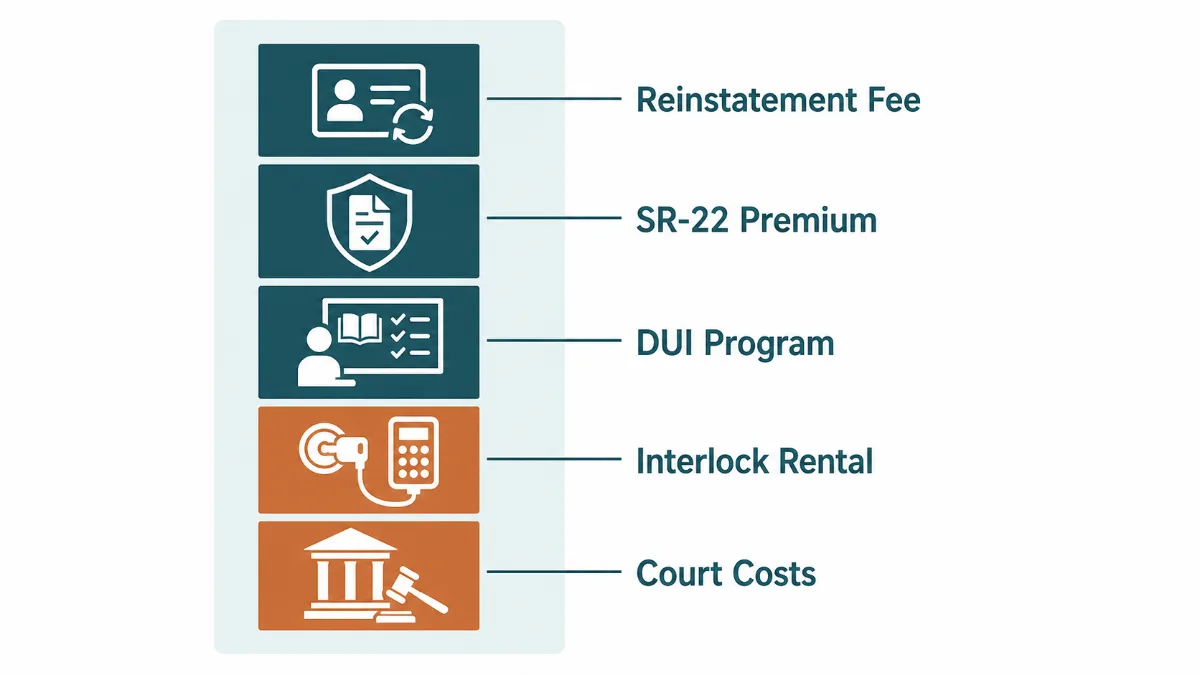 Free tool
The cost estimator
Add up the state fee, the insurance filing, the interlock and the rest into one itemized range, from the figures your own state and providers publish.
Open the estimatorGuides and references
Short, plain-language reads for the parts that trip people up, plus the running log of what changed.
What happens after a first DUI
The two tracks, the deadlines and the ordered path back, with a link to every state's page.
ReadThe ignition interlock, explained
Who has to install one, for how long, what it costs and how it unlocks driving during the suspension.
ReadSR-22 and FR-44, explained
The insurer-filed certificate most states require, the two FR-44 states and the seven that skip it.
ReadHardship and restricted licenses
Driving to work before full reinstatement: the names, the waits and the conditions, state by state.
ReadHow much SR-22 insurance costs
The small one-time filing fee versus the premium a DUI brings, plus the state duration that drives the total.
ReadRecent law changes
The dated changelog of DUI license law updates, state by state, as legislatures pass them.
ReadWhat happens to your license after a first DUI?
In most states, two things happen on separate tracks. The licensing agency suspends the license through an administrative process triggered by the arrest itself, with a short dated window to request a review hearing. The court case then runs on its own calendar and can add its own suspension on conviction. A handful of states skip the administrative track and tie everything to the court case.
The path back is made of the same pieces almost everywhere: serve the suspension or qualify for a restricted license, complete a DUI education or treatment program, file an SR-22 or FR-44 insurance certificate where the state uses one, install an ignition interlock where required, pay the reinstatement fee and apply. What changes at the state line is which pieces apply, in what order and for how long.
The whole sequence, from the first notice through to reissue, sits on one page: how to reinstate your license after a DUI, with the two clocks, the seven steps in order, the cost lines and a route into your own state's rules.
This site organizes and explains what each state requires in plain language. It is educational information, not legal advice and it does not cover contesting the charge. Confirm the current rules with your state before you act. Read the full explainer.

Why this library exists
A small team keeps this library current. We built it because the honest answer to "how do I get my license back?" sat scattered across a court notice, an agency website, an insurer's fine print and forum threads written for other states. No single page told you the truth for your own state, in order.
Every rule here gets read straight from the state statute or the agency that administers it, then dated on the page and re-checked on a set schedule. When a legislature changes a law, we log it in the changelog and update that state's page.
The library stays free because a plain-language reference to the process should not sit behind a paywall. If a state page ever drifts from the current rules, that is a mistake we want to fix, fast. Here is how we verify every page.

From the team behind this library
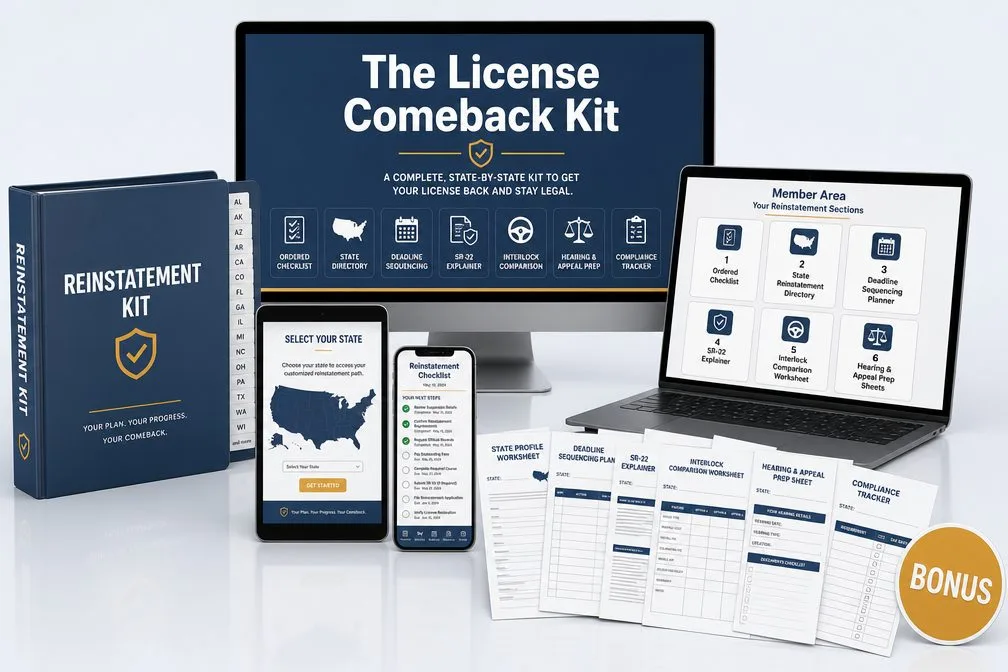
The License Comeback Kit
Your state page tells you what the law requires. The kit hands you the done pieces for your state: the 50-state directory and selector, the dependency-ordered checklist, the SR-22 steps with an insurer call script, a factual interlock comparison worksheet and the compliance and removal tracker. It gives you one ordered path to work through start to finish.
Recent law updates
State legislatures rewrite these rules every session. Here are three recent changes, each already in effect and reflected on its state page.
-
In effect April 9, 2025Ohio · In effect
Ohio's reinstatement fee rose to $315
The Ohio BMV's reinstatement fee for an OVI suspension now stands at $315, confirmed on the BMV's own fee schedule. Live on the Ohio page now.
-
In effect July 1, 2025South Dakota · In effect
SB 3 flattened the first-offense reinstatement fee to $100
South Dakota replaced a tiered fee range with a flat $100 reinstatement fee for a first-offense DUI. Higher tiers at $150 and $200 apply to repeat offenses. Live on the South Dakota page now.
-
In effect January 1, 2026Rhode Island · In effect
Rhode Island's alcohol-education fee rose to $405
The education-program fee tied to Rhode Island reinstatement rose from $350 to $405, beside the $353.50 reinstatement fee itself. Live on the Rhode Island page now.
Ready to check your own state?
Open your state page for the suspension, the hearing deadline, the interlock rule, the insurance filing and the fees, each with the official source behind it.