SR-22 and FR-44 After a DUI (2026): What They Are and Which States Use Them
The quietest requirement in the whole process lives with your insurer, not the court. Most states will not reinstate without it.
An FR-44 is not the same thing as an SR-22, though the two work the same way. Both are certificates your insurer files with the state to prove you carry the liability coverage the state requires, so neither one is a separate policy you buy. The difference is where each applies and how much coverage it demands. Only Florida and Virginia use the FR-44 and both use it for impaired-driving cases specifically. It requires much higher liability limits than an ordinary SR-22 does, which is why it costs more to carry. Every other state that requires a filing after a DUI uses the SR-22 at that state's ordinary minimum limits. So the practical answer is short: a Florida or Virginia case means an FR-44. Anywhere else it is an SR-22 or no filing at all.
SR-22 or FR-44: the short version
- An SR-22 is a certificate, not an insurance policy. Your insurer files it with the state to certify that the auto policy you already carry meets the liability limits the state requires. You keep one ordinary policy and the insurer attaches the filing to it.
- An FR-44 is the same certificate at higher limits. Florida and Virginia use it for impaired-driving cases. It certifies liability coverage well above what either state asks of an ordinary driver.
- The difference in one sentence. Same mechanism, different numbers: an SR-22 certifies your state's ordinary minimum liability limits while an FR-44 certifies a raised set of limits that only Florida and Virginia impose.
- Who needs which. A Florida or Virginia impaired-driving case takes an FR-44. Every other state that requires a filing after a DUI takes an SR-22. Seven states require no filing at all.
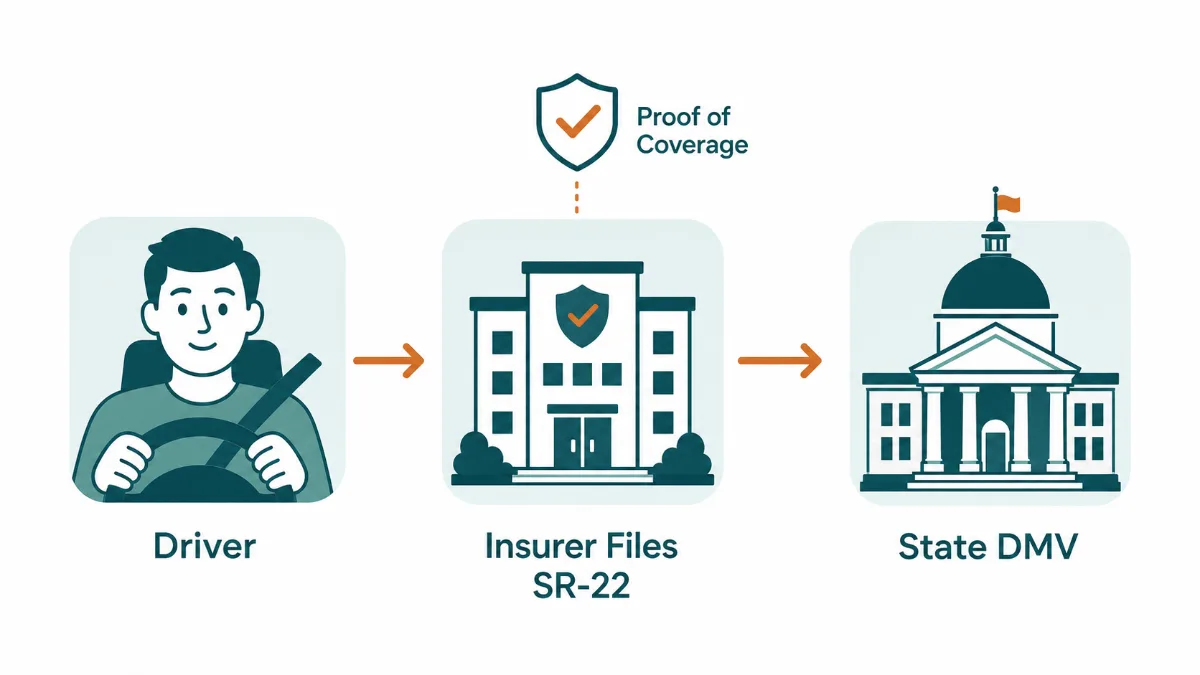
Neither certificate is something you buy on its own or file yourself. You ask your insurer for it, the insurer sends it to the state electronically and the state records it against your license.

SR-22 and FR-44 side by side
One mechanism, two sets of numbers. Every figure below comes from the statute or the state agency, linked at the end of this page.
| Item | SR-22 | FR-44 |
|---|---|---|
| Which states use it | Most states that require a filing after a DUI. Seven require no filing at all | Florida and Virginia only |
| What it certifies | That the auto policy you already carry meets your state's required liability limits | The same thing, measured against a raised set of limits those two states impose after an impaired-driving case |
| What triggers it | Several kinds of financial-responsibility suspension, DUI among them in most states | An impaired-driving case only |
| Liability limits required | The state's ordinary minimum | Florida: $100,000 / $300,000 bodily injury plus $50,000 property damage. Virginia: $100,000 / $200,000 plus $50,000 |
| How much higher than the ordinary minimum | Not higher. The ordinary minimum is the requirement | Virginia: exactly double, written that way in the statute. Florida: from no required bodily injury liability at all to $100,000 / $300,000, plus five times the property damage minimum |
| Filing fee | Set by your insurer rather than by the state, so it is the same small one-time charge either way. The premium behind the certificate is the part that differs. The SR-22 cost page separates the two | |
| How long it stays in force | 3 years in most states. Confirmed outliers: 1 year in Kansas, 2 in Iowa, Missouri plus Texas, 5 in Alaska | 3 years in both states, by statute |
| Who files it | Your insurer, electronically | Your insurer, electronically |
| Is it a second policy? | No | No |
Two statutes do the work and they reach their numbers by different routes. Florida writes its FR-44 limits out as fixed dollars. Virginia defines them as double whatever its ordinary minimum happens to be, which means the Virginia figure moves when the ordinary minimum moves. The two sections below take each state on its own terms.
Florida's FR-44: what the statute sets
Florida requires $100,000 of bodily injury liability for one person, $300,000 for two or more people in one crash and $50,000 of property damage liability, carried for a minimum period of 3 years. Florida Statutes section 324.023 sets those figures and applies them to any driver who, regardless of adjudication of guilt, has been found guilty of or entered a plea of guilty or nolo contendere to driving under the influence under section 316.193 after October 1, 2007.
The size of the jump. An ordinary Florida driver satisfies section 324.022 with $10,000 of property damage liability and no separate bodily injury liability requirement (the statute allows a $30,000 combined single limit as the alternative). An FR-44 driver moves from no required bodily injury liability at all to six figures of it, plus five times the property damage minimum. Florida has the wider of the two FR-44 gaps for that reason.
What the three years run from. The statute says the higher limits must be carried for a minimum period of 3 years. It then exempts a driver who has not been convicted of driving under the influence or a felony traffic offense for a period of 3 years from the date of reinstatement of driving privileges. The clock a Florida driver counts therefore starts at reinstatement rather than at the arrest, so a lapse partway through restarts the problem instead of shortening it.
The alternative route in the same statute. Section 324.023 lets a driver establish the ability to respond in damages by the methods in section 324.031 rather than by insurance alone. Where a driver uses a certificate of deposit, section 324.023 sets it at $350,000. The insurance filing is the ordinary route; the deposit sits in the statute as the other one.
Virginia's FR-44: double the ordinary minimums
Virginia does not print its FR-44 limits as fixed dollars. Code of Virginia section 46.2-316(C) requires a driver convicted of driving under the influence to prove financial responsibility at limits not less than double the minimums set by section 46.2-472, for three years after he otherwise becomes entitled to a license. For policies effective on or after January 1, 2025 those minimums are $50,000 for one person, $100,000 for two or more people and $25,000 for property damage, which puts the FR-44 at $100,000, $200,000 and $50,000.
Virginia uses both certificates, split by offense. Its DMV lists the FR-44 for driving while under the influence of intoxicants or drugs and for maiming while under the influence, on convictions dated on or after January 1, 2008. The SR-22 covers the department's other cases, among them an uninsured motor vehicle suspension and an unsatisfied judgment. The same page states the rule in plain words: FR-44 liability insurance coverage limits are double the SR-22 insurance coverage limits.
The Virginia number moved recently. Section 46.2-472 read $30,000, $60,000 and $20,000 for policies effective from January 1, 2022 through December 31, 2024. Because the FR-44 is written as a multiple rather than as a dollar figure, the January 2025 increase carried it up too. Anything you read quoting $60,000, $120,000 and $40,000 is describing the older rule, so check the date on the page before you rely on it.
Sort the filing tonight

From the team behind this library
The License Comeback Kit
Want the whole path in one place? The License Comeback Kit hands you the done pieces for your state: the 50-state reinstatement directory and selector, the dependency-ordered checklist, the SR-22 and FR-44 explainer with an insurer call script, a factual interlock comparison worksheet and the compliance and removal tracker.
Why the FR-44 costs more than an SR-22
The certificate is not what costs you. The coverage behind it is. Filing an SR-22 or an FR-44 is the same small one-time charge from your insurer either way; the SR-22 cost page separates that fee from the premium and the cost estimator adds both to the rest of your own figures. What makes the FR-44 the expensive one is the size of the policy the state makes you carry underneath it: six figures of bodily injury liability where a Florida driver previously needed none, or a straight doubling in Virginia.
No state sets the premium itself, so no honest source can quote you a single national FR-44 or SR-22 figure. The two things you can pin down are the term (3 years in both FR-44 states) and the limits above. Your own number comes from your insurer.
Which one applies to your case
- A Florida or Virginia case: the FR-44. Higher limits, 3 years, filed by your insurer the same way an SR-22 would be.
- Most other states: the SR-22, at that state's ordinary minimum limits, for the term your state sets. Your state page carries the confirmed duration or flags it where the agency does not publish one.
- Seven states: nothing to file. Delaware, Massachusetts, Minnesota, New Jersey, New Mexico, New York, Pennsylvania run no SR-22 requirement at all, so there is no filing step in those reinstatements.
If you are not sure which pieces your state asks for, the reinstatement timeline tool lays out the filing, the suspension length, the interlock rule and the known fees for whichever state you pick.
What an SR-22 actually is
The SR-22 is the step most likely to be missing from your paperwork. The court does not issue it, the licensing agency does not file it and it rarely appears in the sentencing documents, because it belongs to your insurance company. Yet in most states the license does not come back without it.
An SR-22 is a certificate of financial responsibility. Your insurer files it with the state to certify that you carry the liability coverage the state requires. It is proof, not a policy: you buy or keep an ordinary auto policy and the insurer adds the filing, usually for a modest filing fee plus the higher premium that follows a DUI. How much that adds up to is its own question; the SR-22 cost page separates the small one-time filing fee from the premium. Once filed, the state treats continuous coverage as a condition of your license. The filing is the state's tripwire: if the policy lapses, the insurer must notify the state and the suspension can resume.
SR-22, FR-44 or neither: what your state uses
- Most states: the SR-22. Required after a DUI before reinstatement or a restricted license, almost always for 3 years.
- Florida and Virginia: the FR-44. The same mechanism with higher required liability limits than the state's ordinary minimums, which makes it the more expensive filing to carry.
- Seven states: no SR-22 at all. Delaware, Massachusetts, Minnesota, New Jersey, New Mexico, New York, Pennsylvania run no SR-22 requirement. Several verify insurance their own way: Pennsylvania uses its DL-123 certificate, Minnesota an insurer-filed certificate of insurance. New Jersey and New Mexico lean on the interlock-license system instead.
- The in-between cases. Hawaii uses its own statutory certificate that insurers process like an SR-22. In Kentucky no SR-22-equivalent filing could be confirmed to exist at all. Your state page states which instrument, if any, applies.
How long it runs
Three years is the standard term where a filing is required. The confirmed outliers: Kansas at 1 year, Iowa, Missouri and Texas at 2 and Alaska at 5. Many licensing agencies never publish the duration on their own pages, which is why this is the single most common unconfirmed detail across the states in this library. Where a duration is not confirmed against a primary source, your state page says so and the safest confirmation is your insurer plus the agency itself.
Getting it filed without losing a week
The process is a phone call. You tell your insurer you need an SR-22 (or FR-44) filed with your state, the insurer files it electronically and the state records it. Two details matter. First, not every insurer files them, so a company that will not file may mean shopping for one that does. Second, record the effective date and the required end date, then guard the renewal dates in between, because a lapse notifies the state automatically. Continuous coverage for the whole term is the entire job.
Where the filing sits in the wider path
The filing is one step of seven. It comes after the program in most states and before the fee, because the agency usually wants it on the record before it will mark the conditions complete. How to reinstate your license after a DUI lays the whole order out on one page, from the first notice through to reissue, with a route into your own state's terms.
Where the FR-44 figures on this page come from
- Florida Statutes section 324.023 (financial responsibility for bodily injury or death after a DUI conviction) leg.state.fl.us/statutes (section 324.023)
- Florida Statutes section 324.022 (the ordinary property damage liability minimum) leg.state.fl.us/statutes (section 324.022)
- Code of Virginia section 46.2-316 (proof of financial responsibility after certain convictions, at double the ordinary limits, for three years) law.lis.virginia.gov (section 46.2-316)
- Code of Virginia section 46.2-472 (coverage of an owner's policy, the minimums the FR-44 doubles) law.lis.virginia.gov (section 46.2-472)
- Virginia Department of Motor Vehicles, Financial Responsibility Certifications (which convictions take an SR-22 and which take an FR-44) dmv.virginia.gov/businesses/insurance/certifications
This guide is educational information, not legal advice or insurance advice. Filing rules and durations change by state and case. Confirm the current requirement with your state and your insurer before you act.
SR-22 and FR-44 FAQ
What is an SR-22?
An SR-22 is not an insurance policy. It is a certificate your insurer files with the state proving you carry the required liability coverage. States commonly require it after a DUI before they will reinstate or issue a restricted license. You ask your insurer to file it; the insurer sends it to the state directly.
What is the difference between an SR-22 and an FR-44?
Both are insurer-filed proof of coverage. The FR-44, used by Florida and Virginia for DUI cases, requires higher liability limits than the state's ordinary minimums, so it usually costs more to carry. Every other state that requires a filing uses the SR-22.
How long do you have to keep an SR-22 after a DUI?
Three years in most states that require one. Confirmed shorter terms exist: 1 year in Kansas and 2 years in Iowa, Missouri and Texas. Alaska holds the confirmed long end at 5 years. If the filing lapses before the term ends, the insurer notifies the state and the license can be suspended again.
Which states do not require an SR-22 after a DUI?
Seven states use no SR-22 at all: Delaware, Massachusetts, Minnesota, New Jersey, New Mexico, New York and Pennsylvania. Some of them verify insurance their own way, such as Pennsylvania's DL-123 certificate or Minnesota's insurer-filed certificate of insurance.
Do you need an SR-22 on top of your regular car insurance?
It is not a second policy. The SR-22 is a filing your insurer adds to a policy you already carry, certifying to the state that the coverage meets the required limits. You keep one ordinary auto policy and the insurer files the SR-22 against it, usually for a small filing fee plus the higher premium a DUI brings. Where a driver's current insurer will not file, the fix is switching to a company that does, not buying a separate SR-22 policy.
Can you get an SR-22 without owning a car?
Yes, through a non-owner SR-22. A driver who needs to file but does not own a vehicle buys a non-owner liability policy and has the insurer file the SR-22 against it. It satisfies the filing requirement for reinstatement and tends to cost less than an owner policy because there is no specific vehicle on it. Confirm your state accepts a non-owner filing with the licensing agency and your insurer.
Who needs an SR-22 after a DUI?
The state requires the filing from a driver reinstating a license the state suspended or revoked for a DUI, in the states that use the SR-22 (or the FR-44 in Florida and Virginia). It is the state's way of confirming that a driver it flagged as higher risk carries the required liability coverage before it restores driving privileges. Whether your state requires it and for how long is on your state page.
Is an FR-44 the same thing as an SR-22?
No, though they do the same job. Both are certificates your insurer files with the state to prove you carry liability coverage. The FR-44 exists only in Florida and Virginia, applies to impaired-driving cases and demands much higher liability limits than an ordinary SR-22. Outside those two states there is no such thing as an FR-44.
SR-22 or FR-44: which one do I need?
The state decides, not you. If your case is in Florida or Virginia, the filing is an FR-44. In every other state that requires a filing after a DUI, it is an SR-22. Seven states require no filing at all. Your state page names the instrument that applies and how long it has to stay in force.
Is an FR-44 more expensive than an SR-22?
Usually yes, because of the coverage it requires rather than the filing itself. Florida sets FR-44 limits at $100,000 and $300,000 bodily injury plus $50,000 property damage, against an ordinary Florida requirement of $10,000 property damage with no separate bodily injury requirement. Virginia doubles its ordinary minimums. A bigger policy costs more, so the FR-44 premium runs above what the same driver would pay carrying an SR-22.
How long does an FR-44 have to stay in force?
Three years in both states. Florida Statutes section 324.023 says the higher limits must be carried for a minimum period of 3 years. Code of Virginia section 46.2-316 sets three years after the driver otherwise becomes entitled to a license. A lapse inside the term gets reported to the state by the insurer, the same way an SR-22 lapse does.
Do Florida and Virginia use the SR-22 at all?
Yes, for other cases. Virginia's DMV lists the SR-22 for matters such as an uninsured motor vehicle suspension or an unsatisfied judgment, with the FR-44 reserved for driving under the influence and maiming while under the influence. The FR-44 is the impaired-driving instrument in those two states rather than a replacement for the SR-22 across the board.