What Happens After a First DUI (2026): the License Path Back, Step by Step
Two tracks, six pieces and a clock that can start before your court date. Your state page fills in the exact rules.
A first DUI sets two clocks running at once. One belongs to the criminal case in court. The other belongs to your license and it runs through the state's licensing agency, on its own schedule, with its own deadlines. This guide walks the license side: what happens to your driving privilege, which pieces the path back is made of and the order they come in. Your state page fills in the exact rules, because every one of these pieces changes at the state line.
The two tracks: the agency and the court
Most states run an administrative track beside the court case. The arrest itself triggers a license suspension through the DMV or its equivalent, before any conviction, with a short dated window to request an administrative review hearing. That window is one of the shortest clocks in the whole process: 3 days in Hawaii, 7 days in a cluster of states, 10 days in California and its cohort, up to 90 in Illinois and 120 in South Dakota. The suspension the court imposes on conviction is a separate action and states differ on how the two interact.
A handful of states run no administrative track at all. In West Virginia, Tennessee, New Jersey and Wisconsin the license consequences flow from the court case, so there is no agency hearing window to track. West Virginia is the sharpest example: it abolished its administrative revocation system in 2020, yet older guides still describe the dead system. Your state page states which structure applies to you.
The two clocks run separately. Resolving one does not end the other.
The pieces of the path back, in the usual order
- Note the hearing window if your state has one. Where an administrative track exists, the deadline to request a review hearing runs from the arrest or the notice date, not from when you figure the system out. Your state page shows the window and the office that receives the request.
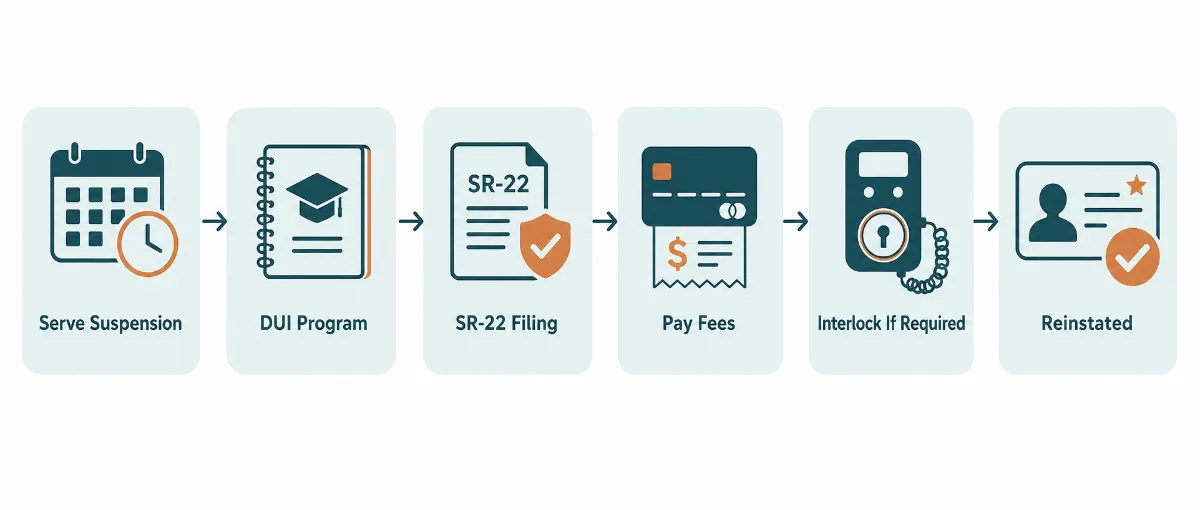
- Serve the suspension, or drive sooner on a restricted license. Most states offer a hardship, restricted or occupational license for work, school and treatment, often conditioned on installing an ignition interlock. A growing group of states puts a first offender back on the road almost immediately once the device is installed. The hardship license guide covers the forms this takes.
- Complete the DUI education or treatment program. Nearly every state requires an education course, an assessment or both. Lengths run from a one-weekend class to a months-long program and higher test results commonly extend them.
- File the insurance certificate where your state requires one. Most states require an SR-22 filing, Florida and Virginia use the higher-limit FR-44 and seven states use no SR-22 at all. This is the quietest step in the process because it lives with your insurer rather than the court or the DMV. The SR-22 and FR-44 explainer covers it.
- Install the ignition interlock where required. Twenty jurisdictions require the device for a standard first offense and others require it above a BAC threshold or as the condition of early restricted driving. The interlock guide covers who must install one and what it costs.
- Pay the reinstatement fee and apply. The state fee runs from under $50 in a number of states to more than $1,000 in a few, depending on the state and the offense. Reinstatement is rarely automatic: once every condition is met, you apply to the licensing agency and the agency reissues the license. That fee is only one line of the total, so the cost estimator sits it beside the program, the insurance filing and the interlock.
Work the path in one evening
From the team behind this library
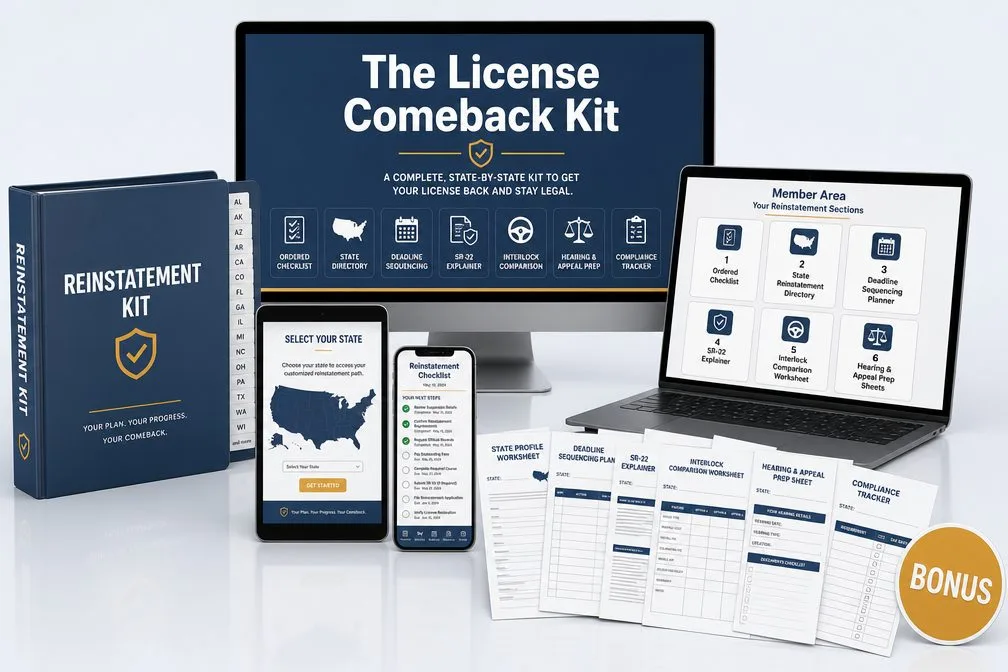
The License Comeback Kit
Want the whole path in one place? The License Comeback Kit hands you the done pieces for your state: the 50-state reinstatement directory and selector, the dependency-ordered checklist, the SR-22 and FR-44 explainer with an insurer call script, a factual interlock comparison worksheet and the compliance and removal tracker.
Where the process most often goes wrong
Three patterns come up again and again. The first is the quiet SR-22: it rarely appears in court paperwork because it belongs to the insurer, so drivers discover it late and a lapse can restart the filing period. The second is the mailed notice: suspension notices arrive by post on their own clock and a notice misread as a duplicate has cost drivers months. The third is order: several steps gate other steps, so completing them out of sequence adds waiting time. The fix for all three is the same, seeing the whole path for your state before acting on any single piece of it.
Want the short version?
This guide is the long read: the two tracks in detail, the states that run no administrative track at all and what sits behind each step. If what you need is the sequence itself, how to reinstate your license after a DUI puts the seven steps in order on one page, with the cost lines, a state selector and the four situations that run outside standard first-offense scope.
Find your state
Open your state's page for the suspension length, the hearing window, the interlock and insurance rules, the fees and the ordered steps back, each cited to the state statute or agency and dated.
This guide is educational information, not legal advice and it does not cover contesting the charge. A contested case needs a licensed DUI attorney. Confirm the current rules with your state before you act.
First DUI license FAQ
How long does it take to get your license back after a first DUI?
It depends on the state and the case. First-offense suspension periods run from about 90 days to a year, but many states let a first offender drive sooner on a restricted or hardship license, often with an ignition interlock installed. The full path (the suspension or restricted period, the DUI program, any insurance filing, the fees) commonly plays out over several months.
Do you lose your license immediately after a DUI arrest?
In most states an administrative suspension starts a set number of days after the arrest unless a hearing is requested within the state's window, which runs from 3 days in the shortest state to 120 in the longest. A separate suspension can follow conviction in court. A few states, including Wisconsin, Tennessee, New Jersey and West Virginia, tie license consequences to the court case rather than an arrest-triggered administrative track.
What are the usual steps to reinstate a license after a DUI?
The common sequence is: serve the suspension period or qualify for a restricted license, complete the state's DUI education or treatment program, file the SR-22 or FR-44 insurance certificate where the state requires one, install an ignition interlock where required, pay the reinstatement fee and apply to the licensing agency. The exact order and the pieces required change by state.
Do they take your license at the scene when you get a DUI?
In most states with an administrative track, the officer takes the physical card at arrest after a failed or refused chemical test and issues a paper notice that doubles as a temporary permit for a set number of days. That temporary permit is also the clock: it runs the short window to request the administrative hearing before the suspension takes effect. States that run no administrative track handle the license through the court instead, so confirm the exact procedure on your state page.
Is your license revoked or suspended after a DUI?
The words get used loosely, so the state's own term is what matters. A suspension is a temporary stop for a set period, after which you reinstate. A revocation cancels the license so you reapply rather than simply reinstate. Some states use "revocation" for the DUI action even for a first offense (Florida is one). Your state page uses the term your state uses.
How do you appeal a DUI license suspension?
Where a state has an administrative track, you request a review hearing with the licensing agency within its window, which runs from 3 days in the shortest state to 120 in the longest and starts from the arrest or notice date. The hearing reviews the administrative suspension, a separate matter from the criminal case in court. A contested case belongs with a licensed DUI attorney; this library states the deadlines and the office, not a legal strategy.
If I pay my reinstatement fee, will my license still be suspended?
Paying the reinstatement fee does not by itself lift a suspension. You still serve the suspension term or move to a restricted license, complete the DUI program, keep any SR-22 or FR-44 filing in force and clear the interlock where the state requires it. The fee is one of the last steps, not a shortcut past the others, which is why paying early does not shorten the term.
Can you get a license with a DUI on your record?
Yes. A first-offense DUI does not permanently bar you from a license. It sets a process to work through: the suspension, the DUI program, any insurance filing and the interlock where required, then reinstatement. What a prior DUI affects is how a later offense is charged, through the lookback period, not whether you can ever hold a license again.
What is a DUI lookback period?
The lookback (or washout) period is the window over which a prior DUI still counts against you when you are charged with a new one. Inside the window a second offense is treated as a repeat, with longer suspensions and more conditions. Windows run from about 5 to 15 years by state, a few states count priors for life and Texas keeps no lookback at all. Your state page carries the confirmed figure.