Indiana DUI License Reinstatement (2026): Suspension, Steps and Fees
How do you get your license back after a first DUI in Indiana?
A first offense OWI in Indiana starts with a pre-trial administrative suspension from the arrest date, lasting up to 180 days or until the case is resolved for a failed chemical test, or 1 year for a first refusal (confirmed against IC 9-30-6-9). A court-ordered suspension on conviction is commonly cited at 90 days to 2 years, though its current statutory section could not be pinned down because the older provision (IC 9-30-5-10) was repealed in 2015. A driver who took the test can request specialized driving privileges after 30 days, usually with an ignition interlock device. Reinstatement requires an SR-22 filing and a BMV reinstatement fee.
Indiana charges this offense as OWI, the same first-offense case most states call a DUI. Whichever term is on your paperwork, this page covers it.
In Indiana the license consequences start with the Indiana Bureau of Motor Vehicles rather than the courtroom. An administrative suspension runs on its own clock beside the court case. The page below lays the pieces out in the order the state runs them.
Whether an ignition interlock is required here depends on the case, commonly the test result or the license option chosen. The SR-22 filing is required. The education or treatment step comes before reinstatement and runs unverifiable. Each piece has its own section below, with the official source beside it.
The parts Indiana drivers most often miss are the insurance filing that lives with your insurer rather than the court and the order of the steps, since several gate the ones after them. The sections below take them in order.
How long is your license suspended after a first DUI in Indiana?
The first-offense term and how the administrative and court tracks interact in Indiana.
| Item | Indiana rule |
|---|---|
| First-offense suspension | Court-ordered suspension upon a first OWI conviction: 90 days to 2 years (commonly cited around 180 days for a failed chemical test). Separate pre-trial administrative suspension: up to 180 days or until the case is disposed of, whichever occurs first, for a failed test; 1 year for a first refusal (2 years for a subsequent refusal). |
| Administrative vs court | Indiana can impose an administrative suspension at the time of arrest, independent of the criminal case, when a chemical test result is prima facie evidence of intoxication or the driver refuses testing. This administrative suspension runs until the earlier of 180 days or the case's disposition (or, for a refusal, 1 year). The court separately imposes its own suspension upon an actual OWI conviction; time under specialized driving privileges with an interlock installed is credited against the suspension period. |
| Worth knowing | A prior OWI conviction within 5 years of the current offense can elevate the charge to a felony level, which falls outside the standard first-offense scope of |
Confirm the exact term for your case with the Indiana Bureau of Motor Vehicles; the figure can shift with the test result and the case details.
The hearing clock: how long you have to act in Indiana
The deadline to request the administrative review of the license suspension. It runs from the arrest or notice date, not from the court date.
| Item | Indiana rule |
|---|---|
| How it works | A driver is entitled to a prompt judicial hearing to challenge the pre-trial administrative suspension or an ignition interlock order, but the hearing is limited to two issues: whether the officer had probable cause to believe the person operated a vehicle while committing an OWI-type offense, or whether the person refused the chemical test. The exact number of days to request this hearing was not confirmed against a primary source; it is a court proceeding rather than a BMV-run administrative hearing. |
The path back: the Indiana reinstatement steps in order
Several of these steps gate the ones after them, so the order matters as much as the list.
- Complete the court-ordered and/or pre-trial administrative suspension period
- If eligible (test was taken, not refused), obtain specialized driving privileges after 30 days with an ignition interlock device installed
- Complete the court-ordered alcohol/drug assessment and any resulting treatment program
- Attend the victim impact panel if ordered by the court
- File and maintain an SR-22 proof of financial responsibility with the BMV for 3 years from the end of the court-imposed suspension
- Pay the BMV reinstatement fee and complete reinstatement through MyBMV, phone, mail or in person at a BMV location
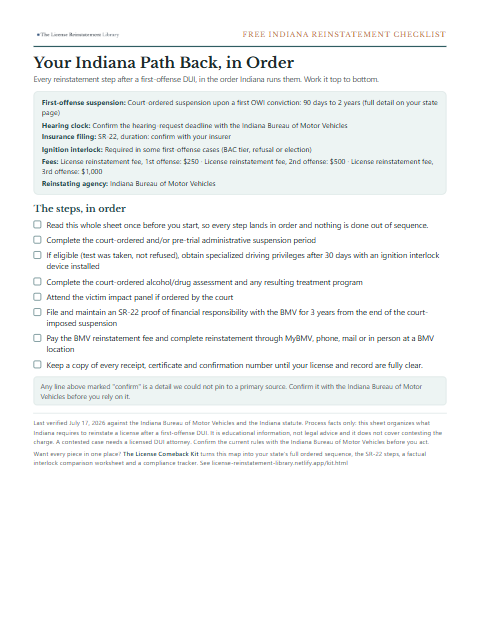
Get the free Indiana reinstatement checklist
The one-page map of the Indiana steps, in the order Indiana runs them.
Instant download, plus Indiana rule-change alerts. Unsubscribe anytime.
Ignition interlock rules in Indiana
Whether the device is required for a first offense, for how long and where the state lists its certified providers.
| Item | Indiana rule |
|---|---|
| Required for a first offense? | In some first-offense cases (see below) |
| First-offense duration | Tied to the length of specialized driving privileges granted by the court; time with the device installed is credited against the suspension period |
| BAC trigger | n/a (interlock in Indiana is generally tied to the choice to obtain specialized driving privileges, or is required to obtain any driving privileges at all after a refusal, rather than triggered by a specific BAC tier) |
| Approved providers | unverifiable (a specific Indiana BMV-published approved-vendor list was not located) |
| Worth knowing | A driver who refused the chemical test is not eligible for specialized driving privileges unless an ignition interlock device is also installed in the vehicle. |
Do you need SR-22 insurance in Indiana?
The financial-responsibility filing your insurer makes with the state, where Indiana requires one.
| Item | Indiana rule |
|---|---|
| Required after a first DUI? | Yes |
| The form | SR-22 |
| How long it must stay in force | 3 years, continuously on file with the BMV, from the date of a BMV request or from the end of the court-imposed suspension |
| Worth knowing | The exact starting-point wording (BMV request date vs. suspension-expiration date) varied slightly between sources and should be confirmed against the individual driver's BMV notice. |
Driving before full reinstatement in Indiana
The limited license, if any, that lets a first offender drive during the suspension.
| Item | Indiana rule |
|---|---|
| Available for a first offense? | Yes |
| What Indiana calls it | Specialized driving privileges |
| Waiting period | 30 days into the suspension period, for a driver who submitted to the chemical test |
| Worth knowing | Granted by the court, generally requires an ignition interlock device and is not available to a driver who refused testing unless an interlock is also installed. Eligibility also requires having held a valid license at the time of the offense and Indiana residency. |
The DUI program, the fees and the lookback
The DUI program. A state-approved alcohol or drug assessment, with any court-ordered treatment program that follows from it, plus a mandatory victim impact panel (attending a panel of speakers affected by OWI driving and visiting a related facility such as an emergency medical facility, alcoholism treatment center or coroner's office) Length: unverifiable (set case by case by the court; no fixed statewide hour figure located).
The lookback period. 5 years (a prior OWI conviction within this window can elevate a subsequent OWI to a felony level; some sources also cite a 7 year window relevant to second-offense charging). This is the window over which a prior offense counts toward repeat-offense treatment.
The costs a Indiana driver can expect on the way back.
| Item | Cost |
|---|---|
| License reinstatement fee, 1st offense | $250 |
| License reinstatement fee, 2nd offense | $500 |
| License reinstatement fee, 3rd offense | $1,000 |
Confirm the exact program length and the providers the Indiana Bureau of Motor Vehicles accepts before you enroll.