Kansas DUI License Reinstatement (2026): Suspension, Steps and Fees
How do you get your license back after a first DUI in Kansas?
A first offense DUI in Kansas carries a 30 day license suspension followed by a mandatory 180 day period restricted to driving only a vehicle with an ignition interlock device, or a full 1 year suspension plus 1 year of mandatory interlock restriction if the BAC was 0.15 or higher. Kansas requires an ignition interlock for every first-offense case, not just high-BAC ones. Reinstatement needs the Alcohol and Drug Safety Action Program (ADSAP), an SR-22 filing and a reinstatement fee paid to the Kansas Department of Revenue.
In Kansas the license consequences start with the Kansas Department of Revenue, Division of Vehicles rather than the courtroom. An administrative suspension runs on its own clock beside the court case and the window to request the administrative hearing is 14 days. The page below lays the pieces out in the order the state runs them.
An ignition interlock is part of every first-offense path here. The SR-22 filing is required and stays in force for 1 year for a first offense. The education or treatment step comes before reinstatement and runs at least 20 hours of alcohol education for the Level 1. Each piece has its own section below, with the official source beside it.
The parts Kansas drivers most often miss are the 14-day hearing-request deadline, which runs from the arrest or notice date, the insurance filing that lives with your insurer rather than the court and the order of the steps, since several gate the ones after them. The sections below take them in order.
How long is your license suspended after a first DUI in Kansas?
The first-offense term and how the administrative and court tracks interact in Kansas.
| Item | Kansas rule |
|---|---|
| First-offense suspension | 30 day suspension for a standard first occurrence (test failure or DUI conviction, BAC under 0.15), followed by a mandatory 180 day ignition-interlock-restricted period. For a BAC of 0.15 or higher on a first occurrence: 1 year suspension, followed by 1 year of mandatory ignition-interlock-restricted driving. |
| Administrative vs court | Kansas's K.S.A. 8-1014 suspension and restriction applies uniformly whether triggered by a test refusal, a test failure, or an alcohol/drug-related conviction; the Division of Vehicles administers the license action once it receives the officer's certification or the conviction report, running largely as a single administrative track rather than two separately stacked suspensions. |
| Worth knowing | The 30-day/180-day standard track and the 1-year/1-year high-BAC track are both first-offense scenarios; the dividing line is the 0.15 BAC threshold, not the number of prior offenses. 8-1014(b)(1)(A), 8-1014(b)(2)(A) and 8-1015(b)(1) statute text (via ksrevisor.gov). Note a first-occurrence test refusal is a separate and harsher case under K.S.A. 8-1014(a)(1): 1 year suspension followed by 2 years of mandatory interlock restriction, not the 30-day/180-day track. K.S.A. 8-1014(e) confirms suspension and restriction periods from the same arrest are not stacked; the longest single applicable period governs and credit is given for time already served. |
The hearing clock: how long you have to act in Kansas
The deadline to request the administrative review of the license suspension. It runs from the arrest or notice date, not from the court date.
| Item | Kansas rule |
|---|---|
| Request window | 14 days |
| How it works | A driver has 14 days from being served the Officer's Certification and Notice of Suspension (DC-27 form) to submit a written request for an administrative hearing with the Division of Vehicles. The DC-27 itself serves as a temporary driving document during the pendency of that request. Missing the 14 day deadline forfeits the right to the administrative hearing and the suspension takes effect automatically. |
The path back: the Kansas reinstatement steps in order
Several of these steps gate the ones after them, so the order matters as much as the list.
- Serve the 30 day suspension (or 1 year suspension if BAC was 0.15 or higher)
- Complete the mandatory ignition interlock restricted-driving period (180 days standard, 1 year for a BAC of 0.15 or higher)
- Complete the court-ordered alcohol and drug evaluation and the Alcohol and Drug Safety Action Program (ADSAP)
- File proof of financial responsibility (SR-22) with the Division of Vehicles
- Submit proof of ignition interlock installation/completion as required
- Pay the reinstatement fee to the Kansas Department of Revenue and complete the reinstatement application
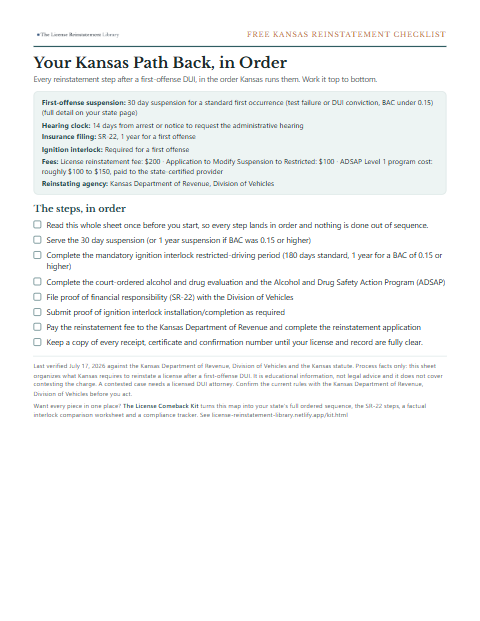
Get the free Kansas reinstatement checklist
The one-page map of the Kansas steps, in the order Kansas runs them.
Instant download, plus Kansas rule-change alerts. Unsubscribe anytime.
Ignition interlock rules in Kansas
Whether the device is required for a first offense, for how long and where the state lists its certified providers.
| Item | Kansas rule |
|---|---|
| Required for a first offense? | Yes, mandatory for a first offense |
| First-offense duration | 180 days for a standard first occurrence (BAC under 0.15); 1 year for a first occurrence with a BAC of 0.15 or higher |
| BAC trigger | all convictions/test failures (mandatory regardless of BAC level); the 0.15 threshold only changes the LENGTH of the mandatory interlock period, not whether one is required |
| Approved providers | Kansas Department of Revenue, Division of Vehicles maintains information on the ignition interlock restriction and modification process (Form DC-1015) at ksrevenue.gov |
| Worth knowing | Kansas requires an ignition interlock restriction on every first-offense DUI case (test refusal, test failure, or conviction), not only on cases with an elevated BAC. A driver can apply to modify a straight suspension into a restricted ignition-interlock driving privilege using Form DC-1015. Test refusal carries its own harsher first-occurrence period (2 years, per K.S.A. 8-1014(a)(1)) rather than the 180 day/1 year periods that apply to a test failure or conviction. |
Do you need SR-22 insurance in Kansas?
The financial-responsibility filing your insurer makes with the state, where Kansas requires one.
| Item | Kansas rule |
|---|---|
| Required after a first DUI? | Yes |
| The form | SR-22 |
| How long it must stay in force | 1 year for a first offense |
| Worth knowing | Required before the Division of Vehicles will reinstate driving privileges after a DUI-related suspension; confirmed as required directly on the Kansas Department of Revenue's own Alcohol Actions Chart (ksrevenue.gov/pdf/AlcoholActionsChart.pdf). The 1-year duration is independently derived from K.S.A. 40-3118(d)(1), which requires the director to obtain and maintain on file evidence of insurance for a period of one year following a conviction of a violation enumerated in K.S.A. 8-285 and K.S.A. 8-285(a)(2) confirms a conviction under K.S.A. 8-1567 (Kansas's DUI statute) is one of the enumerated violations. This reading was corroborated by secondary Kansas DUI/SR-22 sources, which commonly cite roughly 1 year as the baseline first-offense figure. |
Driving before full reinstatement in Kansas
The limited license, if any, that lets a first offender drive during the suspension.
| Item | Kansas rule |
|---|---|
| Available for a first offense? | Yes |
| What Kansas calls it | Restricted ignition interlock driving privileges |
| Waiting period | Available after the initial 30 day (or 1 year, high-BAC) suspension period, via Form DC-1015 |
| Worth knowing | The restricted privilege itself requires an ignition interlock device; it is Kansas's version of a hardship license, functionally merged with the mandatory interlock requirement rather than offered as a separate track. |
The DUI program, the fees and the lookback
The DUI program. A court-ordered alcohol and drug evaluation by an approved provider, followed by the Alcohol and Drug Safety Action Program (ADSAP); first-time offenders generally fall into the Level 1 track Length: at least 20 hours of alcohol education for the Level 1 (first-offender) ADSAP track.
The lookback period. 10 years for enhanced sentencing on a third offense (only convictions/diversions on or after July 1, 2001 count); a fourth or subsequent offense uses a lifetime lookback regardless of how long ago prior offenses occurred. This is the window over which a prior offense counts toward repeat-offense treatment.
The costs a Kansas driver can expect on the way back.
| Item | Cost |
|---|---|
| License reinstatement fee (DUI-related, first occurrence, standard BAC) | $200 |
| Application to Modify Suspension to Restricted Ignition Interlock Driving Privileges (Form DC-1015) fee | $100 |
| ADSAP Level 1 program cost | roughly $100 to $150, paid to the state-certified provider |