Tennessee DUI License Reinstatement (2026): Suspension, Steps and Fees
How do you get your license back after a first DUI in Tennessee?
A first-offense DUI conviction in Tennessee revokes the license for 1 year under state law and a driver stays revoked until the Department of Safety formally reinstates it even after that year passes. A separate administrative implied-consent suspension can also apply from a failed or refused chemical test, with an 18-month minimum suspension for a first refusal as of January 1, 2026. Reinstatement requires DUI school, SR-22 insurance and the state's reinstatement fees.
Tennessee sits between the two common structures: whether an administrative review applies depends on the case. The page below states which situations carry a deadline and lays the reinstatement steps out in the order the state runs them.
Whether an ignition interlock is required here depends on the case, commonly the test result or the license option chosen. The SR-22 filing is required. The education or treatment step comes before reinstatement and runs at least 12 hours. Each piece has its own section below, with the official source beside it.
The parts Tennessee drivers most often miss are the insurance filing that lives with your insurer rather than the court and the order of the steps, since several gate the ones after them. The sections below take them in order.
How long is your license suspended after a first DUI in Tennessee?
The first-offense term and how the administrative and court tracks interact in Tennessee.
| Item | Tennessee rule |
|---|---|
| First-offense suspension | 1 year (Tenn. Code Ann. Section 55-10-404(a)(1)) |
| Administrative vs court | Tennessee's DUI license action is conviction/court-based rather than a DMV administrative per-se system. The 1-year revocation for a first-offense DUI conviction is imposed through the criminal case. An implied-consent refusal under T.C.A. 55-10-406 triggers its own separate revocation adjudicated through the courts; as of January 1, 2026 a first refusal carries a minimum 18-month suspension. The two consequences can arise from the same arrest but are legally distinct. |
| Worth knowing | The 18-month minimum refusal suspension (effective January 1, 2026) applies to a driver with no prior DUI, vehicular assault, or vehicular homicide conviction within the past 10 years who is suspected of misdemeanor DUI and refuses a blood test; it replaced a prior 1-to-5-year range. |
Confirm the exact term for your case with the Tennessee Department of Safety and Homeland Security, Driver Services Division; the figure can shift with the test result and the case details.
The hearing clock: how long you have to act in Tennessee
The deadline to request the administrative review of the license suspension. It runs from the arrest or notice date, not from the court date.
| Item | Tennessee rule |
|---|---|
| Request window | unverified (see description) |
| How it works | Independent verification found Tennessee's DUI license action to be conviction/court-based: there is no separate DMV-style administrative per-se suspension track with a fixed hearing-request window for a standard first-offense DUI. An implied-consent refusal under T.C.A. 55-10-406 triggers its own revocation adjudicated through the courts, distinct from the DUI charge. |
Confirm the request deadline and the receiving office with the Tennessee Department of Safety and Homeland Security, Driver Services Division; the window runs from the arrest or notice date.
The path back: the Tennessee reinstatement steps in order
Several of these steps gate the ones after them, so the order matters as much as the list.
- Serve the 1-year license revocation for the first-offense conviction (and the separate implied-consent suspension period if applicable)
- Complete the state-licensed DUI school program (minimum 12 hours) and any dependency treatment the assessment recommends
- Install an ignition interlock device if the court ordered one as a condition of a restricted license or under the mandatory-circumstance rule
- File SR-22 proof of financial responsibility with the Department of Safety
- Pay the reinstatement fee, SR-22 filing fee and any license-surrender fee owed
- Apply to the Department of Safety for formal reinstatement; the license remains revoked until the Department affirmatively processes reinstatement
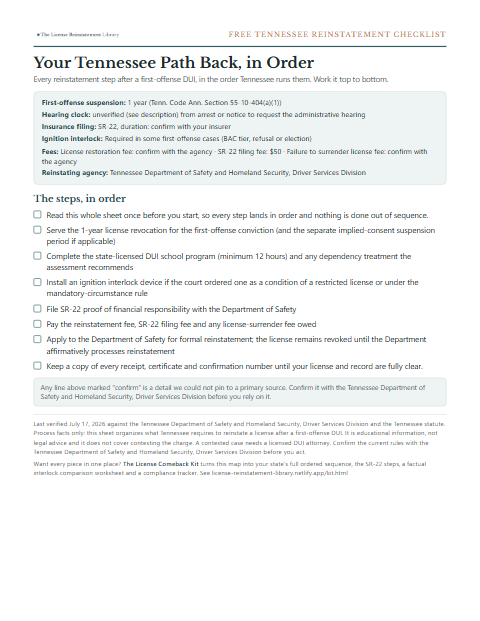
Get the free Tennessee reinstatement checklist
The one-page map of the Tennessee steps, in the order Tennessee runs them.
Instant download, plus Tennessee rule-change alerts. Unsubscribe anytime.
Ignition interlock rules in Tennessee
Whether the device is required for a first offense, for how long and where the state lists its certified providers.
| Item | Tennessee rule |
|---|---|
| Required for a first offense? | In some first-offense cases (see below) |
| First-offense duration | up to 1 year after reinstatement when ordered (T.C.A. 55-10-417) |
| BAC trigger | No automatic interlock for a bare first offense. T.C.A. 55-10-417 primary text reads that a court MAY order installation and use of an ignition interlock device, with the mandate reserved for a second DUI within 10 years. An interlock condition commonly attaches to a first-offense restricted license when the case involved a BAC of 0.08 or higher, a minor passenger, or a reportable accident. The 0.02 device figure is the lockout calibration level, not a legal trigger. |
| Approved providers | Tennessee Department of Safety and Homeland Security ignition interlock program |
| Worth knowing | Most first-time DUI offenders can apply for a restricted license and installing an interlock is commonly required as a condition of that restricted license. |
Confirm the exact interlock term and trigger for your case with the Tennessee Department of Safety and Homeland Security, Driver Services Division before you schedule an install.
Do you need SR-22 insurance in Tennessee?
The financial-responsibility filing your insurer makes with the state, where Tennessee requires one.
| Item | Tennessee rule |
|---|---|
| Required after a first DUI? | Yes |
| The form | SR-22 |
| How long it must stay in force | 3 years, primary-confirmed against T.C.A. 55-12-114 (shall give and shall maintain for three years proof of financial responsibility as required by 55-12-126); commonly administered as 3 years from reinstatement, or 5 years from the suspension date with early cancellation after 3 continuous years within that window |
| Worth knowing | A lapse in coverage during the filing period triggers an SR-26 notice to the state and a new suspension, restarting the SR-22 clock from the point of reinstatement. The $50 SR-22 filing fee is secondary-corroborated only. |
Not settled in one published place. Confirm the filing requirement and how long it must stay in force with the Tennessee Department of Safety and Homeland Security, Driver Services Division and your insurer before you rely on it.
Driving before full reinstatement in Tennessee
The limited license, if any, that lets a first offender drive during the suspension.
| Item | Tennessee rule |
|---|---|
| Available for a first offense? | Yes |
| What Tennessee calls it | Restricted license |
| Waiting period | unverifiable exact waiting period; most first-time offenders can apply for a restricted license, commonly conditioned on ignition interlock installation |
| Worth knowing | Available to most first-time offenders who meet the requirements; installing an interlock device is commonly required as a condition. |
The DUI program, the fees and the lookback
The DUI program. State-licensed DUI school using the Prime for Life curriculum, approved by the Tennessee Department of Mental Health and Substance Abuse Services. The program also assesses the offender for alcohol and drug dependency and may refer to treatment. Online DUI schools are not licensed in Tennessee; attendance must be in person. Length: Minimum 12 hours.
The lookback period. Rolling 10-year gap rule with an absolute 20-year ceiling, primary-confirmed against T.C.A. 55-10-405: a prior counts if it falls within ten years of the date of the present violation and chained 10-year gaps can reach back nearly 20 years, but a violation occurring more than twenty years before the instant violation never counts as a prior. The underlying conviction itself remains on the record for life. This is the window over which a prior offense counts toward repeat-offense treatment.
The costs a Tennessee driver can expect on the way back.
| Item | Cost |
|---|---|
| License restoration fee | $100 flat, set by statute (T.C.A. 55-12-114: a one-hundred-dollar restoration fee). The $103 figure some sources cite is not statutory; it may reflect an online payment processing add-on, which is unverified. |
| SR-22 filing fee | $50 |
| Failure to surrender license fee | $75, if the license is not returned to the Department in time |
| DUI school tuition | varies by provider; not a single statewide figure |