Texas DUI License Reinstatement (2026): Suspension, Steps and Fees
How do you get your license back after a first DUI in Texas?
Texas runs two separate suspension tracks for a first DWI: a civil Administrative License Revocation (ALR) that starts at arrest, 90 days for a failed test or 180 days for a refusal and a court suspension of 90 days to a year if convicted. A driver has only 15 days from the notice date to request an ALR hearing or the suspension takes effect automatically on day 40. Reinstatement runs through a 12-hour DWI education program, SR-22 insurance and the state's reinstatement fee.
Texas charges this offense as DWI, the same first-offense case most states call a DUI. Whichever term is on your paperwork, this page covers it.
Texas runs two tracks after a DUI arrest. The Texas Department of Public Safety handles the license through its own administrative process, with 15 days to request a review hearing, while the court case runs separately on its own calendar. The page below lays out both tracks and the order the pieces come in, so the whole path is visible before any single deadline is due.
Whether an ignition interlock is required here depends on the case, commonly the test result or the license option chosen. The SR-22 filing is required and stays in force for 2 consecutive years. The education or treatment step comes before reinstatement and runs 12 hours. Each piece has its own section below, with the official source beside it.
The parts Texas drivers most often miss are the 15-day hearing-request deadline, which runs from the arrest or notice date, the insurance filing that lives with your insurer rather than the court and the order of the steps, since several gate the ones after them. The sections below take them in order.
How long is your license suspended after a first DUI in Texas?
The first-offense term and how the administrative and court tracks interact in Texas.
| Item | Texas rule |
|---|---|
| First-offense suspension | ALR (administrative): 90 days for a failed breath/blood test per Transportation Code Sec. 524.022 (adult with no alcohol-related or drug-related enforcement contact in the preceding 10 years), 180 days for a refusal per Sec. 724.035. Court (conviction-based): 90 days to 1 year, set by the judge. The 90/180-day figures were re-derived directly from the statute text at statutes.capitol.texas.gov. |
| Administrative vs court | Texas runs the ALR civil suspension and the court's conviction-based suspension as two separate tracks. ALR begins at arrest and is unrelated to the criminal DWI case; a driver can win the ALR hearing and still be convicted criminally, or vice versa. If convicted, the court can impose its own separate suspension. |
| Worth knowing | Drivers under 21 face suspension for any detectable alcohol under Texas's zero-tolerance rule for minors, on a different schedule than the adult 0.08 BAC threshold described here, which is out of scope for this first-offense-adult summary. |
The hearing clock: how long you have to act in Texas
The deadline to request the administrative review of the license suspension. It runs from the arrest or notice date, not from the court date.
| Item | Texas rule |
|---|---|
| Request window | 15 days |
| How it works | A driver has 15 days from receipt of the ALR notice to request a hearing with the State Office of Administrative Hearings (SOAH) to contest the suspension (Transportation Code Sec. 724.041: not later than the 15th day after the date on which the person receives notice; Chapter 524 carries a parallel 15-day clock). Requesting within the window stays the suspension until the hearing is decided. Missing the window lets the suspension take effect automatically on the 40th day after service. |
The path back: the Texas reinstatement steps in order
Several of these steps gate the ones after them, so the order matters as much as the list.
- Serve the ALR suspension (90 days test failure / 180 days refusal) and/or the court-ordered conviction suspension (90 days to 1 year)
- Complete the 12-hour DWI Education Program
- Install an ignition interlock device if BAC was 0.15 or higher (mandatory) or if otherwise ordered
- File SR-22 proof of financial responsibility and maintain it for 2 consecutive years
- Pay the DPS reinstatement fee ($100 conviction-based or $125 ALR)
- Apply to Texas DPS for reinstatement once the suspension period and all conditions are satisfied
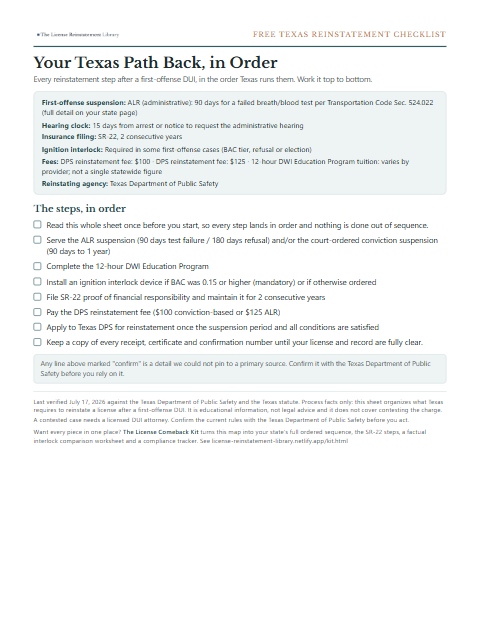
Get the free Texas reinstatement checklist
The one-page map of the Texas steps, in the order Texas runs them.
Instant download, plus Texas rule-change alerts. Unsubscribe anytime.
Ignition interlock rules in Texas
Whether the device is required for a first offense, for how long and where the state lists its certified providers.
| Item | Texas rule |
|---|---|
| Required for a first offense? | In some first-offense cases (see below) |
| First-offense duration | at least half the term of probation when mandatory (BAC 0.15 or higher); duration otherwise set by court order when discretionary |
| BAC trigger | 0.15 or higher triggers mandatory interlock with no judicial discretion under Code of Criminal Procedure Article 42A.408(c)(1); below that threshold a court may still order it, commonly as a condition of an occupational license |
| Approved providers | Texas Department of Public Safety approved ignition interlock device list; occupational license applications route through DPS |
| Worth knowing | A BAC of 0.15 or higher also reclassifies the offense as a Class A misdemeanor regardless of prior-offense status. An occupational license issued in a 0.15-or-higher case carries a mandatory interlock condition for the suspension period. |
Do you need SR-22 insurance in Texas?
The financial-responsibility filing your insurer makes with the state, where Texas requires one.
| Item | Texas rule |
|---|---|
| Required after a first DUI? | Yes |
| The form | SR-22 |
| How long it must stay in force | 2 consecutive years |
| Worth knowing | Required under Texas Transportation Code Section 601.161 for most DWI-related suspensions; must be filed with an authorized insurer and maintained without a lapse for the full 2-year period. |
Driving before full reinstatement in Texas
The limited license, if any, that lets a first offender drive during the suspension.
| Item | Texas rule |
|---|---|
| Available for a first offense? | Yes |
| What Texas calls it | Occupational license |
| Waiting period | Conditional: immediately eligible for a first-offense test-failure ALR with no alcohol-related suspension in the prior 5 years; a 90-day wait applies with a prior alcohol-related suspension within 5 years; a refusal-based suspension carries a mandatory 90-day wait before the petition regardless. A $10 occupational license fee applies. |
| Worth knowing | Allows driving a non-commercial vehicle during the suspension period. Carries a mandatory ignition interlock condition when the underlying case involved a BAC of 0.15 or higher. |
Confirm the restricted-license conditions and the waiting period for your case with the Texas Department of Public Safety before you apply.
The DUI program, the fees and the lookback
The DUI program. A DWI Education Program covering Texas DWI law, the effects of alcohol on judgment and driving and relapse avoidance, required for a first-time DWI offense as a condition of license reinstatement. Length: 12 hours.
The lookback period. None. A prior DWI conviction in Texas counts regardless of age, so any prior can be used for penalty and charge-level enhancement on a subsequent offense. This is the window over which a prior offense counts toward repeat-offense treatment.
The costs a Texas driver can expect on the way back.
| Item | Cost |
|---|---|
| DPS reinstatement fee (conviction-based suspension) | $100 |
| DPS reinstatement fee (ALR suspension from test failure or refusal) | $125 |
| 12-hour DWI Education Program tuition | varies by provider; not a single statewide figure |
Not published as one current figure. Confirm the exact amount with the Texas Department of Public Safety before you pay.