Indiana DUI License Reinstatement (2026): Suspension, Steps and Fees
How do you get your license back after a first DUI in Indiana?
A first offense OWI in Indiana starts with a pre-trial administrative suspension from the arrest date, lasting up to 180 days or until the case is resolved for a failed chemical test, or 1 year for a first refusal (IC 9-30-6-9). On conviction the court may suspend driving privileges under IC 9-30-16-1(c) for a period up to the maximum allowable period of incarceration for the offense, so the ceiling is 60 days for a Class C misdemeanor first OWI and 1 year for a Class A. There is no statutory minimum and no court suspension is guaranteed. Specialized driving privileges have no waiting period: say at the initial hearing that you intend to petition, the court stays the suspension there and then and the petition is due within 10 days. Reinstatement requires an SR-22 filing and a BMV reinstatement fee.
Indiana charges this offense as OWI, the same first-offense case most states call a DUI. Whichever term is on your paperwork, this page covers it.
In Indiana the license consequences start with the Indiana Bureau of Motor Vehicles rather than the courtroom. An administrative suspension runs on its own clock beside the court case. The page below lays the pieces out in the order the state runs them.
Whether an ignition interlock is required here depends on the case, commonly the test result or the license option chosen. The SR-22 filing is required. The education or treatment step comes before reinstatement. Each piece has its own section below, with the official source beside it.
The parts Indiana drivers most often miss are the insurance filing that lives with your insurer rather than the court and the order of the steps, since several gate the ones after them. The sections below take them in order.

How long is your license suspended after a first DUI in Indiana?
The first-offense term and how the administrative and court tracks interact in Indiana.
| Item | Indiana rule |
|---|---|
| First-offense suspension | Court-ordered suspension upon a first OWI conviction: a discretionary ceiling rather than a range. Under IC 9-30-16-1(c) a court may suspend driving privileges for a period up to the maximum allowable period of incarceration for the offense, with no statutory minimum, so the cap is 60 days for a Class C misdemeanor first OWI (0.08 to under 0.15) and 1 year for a Class A (0.15 or above). Separate pre-trial administrative suspension: up to 180 days or until the case is disposed of, whichever occurs first, for a failed test; 1 year for a first refusal (2 years for a subsequent refusal). |
| Administrative vs court | Indiana can impose an administrative suspension at the time of arrest, independent of the criminal case, when a chemical test result is prima facie evidence of intoxication or the driver refuses testing. This administrative suspension runs until the earlier of 180 days or the case's disposition (or, for a refusal, 1 year). The court separately imposes its own suspension upon an actual OWI conviction; time under specialized driving privileges with an interlock installed is credited against the suspension period. |
| Worth knowing | A prior OWI conviction within 5 years of the current offense can elevate the charge to a felony level, which falls outside the standard first-offense scope here. The 180-day, 1-year and 2-year administrative figures come from current IC 9-30-6-9 text. The court-ordered conviction suspension sits in IC 9-30-16-1(c), which sets a discretionary ceiling equal to the maximum period of incarceration for the offense, keyed through IC 9-30-5-1 and the misdemeanor sentencing sections IC 35-50-3-4 and 35-50-3-2. The 90-days-to-2-years figure still repeated across attorney summaries came from IC 9-30-5-10, repealed by P.L.188-2015. |
Is your license suspended immediately after a DUI in Indiana?
Not at the roadside. Indiana's first suspension comes out of a court order rather than out of the arrest itself. The arresting officer swears a probable cause affidavit, the clerk forwards it to the bureau at the conclusion of the initial hearing. At that hearing, if the judicial officer finds probable cause, the court shall recommend immediate suspension of the person's driving privileges to take effect on the date the order is entered (IC 9-30-6-8). So the clock starts the day that order is entered, which is normally some days after the arrest rather than the night of it.
How long that first suspension runs. IC 9-30-6-9 sets the length. Where the chemical test result is prima facie evidence of intoxication, the suspension runs for one hundred eighty (180) days, or until the bureau is notified by a court that the charges have been disposed of, whichever occurs first. Where the driver refused the test it is one (1) year, or two (2) years for a driver with at least one previous conviction for operating while intoxicated.
The interlock alternative in the same statute. Instead of recommending suspension, the court may issue an order recommending that the person be prohibited from operating a motor vehicle unless the vehicle is equipped with a functioning certified ignition interlock device. Where the court takes that route, IC 9-30-6-8(d) provides that no administrative suspension is imposed by the bureau.
This pre-trial suspension is separate from any suspension the court imposes if the case ends in a conviction. Two clocks, not one, which is the detail that catches most Indiana drivers out. The Indiana reinstatement timeline puts both of them in order alongside the rest of the steps.
The hearing clock: how long you have to act in Indiana
The deadline to request the administrative review of the license suspension. It runs from the arrest or notice date, not from the court date.
| Item | Indiana rule |
|---|---|
| How it works | A driver is entitled to a prompt judicial hearing to challenge the pre-trial administrative suspension or an ignition interlock order, but the hearing is limited to two issues: whether the officer had probable cause to believe the person operated a vehicle while committing an OWI-type offense, or whether the person refused the chemical test. The exact number of days to request this hearing was not confirmed against a primary source; it is a court proceeding rather than a BMV-run administrative hearing. |
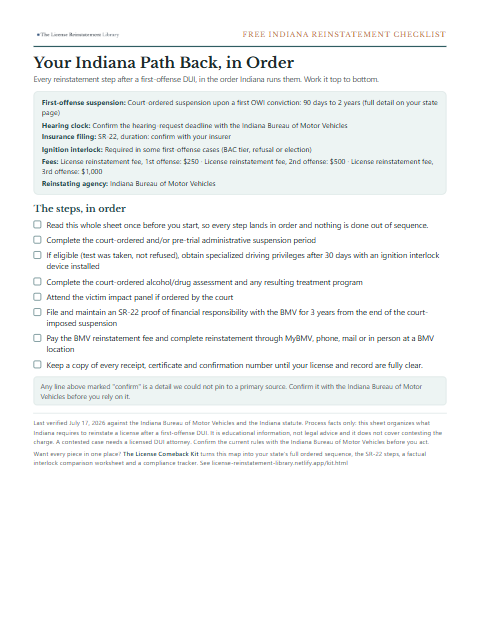
The path back: the Indiana reinstatement steps in order
Several of these steps gate the ones after them, so the order matters as much as the list.
- Complete the court-ordered and/or pre-trial administrative suspension period
- If eligible (test was taken, not refused), state the intent to petition for specialized driving privileges at the initial hearing so the court stays the suspension, then file the petition within 10 days; the hearing is set no later than 30 days after the initial hearing and an ignition interlock device is generally a condition
- Complete the court-ordered alcohol/drug assessment and any resulting treatment program
- Attend the victim impact panel if ordered by the court
- File and maintain an SR-22 proof of financial responsibility with the BMV for 3 years from the end of the court-imposed suspension
- Pay the BMV reinstatement fee and complete reinstatement through MyBMV, phone, mail or in person at a BMV location

From the team behind this library
The License Comeback Kit
Want the whole path in one place? The kit turns everything on this page into one ordered walkthrough for Indiana: your state requirement sheet, the dependency-ordered checklist, the SR-22 steps with an insurer call script, a factual interlock comparison worksheet and the compliance and removal tracker. Set it up in an evening.
Ignition interlock rules in Indiana
Whether the device is required for a first offense, for how long and where the state lists its certified providers.
| Item | Indiana rule |
|---|---|
| Required for a first offense? | In some first-offense cases (see below) |
| First-offense duration | Tied to the length of specialized driving privileges granted by the court; time with the device installed is credited against the suspension period |
| BAC trigger | n/a (interlock in Indiana is generally tied to the choice to obtain specialized driving privileges, or is required to obtain any driving privileges at all after a refusal, rather than triggered by a specific BAC tier) |
| Approved providers | unverifiable (a specific Indiana BMV-published approved-vendor list was not located) |
| Worth knowing | A driver who refused the chemical test is not eligible for specialized driving privileges unless an ignition interlock device is also installed in the vehicle. |
Do you need SR-22 insurance in Indiana?
The financial-responsibility filing your insurer makes with the state, where Indiana requires one.
| Item | Indiana rule |
|---|---|
| Required after a first DUI? | Yes |
| The form | SR-22 |
| How long it must stay in force | 3 years, continuously on file with the BMV, from the date of a BMV request or from the end of the court-imposed suspension |
| Worth knowing | The exact starting-point wording (BMV request date vs. suspension-expiration date) varied slightly between sources and should be confirmed against the individual driver's BMV notice. |
Driving before full reinstatement in Indiana
The limited license, if any, that lets a first offender drive during the suspension.
| Item | Indiana rule |
|---|---|
| Available for a first offense? | Yes |
| What Indiana calls it | Specialized driving privileges |
| Waiting period | None. Under IC 9-30-16-1(g) the court stays the suspension at the initial hearing once the driver says they intend to petition, so there is no period to sit out. The petition must be filed within 10 days of that hearing or the stay lifts and the affidavit goes to the bureau for automatic suspension; the specialized driving privileges hearing is set no later than 30 days after the initial hearing |
| Worth knowing | Granted by the court, generally requires an ignition interlock device and is not available to a driver who refused testing, though a court may still grant privileges under IC 9-30-6-8(d) with an interlock. Eligibility also requires having held a valid license at the time of the offense and Indiana residency. Read the two day counts in IC 9-30-16-1(g) the right way round: the 30 days is the outer limit for the court to set the hearing, the driver is driving on the stay in the meantime and the only deadline that can cost anything is the 10 days to file the petition. |
Specialized driving privileges: how the Indiana petition works
Specialized driving privileges come from a court rather than from the BMV. They come from a petition you file, so there is nothing to request at a license branch and nothing that arrives automatically.
Who is ruled out. IC 9-30-16-1 excludes a person who has never been an Indiana resident, a suspension based on refusing a chemical test offered under IC 9-30-6 or IC 9-30-7, plus the habitual traffic violator and serious moving violation suspensions the section lists. The petitioner also has to have held a driver's license at the time of the conviction or infraction, or to have been an Indiana resident when the privileges were suspended. A refusal case is not simply out of options: a court may still grant driving privileges under IC 9-30-6-8(d), the interlock route.
The 30-day stay most drivers never hear about. Say it at the initial hearing. Where a person indicates an intention to petition for specialized driving privileges, IC 9-30-16-1(g) has the court stay the suspension of driving privileges then set the hearing not later than thirty (30) days after the initial hearing. The stay continues so long as the petition is filed within ten days.
What the petition has to contain. Under IC 9-30-16-3 it must be verified by the petitioner, state the petitioner's age, date of birth and address, state the grounds for relief plus the relief sought, be filed in the court case that resulted in the order of suspension, then be served on the bureau and the prosecuting attorney. Where the BMV imposed the suspension administratively rather than a court, IC 9-30-16-4 puts the petition in a circuit or superior court in the county instead. One petition goes to each court that ordered a suspension.
What you carry while they run. The same section requires you to maintain proof of future financial responsibility insurance during the whole period of the privileges, which in practice is the SR-22 filing. You also carry a copy of the order granting the privileges or keep it in the vehicle, produce that copy on a police officer's request and carry a valid state identification card or driver's license. The privileges never cover a vehicle that requires a commercial driver's license.
The term. Set by the court, which may also set periodic review hearings. Where an ignition interlock device is installed as a condition of specialized driving privileges, the period of the installation is credited as part of the suspension of driving privileges, so device time is not dead time. The hardship and restricted license guide covers how other states structure the same idea.
The DUI program, the fees and the lookback
The DUI program. A state-approved alcohol or drug assessment, with any court-ordered treatment program that follows from it, plus a mandatory victim impact panel (attending a panel of speakers affected by OWI driving and visiting a related facility such as an emergency medical facility, alcoholism treatment center or coroner's office) Length: unverifiable (set case by case by the court; no fixed statewide hour figure located).
The lookback period. 5 years (a prior OWI conviction within this window can elevate a subsequent OWI to a felony level; some sources also cite a 7 year window relevant to second-offense charging). This is the window over which a prior offense counts toward repeat-offense treatment.
The costs a Indiana driver can expect on the way back.
| Item | Cost |
|---|---|
| License reinstatement fee, 1st offense | $250 |
| License reinstatement fee, 2nd offense | $500 |
| License reinstatement fee, 3rd offense | $1,000 |
Confirm the exact program length and the providers the Indiana Bureau of Motor Vehicles accepts before you enroll.
The Indiana reinstatement fee waiver
Indiana lets a court cancel reinstatement fees. It runs on a petition rather than a BMV form. Under IC 9-25-6-15.1, an individual who is liable for a reinstatement fee may file a petition for waiver of part or all of the reinstatement fee in a criminal court of record in the person's county of residence.
What happens once it is filed. The clerk of the court forwards a copy of the petition to the prosecuting attorney of the county plus a copy to the bureau. The prosecuting attorney may appear and be heard on the petition.
What the court has to find. All three things, not whichever one fits. IC 9-25-6-15.1(d) lets the court waive only where it finds that the individual is indigent, that the individual has presented proof of future financial responsibility, then that a waiver is appropriate in light of the individual's character plus the circumstances surrounding the suspension. The statute joins those with "and" rather than "or", so hardship on its own does not reach the test. The court may waive part or all of the fee, may act on its own motion and may impose other reasonable conditions where it grants one. When a waiver is granted the clerk notifies the bureau.
What is actually at stake. The fees themselves come from IC 9-25-6-15: $250 for a first suspension of driving privileges, $500 for a second and $1,000 for a third or subsequent one. Where no waiver applies, the BMV takes payment through a myBMV account, by phone using the access code on the reinstatement notice, by mail with the reinstatement coupon or at a BMV Connect kiosk.