DUI Reinstatement Readiness Checklist
Turn the steps you have finished into an ordered list of what remains.
How to use it
-
Pick the situation that matches your case.
A failed test, a refusal, a conviction, a repeat offense or an out-of-state hold.
-
Answer six short questions about where you stand.
Covers the program, the insurance filing, interlock and the fee.
-
Get your ordered list, then print it.
Some steps gate later ones so the order matters. Your state page fills in the days and the dollars.
First, which situation are you in?
The steps in the checklist are the same for everyone. What changes is which clock leads on your track and which step is urgent this week. Pick the one that matches your case and the note below sets honest expectations for that track before you build the list.
Choose a situation above to see what changes on that track. Nothing you pick is recorded.
A failed chemical test: the agency clock usually leads
Where your state runs an administrative track, the licensing agency can act on the test result itself, long before the court case is finished. That is why the first thing on this track is a deadline rather than a task.
What to check on your own state page
- Whether your state runs an administrative track at all. Several states route the whole license consequence through the court instead, so there is no agency window to watch.
- The dated window to request a review hearing, which runs from the arrest or the notice date rather than from the day you start looking into it.
- Which office receives that request. It is often a specific unit rather than the counter where you renew a license.
A refused test: a separate action under implied consent
A refusal is handled under your state's implied-consent rule. It is a different action from a failed test rather than a harsher version of the same one, so the terms attached to it are set separately.
What to check on your own state page
- Whether the refusal suspension runs a different length from the failure suspension in your state. States set the two separately and your state page carries yours wherever the state publishes it.
- Whether a refusal changes the early-driving path, meaning a hardship or restricted license plus any interlock condition attached to it.
- Whether the review window differs. Where a state gives a refusal its own hearing, that deadline can sit apart from the failure one.
A conviction: the second clock is the live one
A conviction can carry its own suspension, separate from any administrative action the agency already took. States differ on whether the two run at the same time or one after the other, which is why court paperwork on its own rarely tells you your real end date.
What to check on your own state page
- How the two suspensions interact in your state. Where the state publishes that, it sits in the suspension section of your state page.
- What the conviction itself triggers. The program requirement and the insurance filing are usually attached to the conviction rather than to the arrest.
- Which record now controls your date. Reinstatement runs off the licensing agency record rather than the court file.
A repeat offense: outside what this checklist covers
Said plainly so you are not working from the wrong list. Everything below is written for a standard first offense. A second or later offense can carry longer terms, extra conditions and in some states a hearing rather than a counter transaction. This library does not publish repeat-offense terms, so nothing here is your timeline.
What to check on your own state page
- Your state's lookback period, which decides whether an earlier offense still counts against a new one. Your state page carries it. The answer ranges from a few years through to no limit at all.
- Whether your state requires a hearing before it will reinstate. A hearing state runs a different process from a counter state.
- What the licensing agency holds on your record right now, which is the only place your actual conditions live.
The list below still names the pieces most reinstatements are made of, so it works as an inventory of what to ask about. Treat every term on it as unconfirmed until the licensing agency states yours. For a repeat case, a licensed DUI attorney is the right second call. None of this is a judgment about your case. It is a scope limit on what this library verified.
An out-of-state hold: two agencies, one record
Two states are involved and they do different jobs. The state where the offense happened controls the clearance of its own action and sets the conditions to satisfy. Your home state controls the license itself, so it can hold an application while another state's action sits on your record.
States exchange conviction and suspension records with one another under interstate agreements, which is how an action taken in one state reaches the record held by another. Which agreements apply to your two states varies, as does what each state does with the record it receives. That is what makes both agencies worth calling rather than one.
What to check on your own state page
- What the offense state still requires from you plus whether it issues a written clearance once you are done.
- What your home state needs to see before it will act, which is usually that clearance rather than your own account of it.
- Whether either state adds conditions of its own, such as a program or an insurance filing it will accept.
The usual order is to satisfy the offense state first, get its clearance in writing then take that to your home state. Open both pages: the state where the DUI happened and the state that holds your license.
Every one of these tracks ends in the same checklist. None of them changes an item on it. Where a track varies by state, this library says so rather than guessing. Your state page is where the answer lives.
Build your personal checklist
This checklist is written for a standard first offense. A repeat offense or a contested case adds conditions this list does not cover.
Nothing you answer here is sent anywhere. The list is built in your browser and the page keeps no record of it.
Your ordered list
Answer the questions above to build your ordered list. Nothing has been selected yet.
The ordered list is assembled in your browser, so it needs JavaScript switched on. With it off the page still carries everything the list is built from: the five situation panels above are all open and the same steps are set out in their usual order further down this page under "The path back in its usual order". Your own state page carries the days and the dollars either way.
Get your state's free reinstatement checklist
This list puts your remaining steps in order. The state checklist is the one-page map of your own state's steps in the order your state runs them, with the days and the offices on it.
Instant download, plus an alert when a rule changes in your state. Unsubscribe anytime.
From the team behind this library
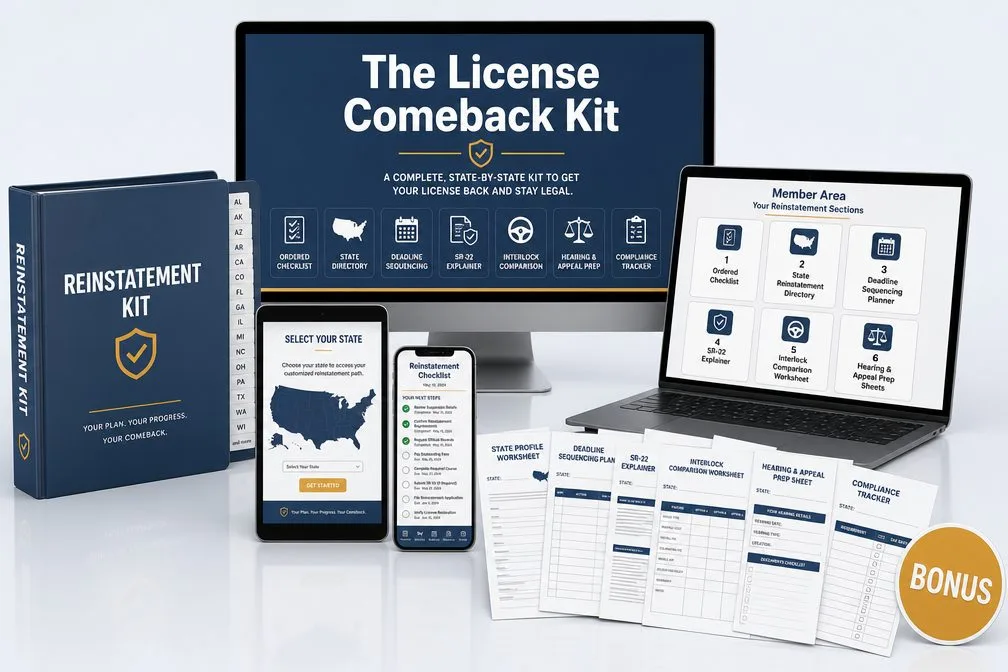
The License Comeback Kit
This checklist tells you what is left and what order it goes in. The License Comeback Kit is the other half: your state requirement sheet, the dependency-ordered checklist filled in, the SR-22 steps with an insurer call script, a factual interlock comparison worksheet and the compliance and removal tracker. Set it up in an evening.
The two clocks
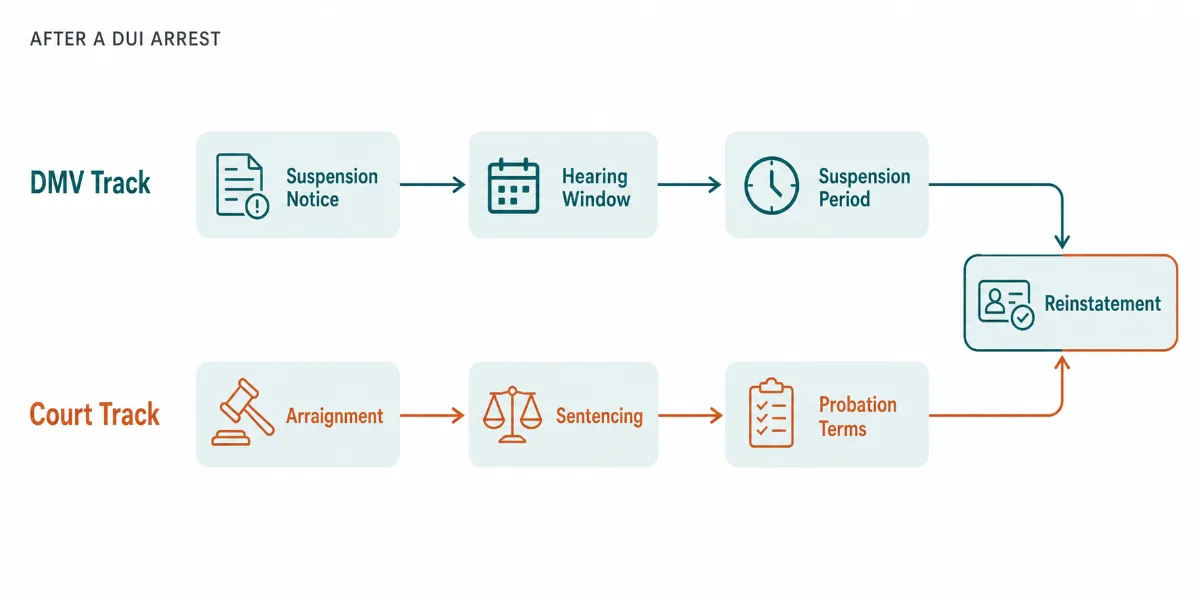
A first DUI can start a court case and a separate license process. The licensing agency runs its process on its own schedule. Resolving one process does not close the other.
Many states run an administrative track beside the court case. The arrest or notice can start a dated window for requesting an agency review hearing. Other states route the license consequences through the court case. Your state page identifies the path and the office that handles it.
The path back in its usual order
The sequence below shows the general dependency chain. Your own notice and state page control the exact requirements.
-
Check the agency hearing window
If your state has an administrative track, the window starts from the arrest or notice date. Read your notice and use your state page for the current deadline.
-
Serve the suspension or check the path for driving sooner
A hardship, restricted or occupational license may allow limited driving before full reinstatement. Your state sets the name and conditions. Read the hardship and restricted license guide.
-
Complete the education or treatment program
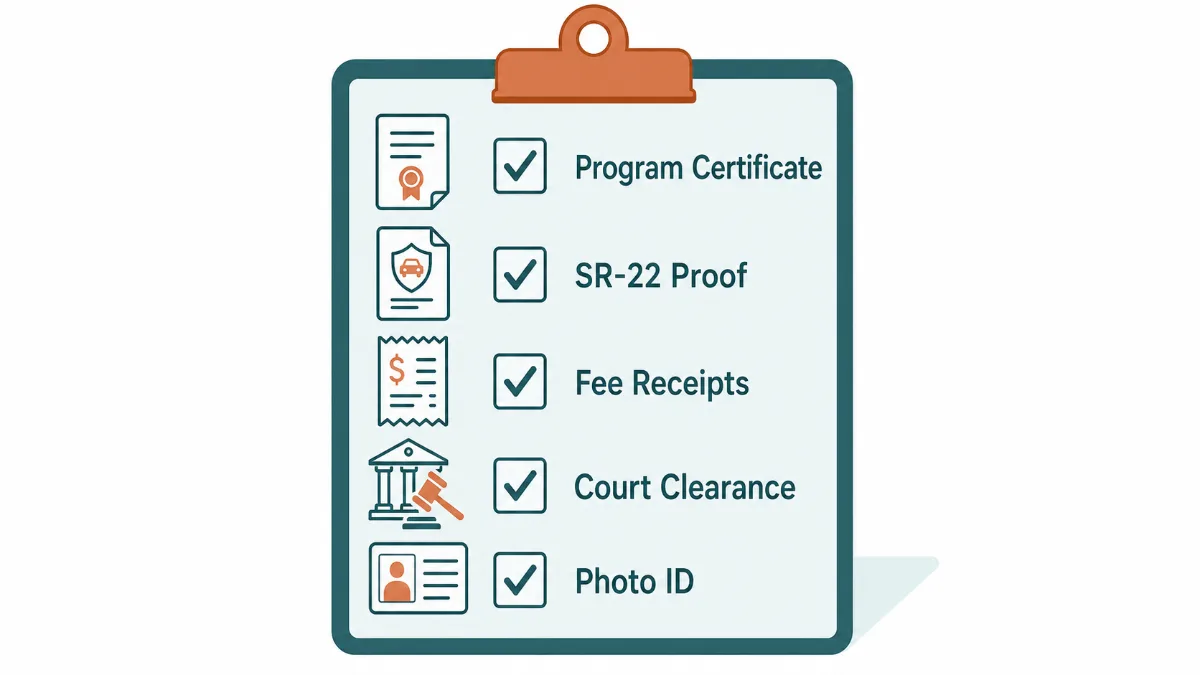
Your state and case determine whether you need education, an assessment or treatment. Keep written proof of completion.
-
Complete the insurance filing where required
The SR-22 or FR-44 is a certificate that an insurer files with the state. It is separate from the policy. Read the SR-22 and FR-44 guide.
-
Install the ignition interlock where required
Use a provider approved by your state. Keep each service appointment and protect the compliance record through authorised removal. Read the ignition interlock guide.
-
Pay the reinstatement fee and apply
Reinstatement may require an application after the licensing agency marks every condition complete. Your state sets the exact fee and application process.
Where the process often goes wrong
This list orders your remaining steps. Your state page fills in the days and the dollars. Open your state for the free reinstatement checklist, the one-page map of the steps in the order your state runs them. The reference stays free.
Frequently asked questions
What order do the DUI reinstatement steps go in?
Start by checking any agency hearing window and reading every notice. Then check the path for driving sooner. Complete the required program followed by the insurance filing and any interlock requirement. Confirm that every condition appears complete before you pay the reinstatement fee and apply for reissue. Your state page supplies the exact terms.
Why does the SR-22 catch people out?
The filing lives with the insurer rather than the court or licensing agency, so it may not appear in court paperwork. Ask the insurer to confirm that the filing reached the state. Record its effective date and required end date then protect every renewal in between.
Can I drive before I am fully reinstated?
Your state may offer a hardship, restricted or occupational license before full reinstatement. The name and conditions vary. Check your state page and the hardship license guide before you plan around that path.
Does this checklist tell me my deadlines?
No. This checklist carries no dates. Your state sets them. Use the timeline tool and your state page to find the current terms then confirm them with the licensing agency.
Does this work for a second offense?
This checklist is written for a standard first offense. A repeat offense or a contested case can add conditions that the list does not cover. Confirm the full process with the licensing agency and talk to a licensed DUI attorney where appropriate.
Does it matter whether I failed the test or refused it?
It can. A refusal is handled under your state's implied-consent rule, which is a separate action from a failed test, so the suspension length and the early-driving path attached to it are set separately. Both are state law rather than a national rule. Pick your situation at the top of this page for what changes on that track then confirm the terms on your own state page.
This checklist is educational information, not legal advice and it does not tell any driver what to do. It does not come from a state licensing agency or a court. It carries no dates and no fees, because those are set by your state and they change. Confirm every requirement and every deadline with your own state's licensing agency before you rely on this list. For a contested case, an agency hearing or a repeat offense, talk to a licensed DUI attorney.