Michigan DUI License Reinstatement (2026): Suspension, Steps and Fees
How do you get your license back after a first DUI in Michigan?
Michigan calls a first offense OWI (Operating While Intoxicated). Conviction brings a license suspension imposed by the Secretary of State: 30 days with no driving followed by 150 days on a restricted license for a standard first offense, or 45 days with no driving followed by 320 days restricted with a mandatory ignition interlock for a High BAC (0.17+) first offense. Reinstatement follows automatically once the suspension period ends and the $125 reinstatement fee is paid, with no hearing required for a standard first-offense conviction suspension.
Michigan charges this offense as OWI, the same first-offense case most states call a DUI. Whichever term is on your paperwork, this page covers it.
Michigan sits between the two common structures: whether an administrative review applies depends on the case. The page below states which situations carry a deadline and lays the reinstatement steps out in the order the state runs them.
Whether an ignition interlock is required here depends on the case, commonly the test result or the license option chosen. The SR-22 filing is required. The education or treatment step comes before reinstatement and runs unverifiable. Each piece has its own section below, with the official source beside it.
The parts Michigan drivers most often miss are the insurance filing that lives with your insurer rather than the court and the order of the steps, since several gate the ones after them. The sections below take them in order.
How long is your license suspended after a first DUI in Michigan?
The first-offense term and how the administrative and court tracks interact in Michigan.
| Item | Michigan rule |
|---|---|
| First-offense suspension | 30 days hard suspension followed by 150 days restricted for a standard first-offense OWI conviction (180 days total); 45 days hard suspension followed by 320 days restricted with mandatory interlock for a High BAC (0.17+) first-offense conviction (365 days total) |
| Administrative vs court | Michigan has no pre-conviction administrative per se suspension for a chemical test failure; the Secretary of State suspension is imposed only after the court forwards a conviction abstract. A chemical test refusal is handled on a separate administrative track under the implied consent law, independent of the criminal case outcome. |
| Worth knowing | A High BAC (0.17+) first offense carries a longer hard-suspension period and a mandatory interlock during the restricted period, unlike a standard first offense below that BAC threshold. The 45-day/320-day High BAC split is consistently and specifically tied to MCL 257.319 and the 2010 'Super Drunk' law (0.17 BAC tier of MCL 257.625) across multiple corroborating legal sources; the exact day figures were not independently pulled verbatim from that specific subsection of statute text. |
The hearing clock: how long you have to act in Michigan
The deadline to request the administrative review of the license suspension. It runs from the arrest or notice date, not from the court date.
| Item | Michigan rule |
|---|---|
| Request window | 14 days from the officer's report of refusal to request a Secretary of State hearing (implied consent / refusal track only); no administrative hearing applies to the standard conviction-based suspension |
| How it works | For a chemical test refusal, the driver must request a Secretary of State hearing within 14 days of the officer's refusal report or the Secretary of State automatically imposes a 1-year suspension. The hearing is limited to specific statutory issues (reasonable grounds, arrest, refusal and related implied-consent advisement issues). The standard conviction-based OWI suspension carries no equivalent administrative hearing; it follows automatically from the court's conviction record. |
The path back: the Michigan reinstatement steps in order
Several of these steps gate the ones after them, so the order matters as much as the list.
- Serve the hard suspension period (no driving)
- Complete the court-ordered NEEDS substance use assessment as part of the criminal case
- Serve the restricted-license period the Secretary of State imposed, with an interlock installed if convicted of High BAC
- Maintain SR-22 proof of financial responsibility if the Secretary of State requires it
- Pay the $125 reinstatement fee
- Resume driving once the suspension period is complete and the fee is paid
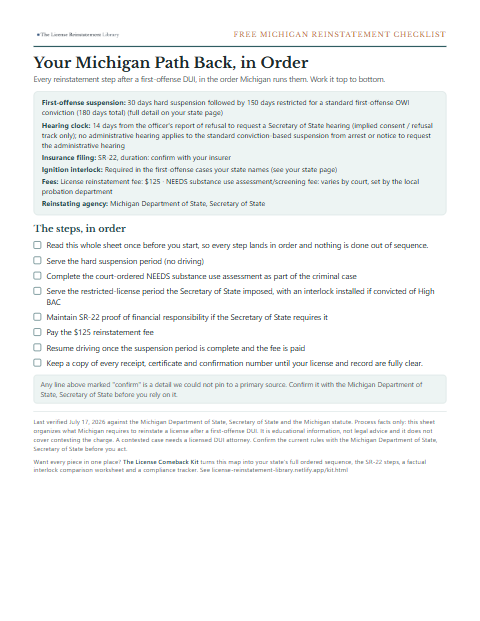
Get the free Michigan reinstatement checklist
The one-page map of the Michigan steps, in the order Michigan runs them.
Instant download, plus Michigan rule-change alerts. Unsubscribe anytime.
Ignition interlock rules in Michigan
Whether the device is required for a first offense, for how long and where the state lists its certified providers.
| Item | Michigan rule |
|---|---|
| Required for a first offense? | mandatory for a High BAC (0.17+) first-offense conviction; not required by default for a standard first offense below that threshold |
| First-offense duration | 320 days (the restricted-license period) for a High BAC first offense |
| BAC trigger | 0.17 and above |
| Approved providers | Michigan Department of State BAIID (Breath Alcohol Ignition Interlock Device) program information, administered through the Secretary of State |
| Worth knowing | The Secretary of State must authorize removal of the BAIID; compliant use for the required period, without violations, is the standard removal path. |
Do you need SR-22 insurance in Michigan?
The financial-responsibility filing your insurer makes with the state, where Michigan requires one.
| Item | Michigan rule |
|---|---|
| Required after a first DUI? | Not settled in the official sources |
| The form | SR-22 |
| Worth knowing | FLAG, re-checked directly against michigan.gov/sos. The only official state mechanism found for a certificate of insurance filed with the Secretary of State (the 'financial responsibility restricted license' under MCL 500.3101 et seq.) is described on michigan.gov/sos/faqs/license-and-id/financial-responsibility-restricted-licenses as tied to an unpaid civil judgment from an at-fault accident by an uninsured driver, not to an OWI conviction itself. That FAQ page does not mention OWI, DUI, alcohol, or a criminal conviction anywhere. Insurance and license-restoration marketing sites widely repeat a 3-year SR-22 requirement after OWI, but no michigan.gov page was found that ties SR-22 specifically to a conviction rather than to a judgment. Treat the commonly cited figure as unconfirmed, not as a confirmed fact. |
Not settled in one published place. Confirm the filing requirement and how long it must stay in force with the Michigan Department of State, Secretary of State and your insurer before you rely on it.
Driving before full reinstatement in Michigan
The limited license, if any, that lets a first offender drive during the suspension.
| Item | Michigan rule |
|---|---|
| Available for a first offense? | Yes |
| What Michigan calls it | Restricted license |
| Waiting period | immediate after the hard suspension period ends (30 days for a standard first offense; 45 days for a High BAC first offense) |
| Worth knowing | The restricted license is built into the sanction structure itself rather than a separately applied-for hardship license: it begins automatically once the hard no-driving period ends and covers travel to work, school, court, probation, community service and alcohol/drug treatment. A High BAC first offense requires an installed interlock during the restricted period. No discretionary hearing-based hardship license process distinct from the automatic restricted-license period was found for a first offense. |
The DUI program, the fees and the lookback
The DUI program. Michigan courts require a substance use assessment before sentencing for anyone convicted of Operating While Visibly Impaired, OWI, or High BAC. The probation department administers a NEEDS survey (a roughly 130-question screening tool) to inform the judge whether treatment or counseling should be a probation condition. Length: unverifiable; not a fixed-hour statewide education program, the assessment and any resulting treatment length are set case by case through the court's probation department.
The lookback period. 7 years for second-offense classification (measured from the date of the prior conviction to the date of the new offense); a driver with two prior convictions faces lifetime lookback for felony third-offense classification. This is the window over which a prior offense counts toward repeat-offense treatment.
The costs a Michigan driver can expect on the way back.
| Item | Cost |
|---|---|
| License reinstatement fee | $125 |
| NEEDS substance use assessment/screening fee | varies by court, set by the local probation department |
Confirm the exact program length and the providers the Michigan Department of State, Secretary of State accepts before you enroll.