Minnesota DUI License Reinstatement (2026): Suspension, Steps and Fees
How do you get your license back after a first DUI in Minnesota?
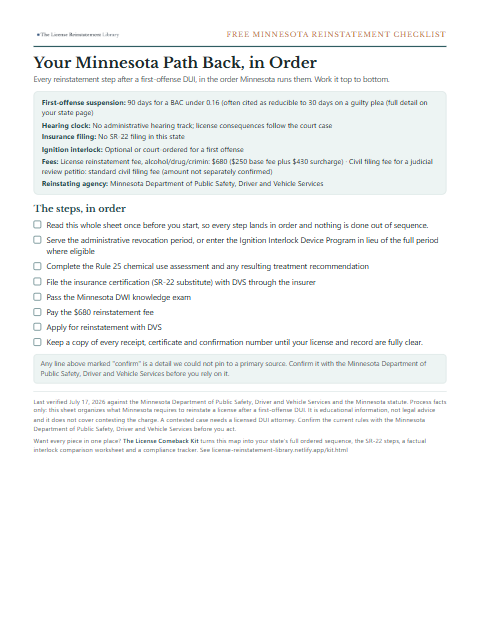
Minnesota calls a first offense DWI (Driving While Impaired). The administrative revocation under the implied consent law is 90 days for a BAC under 0.16 and 1 year for a BAC of 0.16 or higher or a refusal, with a child in the vehicle as a separate aggravating factor that can also escalate the revocation. Minnesota does not use SR-22: reinstatement runs through Driver and Vehicle Services (DVS), a chemical use assessment, a certificate of insurance filed by the insurer in place of an SR-22 and the $680 reinstatement fee.
Minnesota charges this offense as DWI, the same first-offense case most states call a DUI. Whichever term is on your paperwork, this page covers it.
In Minnesota the license follows the conviction, not the arrest. The state runs no administrative per-se track, which removes one clock from the process and puts the weight on the court case. The steps back are laid out below in order.
The ignition interlock is not automatic here; it enters by court order or by the driver's own election, often as the route to driving sooner. There is no SR-22 filing in Minnesota, which puts it among the handful of states that skip the form. The education or treatment step comes before reinstatement. Each piece has its own section below, with the official source beside it.
A 2025 amendment took effect August 1, 2025. Minnesota now requires treatment completion before full reinstatement for drivers with prior offenses or an injury or death case. The standard first-offense path is unchanged. This page reflects the rule in force today; the full history sits in the law-updates log.

How long is your license suspended after a first DUI in Minnesota?
The first-offense term and how the administrative and court tracks interact in Minnesota.
| Item | Minnesota rule |
|---|---|
| First-offense suspension | 90 days for a BAC under 0.16 (often cited as reducible to 30 days on a guilty plea, though this specific reduction was not independently located in statute text); 1 year for a BAC of 0.16 or higher or a test refusal; a child under 16 in the vehicle (more than 36 months younger than the driver) is a separate aggravating factor that also escalates the revocation |
| Administrative vs court | Minnesota's implied consent revocation is administrative and takes effect independent of the criminal DWI case outcome; it runs on its own track through DVS. A first offender at BAC 0.16+ can choose to enter the Ignition Interlock Device Program to drive during the revocation instead of sitting out the full period. |
| Worth knowing | A higher BAC (0.16+) or a test refusal escalates the standard 90-day first-offense revocation to a full 1-year revocation. The child-under-16 aggravating factor doubling the revocation period is corroborated by multiple secondary sources and a Minnesota House Research Department brief tied to the aggravating-factor definition in Minnesota Statutes Section 169A.03, but was not independently pulled verbatim from Section 171.178 itself. |
Confirm the exact term for your case with the Minnesota Department of Public Safety, Driver and Vehicle Services; the figure can shift with the test result and the case details.
Is there a DMV hearing to request in Minnesota?
No. Minnesota does not use a DVS administrative hearing officer for implied consent revocations. A driver instead files a Petition for Judicial Review with the district court in the county of the offense within 60 days, with proof of service on the commissioner. Filing the petition does not stay the revocation; the court must generally hold the hearing within 60 days of the petition being filed and issue its order within 14 days of the hearing.
Confirm the request deadline and the receiving office with the Minnesota Department of Public Safety, Driver and Vehicle Services; the window runs from the arrest or notice date.
The path back: the Minnesota reinstatement steps in order
Several of these steps gate the ones after them, so the order matters as much as the list.
- Serve the administrative revocation period, or enter the Ignition Interlock Device Program in lieu of the full period where eligible
- Complete the Rule 25 chemical use assessment and any resulting treatment recommendation
- File the insurance certification (SR-22 substitute) with DVS through the insurer
- Check your own DVS notice before studying for a knowledge exam. Minn. Stat. 171.29 subd. 1(b) says the examination requirement in paragraph (a) does not apply to a person whose license was revoked because of an impaired driving offense and both DWI triggers (169A.52 and 171.177) were struck from paragraph (a). Minn. R. 7503.1200 still lists a reinstatement examination, so where the two disagree the DVS notice for your case is the document to work from
- Pay the $680 reinstatement fee
- Apply for reinstatement with DVS
From the team behind this library
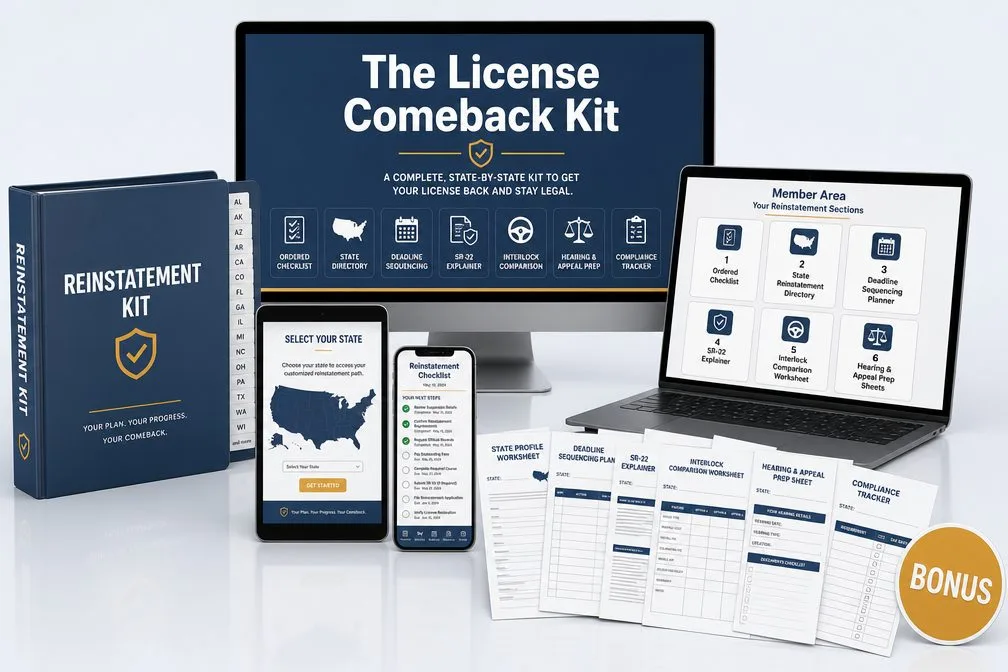
The License Comeback Kit
Want the whole path in one place? The kit turns everything on this page into one ordered walkthrough for Minnesota: your state requirement sheet, the dependency-ordered checklist, the SR-22 steps with an insurer call script, a factual interlock comparison worksheet and the compliance and removal tracker. Set it up in an evening.
Ignition interlock rules in Minnesota
Whether the device is required for a first offense, for how long and where the state lists its certified providers.
| Item | Minnesota rule |
|---|---|
| Required for a first offense? | discretionary for a first offense at BAC 0.16+ (optional route to keep driving during the 1-year revocation); not required for a standard first offense below that threshold that serves the shorter revocation |
| First-offense duration | for the duration the driver elects to participate in lieu of the revocation period (up to the 1-year revocation length at BAC 0.16+) |
| BAC trigger | 0.16 and above triggers eligibility for the 1-year-revocation interlock alternative |
| Approved providers | Minnesota DPS Ignition Interlock Device Program (IIDP) guidelines, dps.mn.gov |
| Worth knowing | Participants are not exempt from a certificate-of-insurance filing. Minnesota Rule 7503.1725, Subpart 2, Item F (revisor.mn.gov), confirmed verbatim, requires an IIDP participant to 'provide a certificate of insurance stating that the coverage for any vehicle equipped with an ignition interlock device is noncancelable for a period not to exceed 12 months.' This certificate of insurance is Minnesota's SR-22 substitute (see sr22 field below), not an exemption from one; a plain insurance card is not sufficient for IIDP enrollment. The 0.16 BAC eligibility threshold itself is drawn from the revocation-length tiers in Minnesota Statutes Section 171.178, not from Section 171.306 (which defines the interlock device's own 0.02 lockout threshold, a separate concept). |
Does Minnesota require an SR-22?
The financial-responsibility filing your insurer makes with the state, where Minnesota requires one.
| Item | Minnesota rule |
|---|---|
| Required after a first DUI? | No |
| The form | none (Minnesota's own term is "certificate of insurance" / "insurance certification") |
| How long it must stay in force | noncancelable for a period not to exceed 12 months per filing, refiled as required through the revocation/limited-license/IIDP period |
| Worth knowing | This was independently re-verified two ways. First, a targeted search of dps.mn.gov and mn.gov for the literal term "SR-22" returns no state-government usage of the term anywhere (only unrelated hits like a State Patrol airplane model and third-party insurance-marketing sites). Second and more directly, Minnesota Rule 7503.0100, Subpart 4a (revisor.mn.gov), confirmed verbatim, defines Minnesota's own instrument: 'Certificate of insurance means a completed insurance certificate from the authorized representative of the insurance carrier authorized to do business in the state stating that the vehicle will be covered by a plan of reparation security as required by Minnesota Statutes, section 65B.48, that is noncancelable for a period not to exceed 12 months.' Rule 7503.1725, Subpart 2, Item F requires this certificate of insurance for reinstatement through the ignition interlock/limited-license path after an alcohol-related revocation. DVS also publishes a standalone 'Insurance Certification' form (assets.dps.mn.gov, DL_InsuranceCertification.pdf) consistent with this rule. The term "SR-22" appears nowhere in this regulatory chapter. R. 7503.0100 subp. 4a and Minn. Stat. Section 65B.48, not SR-22. |
Driving before full reinstatement in Minnesota
The limited license, if any, that lets a first offender drive during the suspension.
| Item | Minnesota rule |
|---|---|
| Available for a first offense? | Yes |
| What Minnesota calls it | Limited license (work permit) |
| Waiting period | 15 days into the revocation for a first-offense DWI |
| Worth knowing | A higher-BAC (0.16+) case is more likely to route through the Ignition Interlock Program instead of the standard limited license. |
The DUI program, the fees and the lookback
The DUI program. DVS requires a chemical use assessment (commonly called a Rule 25 assessment) performed by a licensed alcohol and drug counselor. The assessment determines whether treatment is recommended and at what intensity. As of August 1, 2025, most drivers with a prior DWI, or whose offense involved injury or death, must complete any recommended licensed substance use disorder treatment before regaining full unrestricted driving privileges. Length: unverifiable; the assessment itself is a standardized interview/questionnaire with no fixed hour count and any resulting treatment length is set case by case.
The lookback period. Minnesota runs two different lookback windows for two different purposes.mn.gov. For criminal charge enhancement (aggravating-factor counting under Minnesota Statutes Section 169A.03), the lookback is 10 years: 'a qualified prior impaired driving incident within the ten years immediately preceding the current offense.' For administrative license-revocation tiering (whether the driver has a 'qualified prior impaired driving incident' that increases the DVS revocation period), Minnesota Statutes Section 171.178 uses a 20-year lookback, confirmed verbatim across its Subdivisions 3, 4 and 5 ('within the past 20 years'). A first offense under either window, with no qualifying priors, gets the base 90-day/1-year revocation described above. This is the window over which a prior offense counts toward repeat-offense treatment.
The costs a Minnesota driver can expect on the way back.
| Item | Cost |
|---|---|
| License reinstatement fee, alcohol/drug/criminal vehicular operation revocation | $680 ($250 base fee plus $430 surcharge) |
| Civil filing fee for a judicial review petition | standard civil filing fee (amount not separately confirmed) |
Not published as one current figure. Confirm the exact amount with the Minnesota Department of Public Safety, Driver and Vehicle Services before you pay. Confirm the exact program length and the providers the Minnesota Department of Public Safety, Driver and Vehicle Services accepts before you enroll.