Connecticut DUI License Reinstatement (2026): Suspension, Steps and Fees
How do you get your license back after a first DUI in Connecticut?
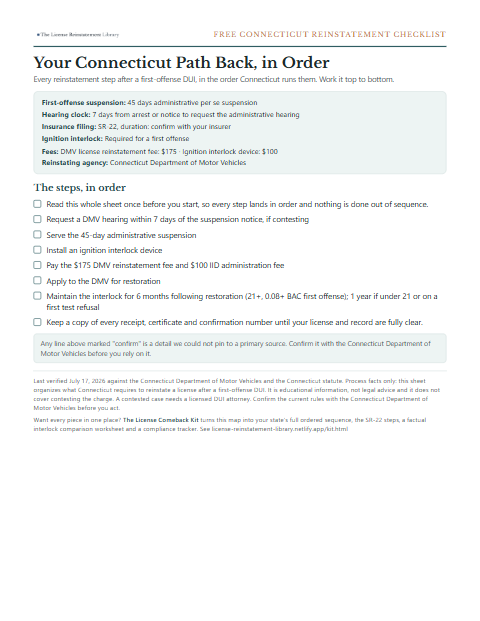
Connecticut's administrative per se license suspension for a first-offense DUI is 45 days, beginning about 30 days after arrest and it runs separately from any suspension the court imposes on conviction. Connecticut requires an ignition interlock device before reinstatement on every alcohol-related suspension, even a first offense and the term depends on which track imposed it: 6 months following restoration on the administrative per se track for a driver 21 or older at 0.08 or higher (1 year for a driver under 21 or on a first test refusal) and one full year following restoration where the driver is convicted under Conn. Gen. Stat. 14-227a. Reinstatement needs the interlock, a $175 DMV reinstatement fee and a $100 interlock administration fee.
In Connecticut the license consequences start with the Connecticut Department of Motor Vehicles rather than the courtroom. An administrative suspension runs on its own clock beside the court case and the window to request the administrative hearing is 7 days. The page below lays the pieces out in the order the state runs them.
An ignition interlock is part of every first-offense path here. The SR-22 filing is required. Each piece has its own section below, with the official source beside it.
The parts Connecticut drivers most often miss are the 7-day hearing-request deadline, which runs from the arrest or notice date, the insurance filing that lives with your insurer rather than the court and the order of the steps, since several gate the ones after them. The sections below take them in order.

How long is your license suspended after a first DUI in Connecticut?
The first-offense term and how the administrative and court tracks interact in Connecticut.
| Item | Connecticut rule |
|---|---|
| First-offense suspension | 45 days administrative per se suspension |
| Administrative vs court | The administrative per se suspension (14-227b) and any court-ordered suspension on conviction (14-227a) are separate. Per the DMV's own page, a first-time offender is eligible for restoration after the 45-day administrative suspension regardless of whether a related suspension from the same arrest has been fully served, indicating the two tracks do not simply stack into one combined clock. |
| Worth knowing | The 45-day suspension generally begins about 30 days after the arrest date rather than immediately. |
The hearing clock: how long you have to act in Connecticut
The deadline to request the administrative review of the license suspension. It runs from the arrest or notice date, not from the court date.
| Item | Connecticut rule |
|---|---|
| Request window | 7 days |
| How it works | The 7 days run from the date the DMV mails the suspension notice, not from the date the driver receives it. Conn. Gen. Stat. 14-227b(e)(1) gives the driver until no later than seven days after the date of mailing to schedule the hearing by contacting the DMV and the same mailing trigger appears in both 14-227b(e)(1) and (e)(2), so it does not vary by case type. The request is handled through the DMV's Administrative Per Se Unit. |
The path back: the Connecticut reinstatement steps in order
Several of these steps gate the ones after them, so the order matters as much as the list.
- Request a DMV hearing within 7 days of the date the suspension notice was mailed, if contesting
- Serve the 45-day administrative suspension
- Install an ignition interlock device
- Pay the $175 DMV reinstatement fee and $100 IID administration fee
- Apply to the DMV for restoration
- Maintain the interlock for the applicable term: 6 months following restoration on the per se track (21+, 0.08+ BAC), 1 year if under 21 or on a first test refusal and one full year following restoration on a first conviction under 14-227a
From the team behind this library
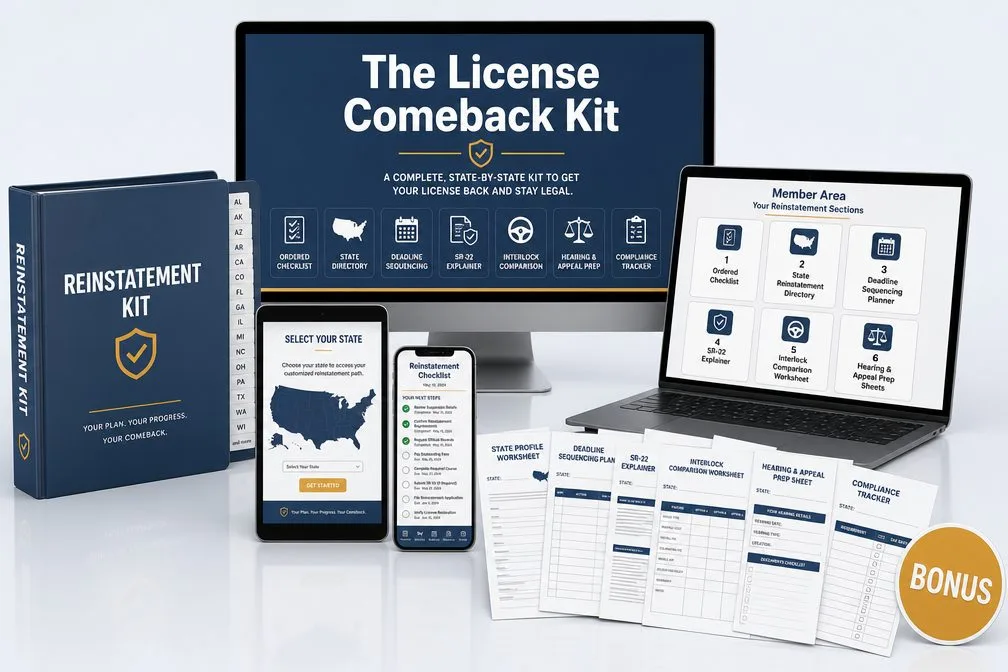
The License Comeback Kit
Want the whole path in one place? The kit turns everything on this page into one ordered walkthrough for Connecticut: your state requirement sheet, the dependency-ordered checklist, the SR-22 steps with an insurer call script, a factual interlock comparison worksheet and the compliance and removal tracker. Set it up in an evening.
Ignition interlock rules in Connecticut
Whether the device is required for a first offense, for how long and where the state lists its certified providers.
| Item | Connecticut rule |
|---|---|
| Required for a first offense? | Yes, mandatory for a first offense |
| First-offense duration | Two tracks, two terms. Administrative per se (14-227b): 6 months following restoration for a driver 21 or older with a 0.08%+ BAC, or 1 year for a driver under 21 with a 0.02%+ BAC or on a first test refusal. Conviction (14-227a(g)(1)): a 45-day suspension, then one full year of interlock following restoration |
| BAC trigger | all alcohol-related suspensions trigger the requirement; the term length itself is set by the track and then tiered by age/BAC as above |
| Approved providers | Connecticut DMV Ignition Interlock Device program page (portal.ct.gov/dmv) |
| Worth knowing | The DMV publishes both tracks side by side. Under Administrative Per Se (14-227b) a driver 21 or older at 0.08%+ serves six months of interlock; under Conviction (14-227a) a first offense is a 45-day license suspension with the device required for one year following restoration. The two are separate consequences of the same arrest, so completing the six-month per se term does not end a one-year conviction term that is also running. An interlock violation (a BAC over the device limit, or a missed rolling retest) adds an additional month to whichever term applies. |
Confirm the exact interlock term and trigger for your case with the Connecticut Department of Motor Vehicles before you schedule an install.
Do you need SR-22 insurance in Connecticut?
The financial-responsibility filing your insurer makes with the state, where Connecticut requires one.
| Item | Connecticut rule |
|---|---|
| Required after a first DUI? | Yes |
| The form | SR-22 |
| How long it must stay in force | commonly cited as 3 years from the date of suspension across multiple independent secondary sources; not confirmed on a CT DMV-hosted page |
| Worth knowing | Neither the CT DMV's DUI suspension page nor its reinstatement-fee page mentions SR-22 by name, but 5+ independent secondary sources consistently and specifically describe a 3-year SR-22 requirement tied to a CT DUI conviction, with the clock starting at the suspension date. |
Not settled in one published place. Confirm the filing requirement and how long it must stay in force with the Connecticut Department of Motor Vehicles and your insurer before you rely on it.
Driving before full reinstatement in Connecticut
The limited license, if any, that lets a first offender drive during the suspension.
| Item | Connecticut rule |
|---|---|
| Available for a first offense? | Not settled in the official sources |
| Worth knowing | No distinct hardship or work-only restricted license was identified separate from the standard interlock-conditioned restoration process in this |
The DUI program, the fees and the lookback
The DUI program. The Impaired Driving Intervention Program (IDIP, formerly the Alcohol Education Program) is a pretrial diversion program in the criminal court track: a first-time offender with no prior DUI history can complete supervised classes in exchange for dismissal of the DUI charge. It is not confirmed as a DMV-side reinstatement requirement in its own right. Length: commonly cited as a 10 or 15-week education class under the program's predecessor description; not confirmed against a current DMV or judicial-branch page.
The lookback period. 10 years. This is the window over which a prior offense counts toward repeat-offense treatment.
The costs a Connecticut driver can expect on the way back.
| Item | Cost |
|---|---|
| DMV license reinstatement fee | $175 |
| Ignition interlock device (IID) administration fee | $100 |
Confirm the exact program length and the providers the Connecticut Department of Motor Vehicles accepts before you enroll.