Massachusetts DUI License Reinstatement (2026): Suspension, Steps and Fees
How do you get your license back after a first DUI in Massachusetts?
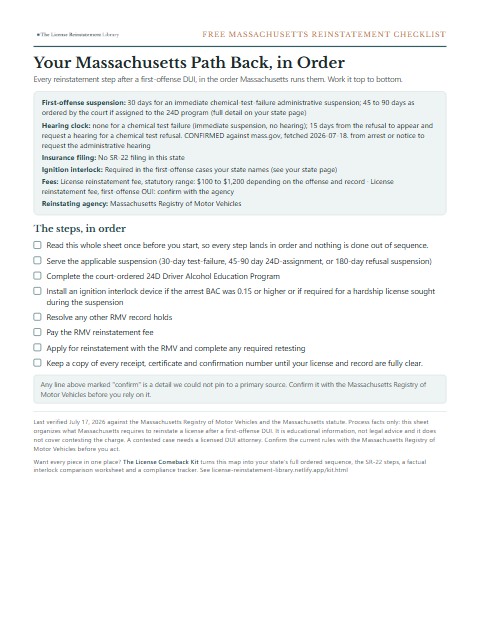
Massachusetts calls a first offense OUI (Operating Under the Influence). A chemical test failure carries an immediate 30-day administrative suspension. On conviction the default is a one-year revocation under MGL c.90 s.24(1)(c)(1), which is what the RMV's own suspension table publishes for a first OUI conviction. The 45 to 90 days people quote belongs to the 24D Driver Alcohol Education Program, an alternative disposition a first offender consents to as a probation condition rather than one that arrives automatically. Reinstatement requires completing the assigned suspension and program, paying the RMV reinstatement fee and, for a first offender seeking a hardship license, installing an ignition interlock where the arrest BAC was 0.15 or higher.
Massachusetts charges this offense as OUI, the same first-offense case most states call a DUI. Whichever term is on your paperwork, this page covers it.
Massachusetts sits between the two common structures: whether an administrative review applies depends on the case. The page below states which situations carry a deadline and lays the reinstatement steps out in the order the state runs them.
Whether an ignition interlock is required here depends on the case, commonly the test result or the license option chosen. There is no SR-22 filing in Massachusetts, which puts it among the handful of states that skip the form. The education or treatment step comes before reinstatement. Each piece has its own section below, with the official source beside it.
The parts Massachusetts drivers most often miss are the order of the steps, since several gate the ones after them. The sections below take them in order.

How long is your license suspended after a first DUI in Massachusetts?
The first-offense term and how the administrative and court tracks interact in Massachusetts.
| Item | Massachusetts rule |
|---|---|
| First-offense suspension | 1 year on a first OUI conviction, which is the default: MGL c.90 s.24(1)(c)(1) bars restoration until one year after the date of conviction and the RMV's suspension table publishes the same figure. 45 to 90 days as ordered by the court where the driver consents to assignment to the 24D program, which is an alternative disposition rather than an automatic one. 30 days for the immediate chemical-test-failure administrative suspension. 180 days for a chemical test refusal by a driver over 21 with no prior OUIs. |
| Administrative vs court | The RMV's chemical-test-failure and refusal suspensions are administrative and separate from the criminal case outcome. On the court side the default is the one-year conviction revocation under MGL c.90 s.24(1)(c)(1). For a first offense the court can instead assign the driver to the 24D alternative disposition, which s.24D frames as something the person consents to as a probation condition and the RMV then suspends for the 45 to 90 days in the court's notice rather than the year. |
| Worth knowing | A test refusal carries a longer suspension (180 days) than a test failure (30 days) for a first offense and only the refusal suspension carries a hearing right. The RMV counts prior OUI convictions and prior 24D assignments (including out-of-state) under a lifetime lookback when classifying an offense as first or subsequent. |
How many suspension clocks does a first Massachusetts OUI have?
Up to three, running from different triggers. There is the immediate administrative suspension the RMV imposes on the chemical test result, the suspension that follows the court's disposition and, for a driver who refused the test, a longer refusal suspension in place of the failure one. Knowing which applies to you is the difference between counting 30 days and counting a year.
- Chemical test failure: 30 days. Immediate and administrative, imposed by the RMV on the test result rather than by a court. No RMV hearing is available on this one.
- Chemical test refusal: 180 days for a driver over 21 with no prior OUIs, in place of the 30-day failure suspension. This one does carry a hearing right, exercised by appearing in person at the Boston (Haymarket) RMV Service Center within 15 days of the refusal.
- A first OUI conviction: one year. That is the standard conviction suspension Mass.gov lists for a first offense over 21, before any program assignment reduces it.
- A 24D assignment instead: 45 to 90 days as the court orders. This is the alternative disposition a first offender can consent to. It is why most first-offense Massachusetts suspensions end up counted in weeks rather than in a year.
The two administrative suspensions belong to the RMV and run separately from the criminal case outcome, which is why the paperwork the court hands you never tells the whole story about your dates. The clocks do not stack neatly on top of one another and your RMV record is the only place your actual dates live. Two Massachusetts-specific facts shape which clock you are on. The state uses a lifetime lookback, counting every prior OUI conviction plus every prior 24D assignment with no time cutoff, including out-of-state offenses with substantially similar elements, so an old case elsewhere can push a new arrest out of first-offense treatment. The 24D assignment is also not automatic: a first offender consents to it as a probation condition rather than receiving it by default.
The hearing clock: how long you have to act in Massachusetts
The deadline to request the administrative review of the license suspension. It runs from the arrest or notice date, not from the court date.
| Item | Massachusetts rule |
|---|---|
| Request window | none for a chemical test failure (immediate suspension, no hearing); 15 days from the refusal to appear and request a hearing for a chemical test refusal. |
| How it works | For a chemical test refusal, the driver must appear in person at the Boston (Haymarket) RMV Service Center within 15 days to request a hearing. The hearing's scope is limited to three issues: reasonable grounds for the arrest, whether the driver was placed under arrest and whether a refusal actually occurred. A chemical test failure carries no equivalent administrative hearing. |
The path back: the Massachusetts reinstatement steps in order
Several of these steps gate the ones after them, so the order matters as much as the list.
- Serve the applicable suspension (one-year conviction revocation, 45-90 day 24D assignment, 30-day test failure, or 180-day refusal suspension)
- Complete the court-ordered 24D Driver Alcohol Education Program
- Install an ignition interlock device where a hardship license is sought during the suspension and the arrest reading was 0.15 or higher
- Resolve any other RMV record holds
- Pay the RMV reinstatement fee
- Apply for reinstatement with the RMV and complete any required retesting
From the team behind this library
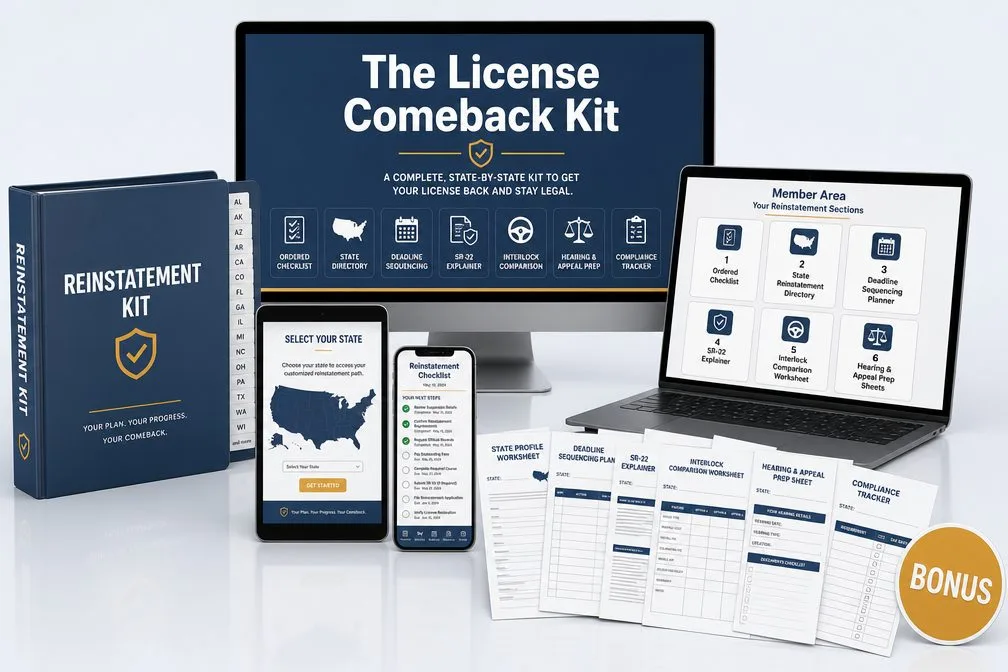
The License Comeback Kit
Want the whole path in one place? The kit turns everything on this page into one ordered walkthrough for Massachusetts: your state requirement sheet, the dependency-ordered checklist, the SR-22 steps with an insurer call script, a factual interlock comparison worksheet and the compliance and removal tracker. Set it up in an evening.
Ignition interlock rules in Massachusetts
Whether the device is required for a first offense, for how long and where the state lists its certified providers.
| Item | Massachusetts rule |
|---|---|
| Required for a first offense? | In some first-offense cases (see below) |
| First-offense duration | through the length of the hardship-license period only, for a first offender who has to install because the arrest reading was 0.15 or higher. The RMV's Ignition Interlock Device Program guide puts the 2-year minimum term, plus a further 2 years after full reinstatement, on drivers with two or more OUI convictions or program assignments; a first offender carries the device for as long as the hardship license runs, with no extra post-reinstatement term |
| BAC trigger | 0.15 and above at arrest, inside the hardship-license path. The 0.15 reading is a condition of that license rather than a standalone mandate: mass.gov states that certain first time OUI offenders seeking a hardship license, who took a breathalyzer at the time of arrest with results of .15 or greater, will be required to have an IID installed as a condition of that hardship license. A first offender who simply serves the suspension and reinstates in the ordinary way is not in the interlock program |
| Approved providers | Massachusetts RMV Ignition Interlock Device Program page (Mass.gov 'Ignition Interlock Device Program' guide), Driver Control Unit |
| Worth knowing | Read the hardship license as the governing condition and the 0.15 reading as a sub-condition inside it. The RMV's interlock program guide puts the standing requirement on drivers who have accumulated two or more OUI convictions, then adds the first-offender case as a hardship-license condition only. A first offender who serves the suspension and reinstates without asking for a hardship license does not install a device on the strength of the reading alone. Under Chapter 227 of the Acts of 2020, effective July 1, 2021, a first offender seeking a hardship license may also face the condition below 0.15. An indigency waiver program covers installation and monitoring costs for eligible applicants. |
Does Massachusetts require an SR-22?
The financial-responsibility filing your insurer makes with the state, where Massachusetts requires one.
| Item | Massachusetts rule |
|---|---|
| Required after a first DUI? | No |
| Worth knowing | Four separate Mass.gov pages were independently checked: the compulsory auto-insurance law page (mass.gov/info-details/massachusetts-law-about-auto-insurance, covering MGL c.90 sections 34A-34R, SDIP surcharges and the assigned risk pool for uninsurable drivers), the alcohol-and-drug-suspensions page, the Ignition Interlock Device Program guide and the first-offense 24D hardship-license criteria document. None of the four mentions an SR-22 or any equivalent special filing as an OUI or hardship-license condition, despite each covering insurance-adjacent or eligibility-condition detail in depth. Combined with Massachusetts running its own compulsory liability insurance system (not a financial-responsibility-filing system), this is treated as sufficient implicit confirmation per the verification brief. |
Driving before full reinstatement in Massachusetts
The limited license, if any, that lets a first offender drive during the suspension.
| Item | Massachusetts rule |
|---|---|
| Available for a first offense? | Yes |
| What Massachusetts calls it | Hardship license (12-hour, 7-day restricted license) |
| Waiting period | No separate minimum day-count wait is stated by the RMV. The published criteria require: documented 24D program enrollment, no operation of a vehicle since the suspension's effective date and completion of all other active suspension/revocation periods before applying. Approval is discretionary even when every criterion is met. |
| Worth knowing | Grant is discretionary, not automatic, even when all listed criteria are met. Requires an employer letter or equivalent third-party documentation and a showing that public transportation cannot adequately serve the documented need. Requires an ignition interlock if the arrest BAC was 0.15 or higher. |
How the Massachusetts hardship license actually works
Massachusetts grants one shape of hardship license, not several. The RMV's own first-offense criteria say it may only grant an identical 12-hour, 7-day license, so there is no separate work permit or school permit to apply for. A hearings officer sets which twelve hours of the day are yours then adds an hours restriction (the letter H) to your license record. Whatever the documented need is, the license that comes out the other side has the same shape.
Where the decision is made. Not at a service counter. A hardship license comes out of a license suspension hearing with the RMV's Driver Control Unit, held at select RMV hearing sites. You bring your documentation to that hearing. Hearings officers can ask for more information after reviewing what you brought, before deciding.
What the RMV's published criteria require. The RMV publishes the first-offense 24D criteria as its own document. The core conditions:
- No evidence of any operation of a motor vehicle since the effective date of the suspension or revocation.
- All other active suspension or revocation periods completed.
- Documented entry or enrollment, on program letterhead, verifying that you are enrolled in the court-ordered 24D program.
- On a second-chance 24D assignment, a prior OUI finding or conviction that is over 10 years from the most recent incident date.
The paperwork that carries the request. An employed driver brings an employer letter on letterhead, less than 30 days old, stating the need plus the work hours. A self-employed driver brings a business certificate, tax forms or a professional license, plus a personal letter. Education or medical need takes third-party documentation of the same kind. Public transportation is weighed too: where transit can adequately serve the documented need, the RMV can deny on that ground.
The interlock condition on a first offense. A first offender whose arrest reading registered at or above 0.15 installs an ignition interlock device and produces proof of installation plus the affidavits. The longer term people quote at first offenders belongs somewhere else: the RMV applies the length of the hardship plus an additional 2 years after full reinstatement to customers with 2 or more OUI convictions or assignments.
Approval is discretionary throughout. Meeting every published criterion does not oblige the RMV to grant the license, which is why the documentation is worth assembling properly the first time. Where a hardship license sits in the wider sequence is the next question. The Massachusetts reinstatement timeline lays that order out step by step.
The DUI program, the fees and the lookback
The DUI program. The 24D Driver Alcohol Education Program, now formally called the Massachusetts Impaired Driving Program (MID), is the first-offense alternative disposition: a court-ordered program the driver is assigned to as a probation condition, tied to the 45-to-90-day RMV suspension. Length: 38 total hours over 16 weeks: an intake session, 16 weekly 2-hour group psychoeducational sessions (32 hours), a mid-point review, a victim impact awareness session, community self-help meetings and a discharge session..
The lookback period. Lifetime (no time cutoff; the RMV counts every prior OUI conviction and every prior 24D program assignment on the record, including out-of-state offenses with substantially similar elements). This is the window over which a prior offense counts toward repeat-offense treatment.
The costs a Massachusetts driver can expect on the way back.
| Item | Cost |
|---|---|
| License reinstatement fee, statutory range | $100 to $1,200 depending on the offense and record |
| License reinstatement fee, first-offense OUI (commonly cited) | $500 (commonly cited by MA license-reinstatement attorneys; not independently confirmed as a single fixed OUI-specific figure on a Mass.gov fee schedule) |
Not published as one current figure. Confirm the exact amount with the Massachusetts Registry of Motor Vehicles before you pay.
Reinstating with the RMV: the fee plus the last steps
Massachusetts does not publish a single OUI reinstatement price, so treat any one figure you read with care. What the RMV does publish is the range: reinstatement fees are determined by Massachusetts General Laws, Chapter 90, Section 33 and run from $100.00 to $1,200.00. The $500 figure that circulates on law-firm pages is not stated as a fixed first-offense OUI amount on any Mass.gov fee schedule, which is why this library flags it rather than repeating it as fact. Your own number comes off your RMV record.
How the payment happens. Two routes. In person at an RMV Service Center with a completed application plus the applicable fees, or by paying the reinstatement fees online through the state portal.
The retest most people do not expect. An RMV hearings officer may determine, on review of an operator's record, that the operator has to take a learner's permit exam or a road test, for suspensions or revocations of less than 2 years. It is a decision made on your record rather than an automatic step, so it is worth asking about at the hearing instead of discovering it at the counter.
The fee is the last piece, never a shortcut past the others. The suspension term, the 24D program enrollment plus any interlock condition all come first, in that order. The RMV reinstates when the record shows them done.