New York DUI License Reinstatement (2026): Suspension, Steps and Fees
How do you get your license back after a first DUI in New York?
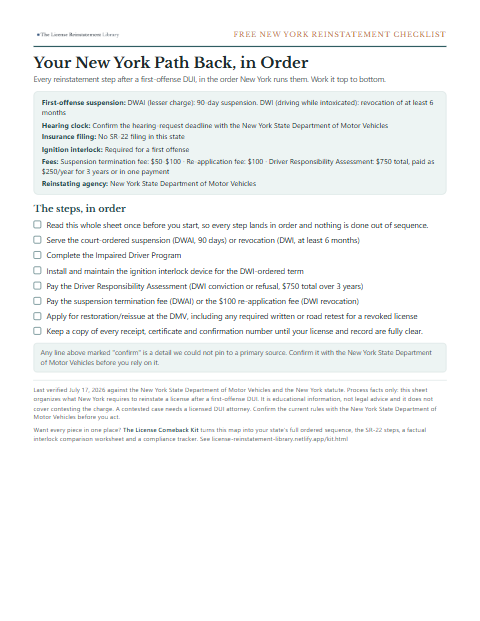
New York separates its alcohol-driving offenses into DWAI (driving while ability impaired, a lesser charge) and DWI (driving while intoxicated). A first DWAI conviction carries a 90-day license suspension, while a first DWI conviction carries at least a 6-month revocation. New York requires an ignition interlock device for a DWI conviction under Leandra's Law and does not require SR-22 insurance.
New York charges this offense as DWI, the same first-offense case most states call a DUI. Whichever term is on your paperwork, this page covers it.
New York sits between the two common structures: whether an administrative review applies depends on the case. The page below states which situations carry a deadline and lays the reinstatement steps out in the order the state runs them.
An ignition interlock is part of every first-offense path here. There is no SR-22 filing in New York, which puts it among the handful of states that skip the form. The education or treatment step comes before reinstatement. Each piece has its own section below, with the official source beside it.
The parts New York drivers most often miss are the order of the steps, since several gate the ones after them. The sections below take them in order.

How long is your license suspended after a first DUI in New York?
The first-offense term and how the administrative and court tracks interact in New York.
| Item | New York rule |
|---|---|
| First-offense suspension | DWAI (lesser charge): 90-day suspension. DWI (driving while intoxicated): revocation of at least 6 months. |
| Administrative vs court | The suspension/revocation is imposed by the court as part of DWI/DWAI sentencing, not through a separate administrative per-se DMV process comparable to other states. |
| Worth knowing | A DWAI results in a suspension (license returns automatically once the period ends and the termination fee is paid), while a DWI results in a revocation (requires a new license application and possibly retesting). |
The hearing clock: how long you have to act in New York
The deadline to request the administrative review of the license suspension. It runs from the arrest or notice date, not from the court date.
| Item | New York rule |
|---|---|
| How it works | New York's license consequence for a first-offense DWI/DWAI is primarily a function of the criminal court conviction and sentencing rather than a separate administrative per-se hearing process. A pre-conviction 'suspension pending prosecution' can apply at arraignment for a BAC of 0.08% or above; the request-window mechanics for contesting that specific pre-conviction suspension were not confirmed against a primary source. |
Confirm the request deadline and the receiving office with the New York State Department of Motor Vehicles; the window runs from the arrest or notice date.
The path back: the New York reinstatement steps in order
Several of these steps gate the ones after them, so the order matters as much as the list.
- Serve the court-ordered suspension (DWAI, 90 days) or revocation (DWI, at least 6 months)
- Complete the Impaired Driver Program
- Install and maintain the ignition interlock device for the DWI-ordered term
- Pay the Driver Responsibility Assessment (DWI conviction or refusal, $750 total over 3 years)
- Pay the suspension termination fee (DWAI) or the $100 re-application fee (DWI revocation)
- Apply for restoration/reissue at the DMV, including any required written or road retest for a revoked license
From the team behind this library
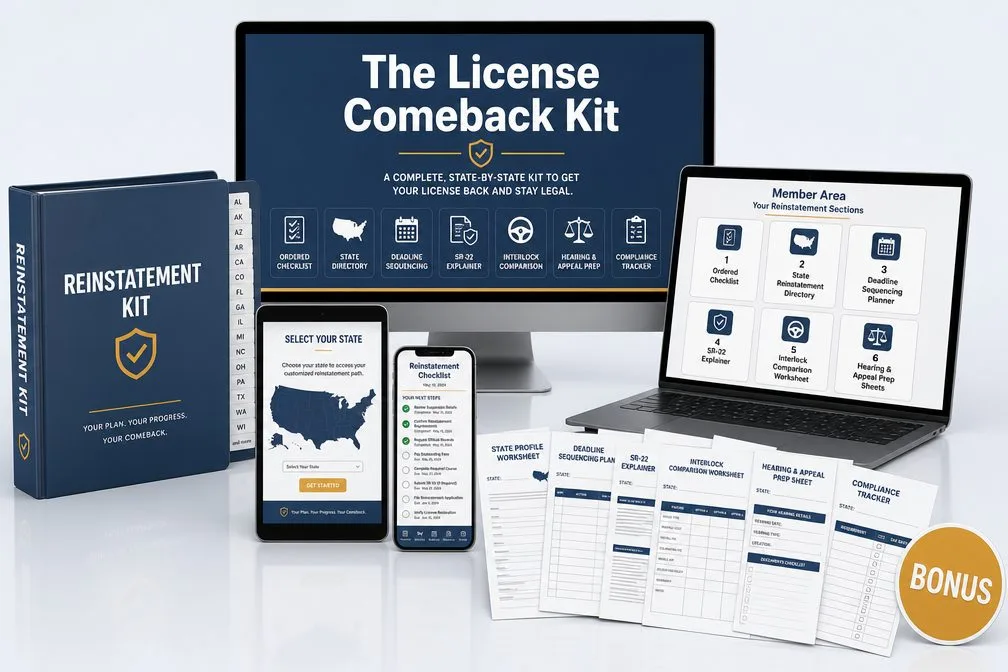
The License Comeback Kit
Want the whole path in one place? The kit turns everything on this page into one ordered walkthrough for New York: your state requirement sheet, the dependency-ordered checklist, the SR-22 steps with an insurer call script, a factual interlock comparison worksheet and the compliance and removal tracker. Set it up in an evening.
Ignition interlock rules in New York
Whether the device is required for a first offense, for how long and where the state lists its certified providers.
| Item | New York rule |
|---|---|
| Required for a first offense? | Yes, mandatory for a first offense |
| First-offense duration | 12 months as a court-ordered condition, though the restriction may end after proof of 6 months of installation and maintenance unless the court orders a longer period |
| BAC trigger | all DWI convictions (Leandra's Law applies interlock to DWI misdemeanor and felony convictions; DWAI, the lesser offense, does not carry the same mandatory interlock condition) |
| Approved providers | NY DMV / county STOP-DWI program approved ignition interlock provider information |
| Worth knowing | Leandra's Law (effective August 15, 2010) made ignition interlock monitoring a required part of sentencing for DWI convictions. The offender bears the installation and maintenance cost unless the court finds them financially unable to afford it. |
Does New York require an SR-22?
The financial-responsibility filing your insurer makes with the state, where New York requires one.
| Item | New York rule |
|---|---|
| Required after a first DUI? | No |
| Worth knowing | New York does not require SR-22 filings for a DWI or DWAI conviction. The DMV's own insurance-requirement pages describe only standard liability coverage rules, with no SR-22 or special high-risk certificate referenced. |
Driving before full reinstatement in New York
The limited license, if any, that lets a first offender drive during the suspension.
| Item | New York rule |
|---|---|
| Available for a first offense? | Yes |
| What New York calls it | Conditional license |
| Waiting period | Generally available about 20 to 30 days after sentencing |
| Worth knowing | Requires enrollment in the Impaired Driver Program and no prior DWI/DWAI conviction within the past 5 years. It allows driving for limited purposes such as work, school and medical appointments during the suspension or revocation period. |
The DUI program, the fees and the lookback
The DUI program. The Impaired Driver Program (formerly the Drinking Driver Program) is New York's required alcohol/drug education program for DWI and DWAI offenders. Completing it can end an active suspension or revocation early and is a prerequisite for a conditional license. Length: commonly cited as 7 weekly sessions of 2-3 hours each, totaling about 16 hours, per secondary legal-directory sources; not independently confirmed against a primary DMV program page.
The lookback period. Unverifiable exact statutory window; conditional-license eligibility specifically requires no prior DWI/DWAI conviction within the past 5 years. This is the window over which a prior offense counts toward repeat-offense treatment.
The costs a New York driver can expect on the way back.
| Item | Cost |
|---|---|
| Suspension termination fee (DWAI) | $50-$100 |
| Re-application fee (DWI revocation) | $100 |
| Driver Responsibility Assessment (DWI conviction or refusal) | $750 total, paid as $250/year for 3 years or in one payment |
| Impaired Driver Program tuition | varies by provider, exact figure unverifiable |
Not published as one current figure. Confirm the exact amount with the New York State Department of Motor Vehicles before you pay. Confirm the exact program length and the providers the New York State Department of Motor Vehicles accepts before you enroll.