Hardship and Restricted Licenses After a DUI (2026): Driving Before Full Reinstatement
Forty-four of 51 jurisdictions let a first offender drive before full reinstatement. The name and the wait change at every state line.
Losing a license does not usually mean months with no legal way to drive. Forty-four of the 51 US jurisdictions offer a first offender some form of limited license during the suspension: to work, to school, to treatment, sometimes to childcare and medical appointments. The names, the waiting periods and the conditions change at every state line, which is why this piece of the process confuses more drivers than any other.
One idea, a dozen names
Every state names it differently. Texas issues an occupational license, Indiana grants specialized driving privileges, Iowa and South Dakota a temporary restricted license, Minnesota a limited license, South Carolina a Temporary Alcohol License and states like California, Colorado and Utah an interlock-restricted license. Whatever the label, the shape is the same: a license limited by purpose, by hours or by the vehicle's equipment, issued before full reinstatement.
The waiting period, from zero days up
The strongest national trend in this corner of the law is the disappearance of the hard wait. Colorado, Iowa, Nevada and Nebraska put a first offender back on the road immediately or nearly immediately once an ignition interlock is installed. Where fixed waits survive they are commonly measured in weeks: 30 days in Indiana, 90 days on Arizona's court track. A few states hold out at the other end. New Jersey and Vermont run no traditional hardship license at all; in both, the interlock-restricted path is the only route to driving before the term ends.
The usual conditions
- An ignition interlock, in a growing majority of states, either as the express condition of the restricted license or because installing one is what ends the no-driving period.
- The SR-22 or FR-44 filing, where the state uses one, filed before the restricted license issues.
- Proof of the qualifying purpose, such as an employer letter, an enrollment record or treatment schedule, in the states that limit driving by destination.
- Program enrollment, where the state gates the restricted license on starting the DUI education or treatment course.
- Fees, for the restricted license itself and again at full reinstatement.
The application usually runs through the same licensing agency that will later reinstate the full license, though a few states route it through the court. Your state page names the office, the wait and the conditions for your state.
Line up the pieces once
From the team behind this library
The License Comeback Kit
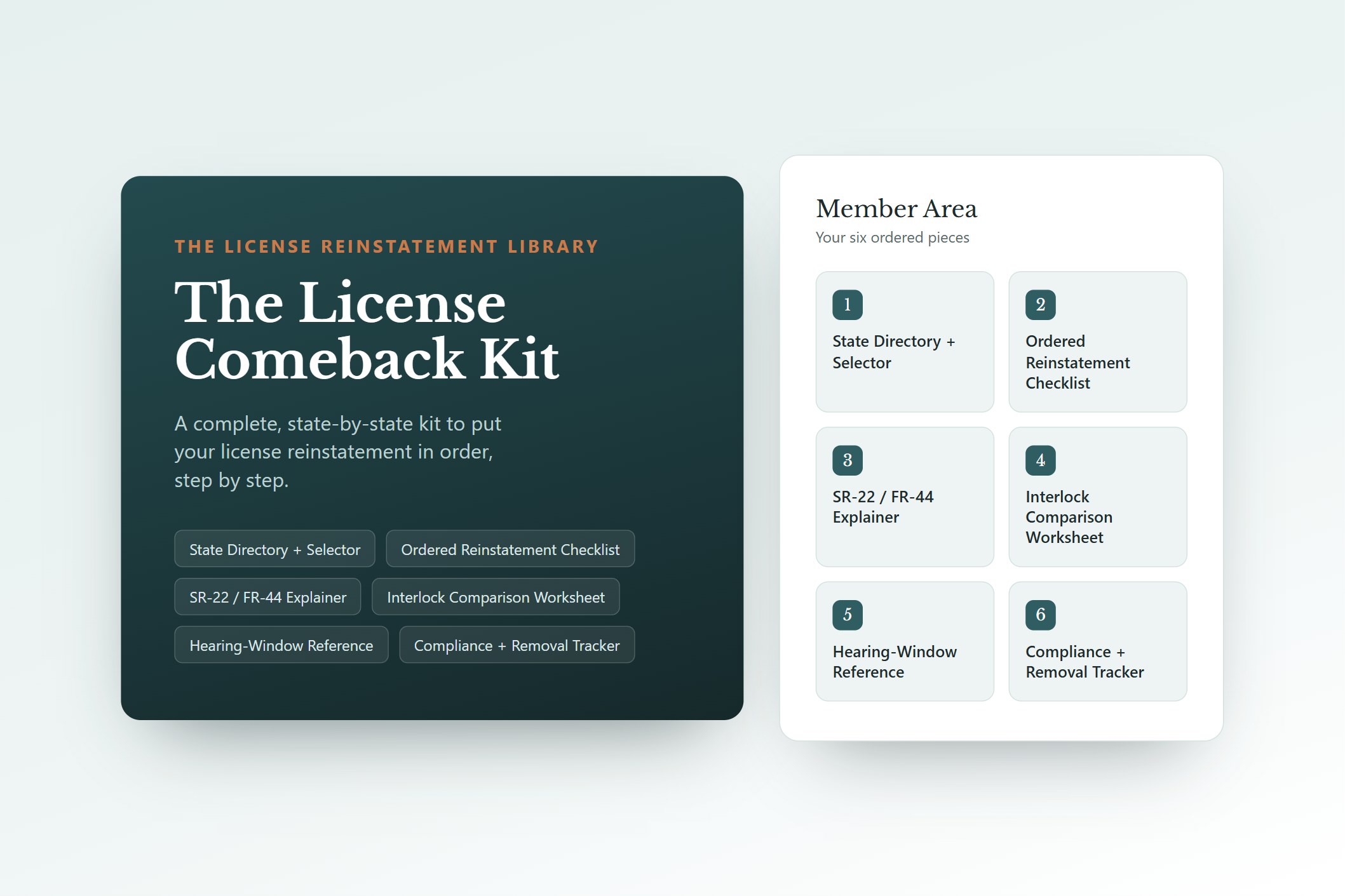
Want the whole path in one place? The License Comeback Kit hands you the done pieces for your state: the 50-state reinstatement directory and selector, the dependency-ordered checklist, the SR-22 and FR-44 explainer with an insurer call script, a factual interlock comparison worksheet and the compliance and removal tracker.
This guide is educational information, not legal advice. Eligibility depends on the case and some states exclude refusals or high test results. Confirm the current rules with your state before you apply.
Hardship license FAQ
Can you drive to work after a DUI suspension?
In most states, yes, on a hardship, restricted or occupational license limited to purposes like work, school and treatment. Forty-four of the 51 US jurisdictions offer some version for first offenders. Conditions commonly include an ignition interlock, an SR-22 filing and a waiting period served first.
How soon can you get a hardship license after a first DUI?
It ranges from immediately to several months, set by state law. States like Colorado, Iowa, Nevada and Nebraska allow restricted driving immediately or almost immediately once an ignition interlock is installed. Others set fixed waits, such as 30 days in Indiana or 90 days on Arizona's court track. Your state page shows the wait that applies.
What is a hardship license called in my state?
The names vary widely: occupational license (Texas), specialized driving privileges (Indiana), temporary restricted license (Iowa and South Dakota), limited license (Minnesota), restricted or IID-restricted license (California, Colorado, Utah) and Temporary Alcohol License (South Carolina). Different names, the same idea: limited legal driving before full reinstatement.
How much does a hardship license cost?
The state charges a fee for the restricted license itself, then again for full reinstatement later. Where an interlock is a condition, the device is the larger cost. The application fee is commonly modest (California, for example, runs a $55 reissue fee plus a $15 restriction fee), but the figure changes at every state line. Your state page carries the confirmed fee for your state, or flags it to confirm with the agency where the state does not publish one figure.
Does a hardship license expire or have a time limit?
A hardship or restricted license is an interim credential, so it lasts for the restricted-driving period the state sets and ends when you either fully reinstate or the term lapses. Some states issue it for the length of the suspension, others for a fixed interval that renews. Confirm the validity period and any renewal step for your state with the licensing agency on your state page.
Can you drive other people on a hardship license?
A hardship license limits driving by purpose (work, school, treatment, sometimes childcare or medical trips), not usually by who is in the car, so carrying passengers within those permitted purposes is generally allowed. Driving for pay, such as rideshare, is a separate question that depends on the state and the license class. Because the conditions vary, confirm the exact restrictions for your state before you rely on them.
Can you get a hardship license at 14 or 15?
That question is almost always about a different program. A hardship or minor-restricted license at 14 or 15 is a teen learner-driver provision in states that allow early licensing for school or family need, not the DUI hardship license this guide covers. The DUI restricted license is for a licensed adult driving through a suspension. If you are looking for the teen program, check your state driver-licensing office rather than this reinstatement reference.