Ignition Interlock After a DUI (2026): Who Needs One, for How Long and What It Costs
Twenty jurisdictions require it for every first offense. In many others it is the key that unlocks driving during the suspension.
An ignition interlock device (IID) is a breath tester wired to your vehicle's ignition: the engine starts only after an alcohol-free breath sample and the device asks for rolling retests while you drive. After a DUI, states use it two ways. Some require it before full reinstatement. Many more offer it as the key that unlocks driving during the suspension, turning a hard no-driving period into a restricted-but-driving one.
Who has to install one
Twenty jurisdictions require an interlock for a standard first offense, whatever the test result: Alaska, Arkansas, Arizona, Colorado, Connecticut, District of Columbia, Delaware, Hawaii, Idaho, Kansas, Kentucky, Nebraska, New Jersey, New Mexico, New York, Oregon, South Carolina, Utah, Virginia, Washington. Iowa sits functionally beside them, because a 2024 law made the device a condition of any first-offense temporary restricted license.
Most of the remaining states draw a line by case. The common triggers are a BAC at or above a threshold (0.15 in Texas and Massachusetts, 0.17 in Michigan), a chemical-test refusal, a court's discretion or the driver's own election of the device to drive sooner. At the light end, Missouri and Minnesota require no device for a standard single first offense. Your state page states which trigger applies and for how long the device stays on.
What it costs
The interlock is the largest cost in most reinstatements. All-in, with installation, monthly calibration and fees, plan on roughly $80 to $135 a month, which comes to roughly $970 to $1,640 across a 12-month term. Set beside a state reinstatement fee of $40 to $680, the device is where the money goes. Two facts soften it. Most states run ability-to-pay provisions that reduce the cost for qualifying drivers (California writes the requirement into its regulations) and vendors compete, so the quoted price varies by provider for the same state term.
Living with the device
The device needs a calibration appointment on a set cycle, commonly every 30 to 60 days, at the vendor's service location. The device logs every test and the state or the vendor reviews the record. A missed calibration or a failed test can extend the term in many states, so the compliance record is what carries a driver to the removal date. Removal itself is a dated, paperwork-bound step: the state confirms the term is served and the record is clean, then authorizes the vendor to take the device out.
The interlock as the way back, not the punishment
The clear national trend is interlock-conditioned driving replacing hard waiting periods. Colorado, Iowa, Nevada and Nebraska put a first offender back on the road immediately or nearly immediately once the device is in. South Carolina went further in 2024: entering the interlock program ends the suspension itself. For a driver whose job depends on the car, the device is often the difference between months without driving and weeks.
Choose the vendor on facts
From the team behind this library
The License Comeback Kit
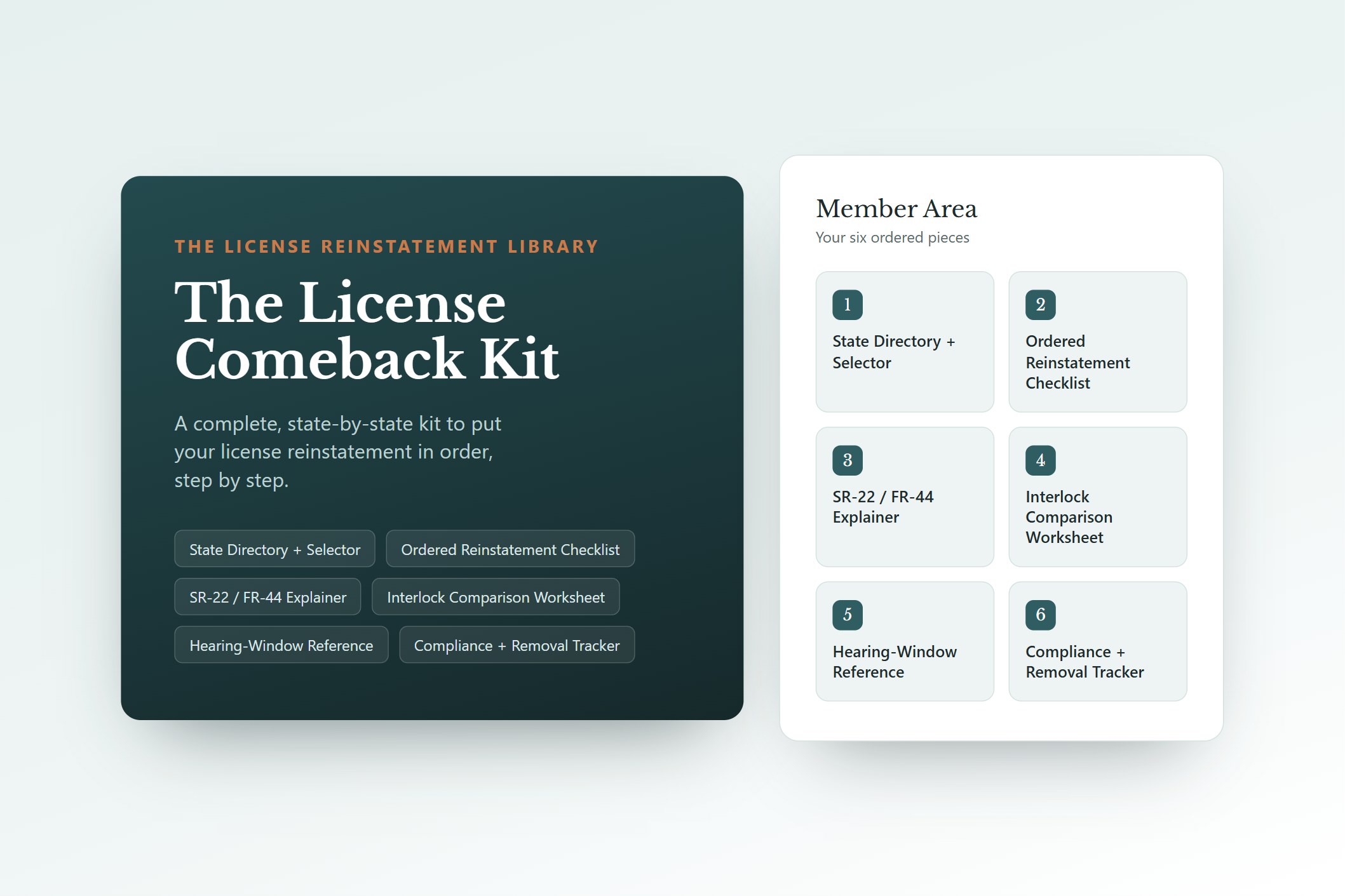
Want the whole path in one place? The License Comeback Kit hands you the done pieces for your state: the 50-state reinstatement directory and selector, the dependency-ordered checklist, the SR-22 and FR-44 explainer with an insurer call script, a factual interlock comparison worksheet and the compliance and removal tracker.
This guide is educational information, not legal advice. Costs are typical ranges, not quotes. Interlock rules and certified-provider lists change; confirm the current requirements with your state before you commit to a vendor.
Ignition interlock FAQ
Is an ignition interlock required after a first DUI?
In 20 jurisdictions, yes, for a standard first offense. In many others it is required only above a BAC threshold (0.15 in Texas and Massachusetts, 0.17 in Michigan), on a test refusal or as the condition of driving early on a restricted license. A few states, including Missouri and Minnesota, do not require one for a standard single first offense.
How much does an ignition interlock device cost?
Plan on roughly $80 to $135 a month all-in once installation, monthly calibration and fees are counted, which comes to roughly $970 to $1,640 over a 12-month term. The device cost dwarfs the state reinstatement fee in nearly every state. Many states run ability-to-pay programs that reduce the cost for qualifying drivers.
Who installs the interlock and which providers can you use?
State-certified vendors install and service the devices. Each state publishes its own approved-provider list through the licensing agency or its interlock program page, so the choice is between the certified vendors serving your area. Your state page links where that list lives.
What happens if you violate ignition interlock terms?
A failed breath test, a missed calibration appointment or a skipped rolling retest is logged and reported to the state or the program. Common consequences are a temporary lockout of the vehicle, a reset of the compliance clock and an extension of the interlock term. A serious or repeated violation can send the case back to the court. The exact consequence is set by each state's interlock program, so confirm it with the agency that runs yours.
Does an ignition interlock detect weed or other drugs?
No. An ignition interlock is a breath-alcohol tester only. It measures alcohol on the breath and does not detect THC, other drugs or anything besides alcohol. Impairment by drugs is handled through the case and any testing a court orders, not through the interlock device.
Can you drink one beer with an ignition interlock installed?
The device is set to a low alcohol threshold, commonly around 0.02, well below the 0.08 driving limit. Any measurable alcohol above that low set point registers as a failed test and stops the engine from starting, so a single drink can trigger a fail. Mouthwash, some foods and other alcohol sources can also read positive, which is why the device asks for rolling retests.
Does an ignition interlock have GPS or a camera?
Many current devices include a camera that photographs whoever gives the breath sample, to confirm it is the driver. GPS is less universal and depends on the state program and the vendor's model. What the device always records is the date, time and result of every test. Your state's interlock program page describes what its approved devices log.
Does an ignition interlock drain your car battery or void the warranty?
A properly installed device draws little power, though a car that sits unused for long stretches can see the small draw add up, so vendors advise driving or charging regularly. Professional installation by a certified vendor is designed to work with the vehicle's wiring and does not by itself void a manufacturer warranty, but confirm any specific concern with the vendor and your dealer before installation.
Can an ignition interlock be installed on an older car?
Usually, yes. The device wires into a standard ignition system, so most older gasoline vehicles can take one. Push-button start, some hybrids and certain electrical setups can complicate the install, which is a question for the certified vendor. The requirement follows the driver, so a state will work with you where a specific vehicle cannot take the device.