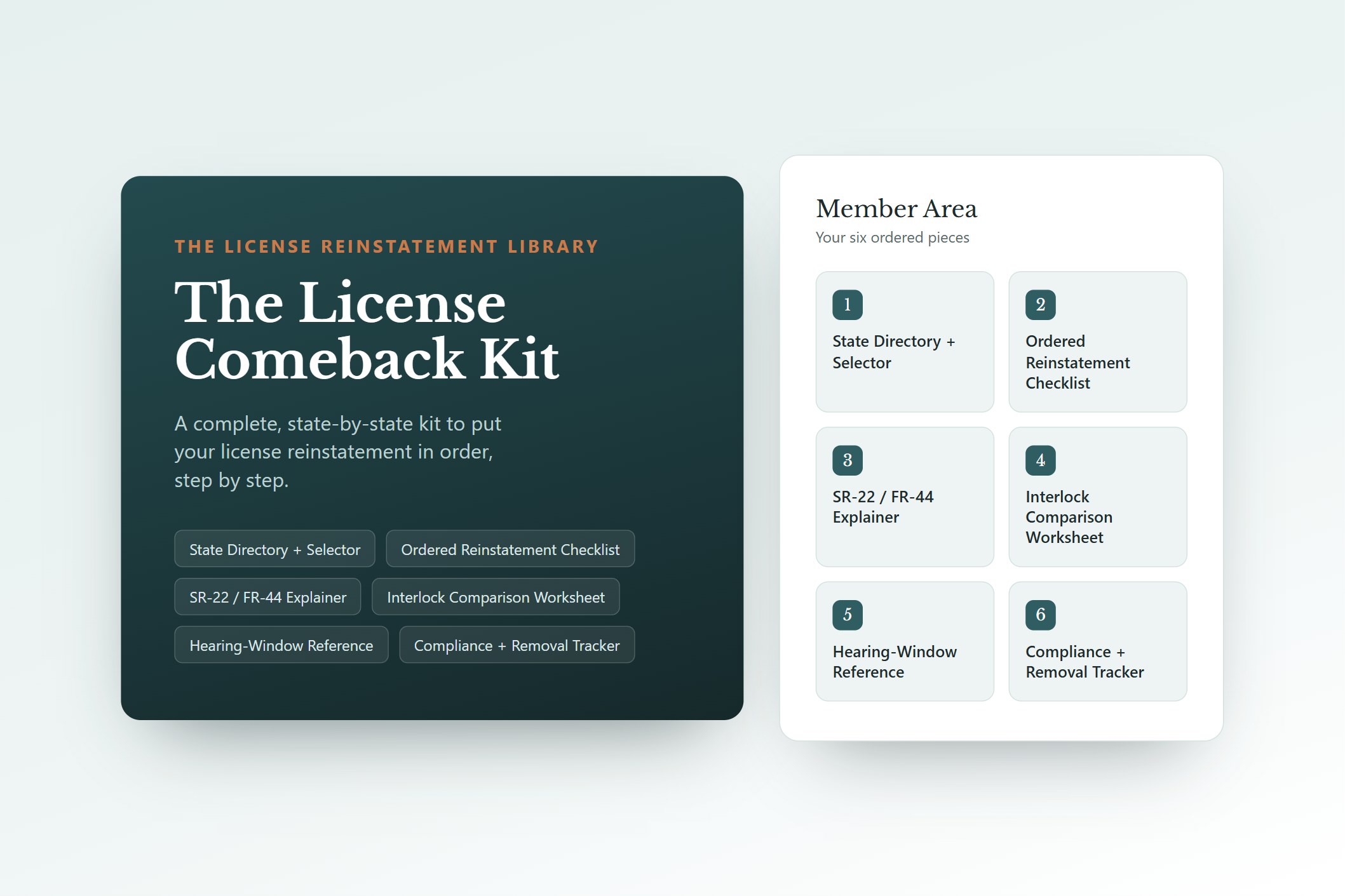
The First-Offense DUI Reinstatement Timeline, State by State
An independent reference tool. It organizes what each state requires to reinstate a first-offense DUI license. It is educational information, not legal advice, it does not come from a state agency and it does not cover contesting the charge.
How do you get your license back after a first DUI?
After a first-offense DUI, most states run two license tracks at once. The licensing agency starts an administrative suspension from the arrest, with a short dated window to request a review hearing. The court can add its own suspension on conviction. First-offense suspensions commonly run from about 90 days to a year.
The path back is built from the same pieces almost everywhere: serve the suspension or move to a restricted license, complete a DUI education or treatment program, file an SR-22 or FR-44 insurance certificate where the state uses one, install an ignition interlock where it is required and pay the reinstatement fee. What changes at the state line is which pieces apply, in what order and for how long. Pick your state below to see all of it on one screen, each figure read from that state's own statute and licensing agency.
The two clocks run separately. Resolving one does not end the other.
Build your state's path
The test and BAC choices surface your state's own text for that path. They never change a figure the state did not publish separately, because the underlying rules are written that way.
Pick your state above to see the suspension, the interlock rule, the SR-22 or FR-44 filing, the known state fees and the earliest restricted-license path, in order.
What Alabama requires to get a first-offense DUI license back
These figures are for a first offense. Repeat offenses run longer and add conditions, so confirm those with the Alabama Law Enforcement Agency.
A first-offense Alabama DUI carries a 90-day license suspension when the driving record shows no prior alcohol or drug-related contact in the preceding 10 years.
| What Alabama requires | The rule |
|---|---|
| Suspension length | 90 days administrative per-se suspension (no prior alcohol/drug-related enforcement contact in the preceding 10 years, per Ala. Code 32-5A-304 as amended by Act 2018-546); entirely stayed if the driver installs an ignition interlock device |
| Ignition interlock | In some first-offense cases (see below)Term: 90 days if elected below 0.15 BAC; 1 year if mandatory at 0.15 BAC or above. Trigger: 0.15 and above triggers mandatory installation; below 0.15 installation is elective (drivers may elect it to stay the entire suspension). |
| SR-22 or FR-44 | Required. Form: SR-22. In force: 3 years. |
| Earliest restricted-license path | Available in some cases. Alabama calls it the Ignition interlock restricted driver license. Earliest: none, immediate upon proof of interlock installation. |
On a refusal. Alabama's published text notes that a refusal can change some of these figures. It does not state a separate refusal number for every field here, so confirm the exact terms on the full Alabama page or with the Alabama Law Enforcement Agency.
For a high-BAC case. At a BAC of 0.15 or higher, Alabama applies a different interlock or suspension rule than a standard first offense. The interlock row above shows the trigger. The full Alabama page carries the exact terms.
Known state fees. At least $275 in confirmed Alabama state fees, the core reinstatement fee. This is a floor, not a total: your track can add more of the lines below and several vary or were not published as one figure.
| Fee | Amount |
|---|---|
| Reinstatement fee, alcohol/drug-related suspension or revocation | $275 |
| Additional drug-related suspension fee | $25 |
| Ignition interlock restricted driver license issuance fee | $150 |
The hearing clock
You have 10 days from the arrest or notice to request the administrative review hearing. It runs from that date, not the court date.
The steps back, in order
- Serve the 90-day suspension period, or stay it immediately by installing an ignition interlock device
- Complete the Court Referral Program (alcohol/drug evaluation and education)
- Obtain an SR-22 certificate of insurance
- Pay the ALEA reinstatement fee ($275, plus $25 if drug-related)
- Pay the ignition interlock restricted license fee ($150) if using that option
- Submit the reinstatement application to ALEA online (alabamadl.alea.gov) or in person
The DUI program
Court Referral Program: an alcohol and substance abuse evaluation followed by an education or treatment track, administered through the sentencing court. Most first offenders complete a basic education course; higher-BAC or repeat cases can be referred to more intensive treatment based on the evaluation.
The lookback period
10 years, both for the administrative per-se suspension schedule (Ala. Code 32-5A-304) and for court-based first-offense versus repeat-offense DUI conviction classification, since Act 2018-546 extended the window from 5 to 10 years effective July 1, 2018. A separate implied-consent refusal suspension (32-5-192) uses its own 5-year lookback for counting prior refusals. This is the window over which a prior offense counts toward repeat treatment.
This tool organizes and explains the Alabama reinstatement process in plain language. It is educational information, not legal advice and it does not cover contesting the charge. A contested case needs a licensed DUI attorney. It does not come from a state agency. Alabama rules can change and courts keep discretion in individual cases. Confirm the current requirements with the Alabama Law Enforcement Agency before you act.
What Alaska requires to get a first-offense DUI license back
These figures are for a first offense. Repeat offenses run longer and add conditions, so confirm those with the Alaska Division of Motor Vehicles.
A first-offense DUI in Alaska carries a 90-day license revocation, with a possible limited license for the final 60 days if the driver installs an ignition interlock device.
| What Alaska requires | The rule |
|---|---|
| Suspension length | 90 days revocation |
| Ignition interlock | Yes, mandatory for a first offenseTerm: 6 months below 0.15 BAC; 1 year at 0.15 BAC or above. Trigger: 0.15 and above triggers the longer first-offense term. |
| SR-22 or FR-44 | Required. Form: SR-22. In force: 5 years from the ending date of the revocation, on a first offense (10 years on a second offense). |
| Earliest restricted-license path | Available in some cases. Alaska calls it the Limited license. Earliest: 30 days into the 90-day revocation, first offense. |
On a refusal. Alaska's published text notes that a refusal can change some of these figures. It does not state a separate refusal number for every field here, so confirm the exact terms on the full Alaska page or with the Alaska Division of Motor Vehicles.
For a high-BAC case. At a BAC of 0.15 or higher, Alaska applies a different interlock or suspension rule than a standard first offense. The interlock row above shows the trigger. The full Alaska page carries the exact terms.
Known state fees. At least $200 in confirmed Alaska state fees, the core reinstatement fee. This is a floor, not a total: your track can add more of the lines below and several vary or were not published as one figure.
| Fee | Amount |
|---|---|
| Reinstatement fee, one DUI/refusal | $200 |
| Reinstatement fee, one DUI/refusal plus any other administrative action | $250 |
| Reinstatement fee, two DUIs and refusal plus any administrative action | $500 |
The hearing clock
You have 7 days from the arrest or notice to request the administrative review hearing. It runs from that date, not the court date.
The steps back, in order
- Serve the 90-day revocation, or become eligible for a limited license after 30 days with an interlock installed
- Complete ASAP screening and any assigned alcohol education or treatment
- Install a court-ordered ignition interlock device
- File SR-22 proof of insurance dated within 30 days
- Pass the written and vision tests (road test if required)
- Pay the DMV reinstatement fee and submit the application
The DUI program
Alcohol Safety Action Program (ASAP) screening, which designs and recommends the applicable education or treatment track. A certificate of completion is required for reinstatement.
The lookback period
15 years (Alaska Statutes § 28.35.030) for counting prior DUI or refusal convictions toward sentencing; a separate 10-year window governs when two or more priors elevate a new offense to a felony. This is the window over which a prior offense counts toward repeat treatment.
This tool organizes and explains the Alaska reinstatement process in plain language. It is educational information, not legal advice and it does not cover contesting the charge. A contested case needs a licensed DUI attorney. It does not come from a state agency. Alaska rules can change and courts keep discretion in individual cases. Confirm the current requirements with the Alaska Division of Motor Vehicles before you act.
What Arizona requires to get a first-offense DUI license back
These figures are for a first offense. Repeat offenses run longer and add conditions, so confirm those with the Arizona Department of Transportation, Motor Vehicle Division.
Arizona's administrative per-se suspension for a first-offense DUI runs 90 days, reducible to 30 days of full suspension followed by 60 days of restricted driving if the driver has no prior conviction in the preceding 84 months and completes an alcohol or drug screening.
| What Arizona requires | The rule |
|---|---|
| Suspension length | 90 days administrative per-se suspension, reducible to 30 days full suspension plus 60 days restricted driving with no prior conviction in 84 months and completed alcohol/drug screening |
| Ignition interlock | Yes, mandatory for a first offenseTerm: 12 months typical for a standard first-offense DUI involving alcohol. Trigger: all alcohol-related DUI convictions (regular, extreme and super-extreme tiers all trigger installation; higher BAC tiers can extend the required term). |
| SR-22 or FR-44 | Required. Form: SR-22. In force: 3 years. |
| Earliest restricted-license path | Available for a first offense. Arizona calls it the Special Ignition Interlock Restricted Driver License (SIIRDL). Earliest: 30 days into the administrative suspension under the reduced-suspension path (A.R.S. 28-1385(I), confirmed); 90 days into a standard first-offense court-ordered suspension/revocation under A.R.S. 28-1381 (confirmed via 28-1381 and 28-1401 statute text). |
On a refusal. Arizona's published text notes that a refusal can change some of these figures. It does not state a separate refusal number for every field here, so confirm the exact terms on the full Arizona page or with the Arizona Department of Transportation, Motor Vehicle Division.
For a high-BAC case. Arizona treats a high-BAC or aggravated case differently from a standard first offense. Confirm the exact terms on the full Arizona page or with the Arizona Department of Transportation, Motor Vehicle Division.
Known state fees. The Arizona Department of Transportation, Motor Vehicle Division does not publish one combined dollar figure. The lines below are what could be confirmed. Confirm your exact total with the Arizona Department of Transportation, Motor Vehicle Division.
| Fee | Amount |
|---|---|
| MVD reinstatement/reissue application fee (age-tiered) | $10 (age 50+) to $25 (age 39 and younger) |
| Admin Per Se / Implied Consent suspension fee | commonly cited around $50, not confirmed against an MVD-hosted fee schedule |
The hearing clock
You have 30 days from the arrest or notice to request the administrative review hearing. It runs from that date, not the court date.
The steps back, in order
- Serve the 90-day suspension, or the reduced 30-day suspension plus 60-day restricted period if eligible
- Complete court-ordered alcohol/drug screening and any assigned education, psychotherapy or treatment
- Complete DUI/Traffic Survival School
- Install a certified ignition interlock device on every vehicle operated
- File an SR-22 certificate and maintain it for 3 years
- Pay court fines and the MVD reinstatement/reissue application fee
- Submit the reinstatement application to MVD online (AZMVDNow.gov) or at an MVD/Third Party office
The DUI program
Court-ordered alcohol or other drug screening, education, evidence-based psychotherapy or treatment program, plus completion of an approved DUI/Traffic Survival School course.
The lookback period
36 months (A.R.S. 28-1381) for court sentencing enhancement; a separate 84-month (7-year) look-back applies to administrative suspension-reduction eligibility (A.R.S. 28-1385) and to aggravated DUI felony classification (A.R.S. 28-1383). This is the window over which a prior offense counts toward repeat treatment.
This tool organizes and explains the Arizona reinstatement process in plain language. It is educational information, not legal advice and it does not cover contesting the charge. A contested case needs a licensed DUI attorney. It does not come from a state agency. Arizona rules can change and courts keep discretion in individual cases. Confirm the current requirements with the Arizona Department of Transportation, Motor Vehicle Division before you act.
What Arkansas requires to get a first-offense DUI license back
These figures are for a first offense. Repeat offenses run longer and add conditions, so confirm those with the Arkansas Department of Finance and Administration.
A first-offense DWI in Arkansas carries a 6-month license suspension under Ark.
| What Arkansas requires | The rule |
|---|---|
| Suspension length | 6 months (180 days) |
| Ignition interlock | Yes, mandatory for a first offenseTerm: 6 months, equal to the suspension length. Trigger: all convictions (the interlock requirement is tied to the DWI/BWI conviction itself, not stated as BAC-tiered for a first offense). |
| SR-22 or FR-44 | Not settled in the official sources. Form: SR-22. In force: unverifiable, no confirmed statutory duration. |
| Earliest restricted-license path | Available for a first offense. Arkansas calls it the Ignition interlock-restricted license. Earliest: none, available immediately for a first offense if testing was not refused. |
On a refusal. Arkansas's published text notes that a refusal can change some of these figures. It does not state a separate refusal number for every field here, so confirm the exact terms on the full Arkansas page or with the Arkansas Department of Finance and Administration.
Not settled in one published place. Confirm the filing requirement and how long it must stay in force with the Arkansas Department of Finance and Administration and your insurer before you rely on it.
Known state fees. At least $150 in confirmed Arkansas state fees, the core reinstatement fee. This is a floor, not a total: your track can add more of the lines below and several vary or were not published as one figure.
| Fee | Amount |
|---|---|
| Driver's license reinstatement fee | $150 |
The hearing clock
You have 7 days from the arrest or notice to request the administrative review hearing. It runs from that date, not the court date.
The steps back, in order
- Serve the 6-month suspension, or use the immediately available interlock-restricted license if testing was not refused
- Install and maintain the ignition interlock device for the suspension length
- Complete the Drug and Alcohol Education or treatment program and obtain the completion certificate
- Attend the Victim Impact Panel class and obtain the completion certificate
- File SR-22 proof of insurance if required for the individual case (unconfirmed as a standing requirement for a standard first-offense DWI)
- Pay the $150 reinstatement fee
- Submit all original certificates and payment to Driver Control (in person, by mail, or online at mydmv.arkansas.gov)
The DUI program
A state-sanctioned Drug and Alcohol Education or treatment program, plus a separate Victim Impact Panel class. Both require submission of an original signed completion certificate to Driver Control.
Confirm the exact program length and the providers the Arkansas Department of Finance and Administration accepts before you enroll.
The lookback period
10 years (changed from 5 years by a 2021 law change; extends to 20 years for a sixth offense). This is the window over which a prior offense counts toward repeat treatment.
A small number of details on this page could not be confirmed against a primary source. They are noted where they appear above. Confirm those with the Arkansas Department of Finance and Administration before you rely on them.
This tool organizes and explains the Arkansas reinstatement process in plain language. It is educational information, not legal advice and it does not cover contesting the charge. A contested case needs a licensed DUI attorney. It does not come from a state agency. Arkansas rules can change and courts keep discretion in individual cases. Confirm the current requirements with the Arkansas Department of Finance and Administration before you act.
What California requires to get a first-offense DUI license back
These figures are for a first offense. Repeat offenses run longer and add conditions, so confirm those with the California Department of Motor Vehicles.
California's DMV imposes a 4-month Administrative Per Se (APS) suspension on a first-offense DUI with a 0.08 or higher chemical test, separate from any court suspension on conviction.
| What California requires | The rule |
|---|---|
| Suspension length | 4-month Administrative Per Se (APS) suspension for a 0.08+ chemical test or refusal |
| Ignition interlock | Not automatic; by court order or the driver's own electionTerm: 4 months if elected immediately in lieu of the APS arrest-based suspension (runs concurrent with what would have been the suspension term); 12 months for the alternative employment/DUI-program restriction if chosen instead and the court did not order an IID after conviction; if the court orders the IID as a sentencing term after conviction, the restriction runs until all reinstatement requirements are met, with the court setting the specific term. Trigger: available as an option at any first-offense BAC level; not mandatory for a standard first offense unless the court orders it or the driver chooses it in place of the hard suspension. |
| SR-22 or FR-44 | Required. Form: SR-22. In force: 3 years, required to fully reinstate with no restrictions. |
| Earliest restricted-license path | Available for a first offense. California calls it the Restricted license (via IID) or work/DUI-program restriction. Earliest: APS arrest-based track: none for the IID option (immediate), or 30 days into the 4-month suspension for the employment/DUI-program restriction option (up to 5 months). Conviction-based track: the employment/DUI-program restriction runs 12 months; the IID restricted-license option is available once the court order or driver's election is in place.. |
On a refusal. California's published text notes that a refusal can change some of these figures. It does not state a separate refusal number for every field here, so confirm the exact terms on the full California page or with the California Department of Motor Vehicles.
For a high-BAC case. At a BAC of 0.20 or higher, California applies a different interlock or suspension rule than a standard first offense. The interlock row above shows the trigger. The full California page carries the exact terms.
Known state fees. At least $125 in confirmed California state fees, the core reinstatement fee. This is a floor, not a total: your track can add more of the lines below and several vary or were not published as one figure.
| Fee | Amount |
|---|---|
| DMV reissue fee (full reinstatement after serving the suspension in full) | $125 |
| APS fee (arrest-track restricted license, either the IID or the employment/DUI-program option) | $125 |
| Reissue fee plus restriction fee (conviction-track restricted license) | $55 reissue fee plus $15 restriction fee (plus an added IID restriction fee for the IID option) |
The hearing clock
You have 10 days from the arrest or notice to request the administrative review hearing. It runs from that date, not the court date.
The steps back, in order
- Request a DMV hearing within 10 days of arrest if contesting the APS suspension
- Serve the 4-month APS suspension, or install an IID and drive on a restricted license instead
- Complete the 3-month, 30-hour first-offender DUI program (9-month, 60-hour if BAC 0.20+ or refusal)
- File an SR-22 certificate of financial responsibility
- Pay the $125 DMV reissue fee
- Submit proof of program completion and insurance to the DMV
The DUI program
State-licensed DUI program through the county alcohol program (administered under the Department of Health Care Services), combining alcohol/drug education and counseling.
The lookback period
10 years. This is the window over which a prior offense counts toward repeat treatment.
This tool organizes and explains the California reinstatement process in plain language. It is educational information, not legal advice and it does not cover contesting the charge. A contested case needs a licensed DUI attorney. It does not come from a state agency. California rules can change and courts keep discretion in individual cases. Confirm the current requirements with the California Department of Motor Vehicles before you act.
See the full California page, with the statute and sources →
What Colorado requires to get a first-offense DUI license back
These figures are for a first offense. Repeat offenses run longer and add conditions, so confirm those with the Colorado Department of Revenue, Division of Motor Vehicles.
A first-offense Colorado DUI carries a 9-month administrative revocation under the Express Consent law, run by the Department of Revenue's DMV separately from any court case.
| What Colorado requires | The rule |
|---|---|
| Suspension length | 9 months administrative revocation under the Express Consent law |
| Ignition interlock | Yes, mandatory for a first offenseTerm: 9 months at BAC below 0.15 (matches the standard revocation length); at 0.15 BAC or above the statute is internally inconsistent across the subsections found in this independent re-check, see notes for the conflict between a 1-year and a 2-year figure. Trigger: 0.15 and above triggers a longer first-offense interlock term, but the exact length is FLAGGED, not confirmed. |
| SR-22 or FR-44 | Required. Form: SR-22. In force: 9 months for a first 0.08+ BAC offense (3 years if an accident was involved); 1 year for a first refusal (3 years with a prior alcohol violation or accident); 3 years if reinstating early through the interlock path. |
| Earliest restricted-license path | Available for a first offense. Colorado calls it the Early reinstatement with interlock (also described as a restricted license for a refusal revocation). Earliest: none required, immediate upon interlock installation and application. |
Confirm the exact interlock term and trigger for your case with the Colorado Department of Revenue, Division of Motor Vehicles before you schedule an install.
For a high-BAC case. At a BAC of 0.15 or higher, Colorado applies a different interlock or suspension rule than a standard first offense. The interlock row above shows the trigger. The full Colorado page carries the exact terms.
Known state fees. At least $25 in confirmed Colorado state fees, the core reinstatement fee. This is a floor, not a total: your track can add more of the lines below and several vary or were not published as one figure.
| Fee | Amount |
|---|---|
| Reinstatement fee | $95 |
| DUI restoration fee (offenses after January 1, 2022) | $25 |
The hearing clock
You have 7 days from the arrest or notice to request the administrative review hearing. It runs from that date, not the court date.
The steps back, in order
- Request a DMV hearing within 7 days if contesting the revocation
- Serve the 9-month revocation, or install an ignition interlock device for immediate early reinstatement
- Complete Level II Alcohol or Drug Education and Treatment where required
- File an SR-22 certificate of insurance
- Install the interlock device in every vehicle owned or driven, where applicable
- Pass eye, written and drive tests (drive test in an interlock-equipped vehicle if applicable)
- Pay the $95 reinstatement fee plus the $25 DUI restoration fee
- Submit Form DR 2870 and obtain a Letter of Clearance before applying for the license at a Driver License Office
The DUI program
Level II Alcohol or Drug Education and Treatment, documented with either an Affidavit of Enrollment or a Discharge/Referral Summary showing completion. May not be required for a single BAC violation reinstating early with an interlock device.
Confirm the exact program length and the providers the Colorado Department of Revenue, Division of Motor Vehicles accepts before you enroll.
The lookback period
Unverifiable exact figure; the DMV reinstatement FAQ references '2 alcohol or drug convictions in a 5 year period' as a threshold for specific reinstatement rules, suggesting a 5-year window. This is the window over which a prior offense counts toward repeat treatment.
This tool organizes and explains the Colorado reinstatement process in plain language. It is educational information, not legal advice and it does not cover contesting the charge. A contested case needs a licensed DUI attorney. It does not come from a state agency. Colorado rules can change and courts keep discretion in individual cases. Confirm the current requirements with the Colorado Department of Revenue, Division of Motor Vehicles before you act.
What Connecticut requires to get a first-offense DUI license back
These figures are for a first offense. Repeat offenses run longer and add conditions, so confirm those with the Connecticut Department of Motor Vehicles.
Connecticut's administrative per se license suspension for a first-offense DUI is 45 days, beginning about 30 days after arrest and it runs separately from any suspension the court imposes on conviction.
| What Connecticut requires | The rule |
|---|---|
| Suspension length | 45 days administrative per se suspension |
| Ignition interlock | Yes, mandatory for a first offenseTerm: 6 months following restoration for a driver 21 or older with a 0.08%+ BAC; 1 year for a driver under 21 with a 0.02%+ BAC, or for any driver on a first test refusal. Trigger: all alcohol-related suspensions trigger the requirement; the term length itself is tiered by age/BAC as above. |
| SR-22 or FR-44 | Required. Form: SR-22. In force: commonly cited as 3 years from the date of suspension across multiple independent secondary sources; not confirmed on a CT DMV-hosted page. |
| Earliest restricted-license path | Not settled in the official sources. |
On a refusal. Connecticut's published text notes that a refusal can change some of these figures. It does not state a separate refusal number for every field here, so confirm the exact terms on the full Connecticut page or with the Connecticut Department of Motor Vehicles.
Confirm the exact interlock term and trigger for your case with the Connecticut Department of Motor Vehicles before you schedule an install.
Not settled in one published place. Confirm the filing requirement and how long it must stay in force with the Connecticut Department of Motor Vehicles and your insurer before you rely on it.
Known state fees. At least $175 in confirmed Connecticut state fees, the core reinstatement fee. This is a floor, not a total: your track can add more of the lines below and several vary or were not published as one figure.
| Fee | Amount |
|---|---|
| DMV license reinstatement fee | $175 |
| Ignition interlock device (IID) administration fee | $100 |
The hearing clock
You have 7 days from the arrest or notice to request the administrative review hearing. It runs from that date, not the court date.
The steps back, in order
- Request a DMV hearing within 7 days of the suspension notice, if contesting
- Serve the 45-day administrative suspension
- Install an ignition interlock device
- Pay the $175 DMV reinstatement fee and $100 IID administration fee
- Apply to the DMV for restoration
- Maintain the interlock for 6 months following restoration (21+, 0.08+ BAC first offense); 1 year if under 21 or on a first test refusal
The lookback period
10 years. This is the window over which a prior offense counts toward repeat treatment.
This tool organizes and explains the Connecticut reinstatement process in plain language. It is educational information, not legal advice and it does not cover contesting the charge. A contested case needs a licensed DUI attorney. It does not come from a state agency. Connecticut rules can change and courts keep discretion in individual cases. Confirm the current requirements with the Connecticut Department of Motor Vehicles before you act.
See the full Connecticut page, with the statute and sources →
What Delaware requires to get a first-offense DUI license back
These figures are for a first offense. Repeat offenses run longer and add conditions, so confirm those with the Delaware Division of Motor Vehicles.
Delaware's administrative revocation for a first-offense DUI arrest is 3 months, separate from a court-ordered revocation on conviction, which runs 12 months at a standard BAC, 18 months at 0.15-0.19 BAC, or 24 months at 0.20+ BAC or on a refusal, under 21 Del.
| What Delaware requires | The rule |
|---|---|
| Suspension length | 3 months administrative revocation for probable cause; court-ordered revocation on a first-offense conviction runs 12 months at a standard BAC, 18 months at 0.15-0.19 BAC, or 24 months at 0.20+ BAC or on a refusal, under 21 Del. C. § 4177A (confirmed 2026-07-17 via independent statute search, resolving the prior 'commonly cited around 1 year' approximation) |
| Ignition interlock | Yes, mandatory for a first offenseTerm: First Offenders Election (FOE) diversion track: 4 months from the date of IID issuance, confirmed directly on the DMV FAQ ('Any person who elects the FOE program must remain on the Ignition Interlock Device license for 4 months from the date of issuance'). Standard conviction ('Mandatory IID Program') track: not independently confirmed as a distinct figure from the 12/18/24-month revocation tiers; treat as likely tied to the revocation length itself pending direct DMV confirmation.. Trigger: all first-time offenders regardless of BAC (mandatory program effective February 1, 2015); BAC does affect the standard court-conviction revocation length (12/18/24 months) which the interlock requirement likely tracks on that track. |
| SR-22 or FR-44 | Not required. |
| Earliest restricted-license path | Available in some cases. Delaware calls it the First Offenders Election ignition interlock license. Earliest: 45 days into the revocation, confirmed directly on the DMV FAQ. |
On a refusal. Delaware's published text notes that a refusal can change some of these figures. It does not state a separate refusal number for every field here, so confirm the exact terms on the full Delaware page or with the Delaware Division of Motor Vehicles.
Confirm the exact interlock term and trigger for your case with the Delaware Division of Motor Vehicles before you schedule an install.
For a high-BAC case. At a BAC of 0.15 or higher, Delaware applies a different interlock or suspension rule than a standard first offense. The interlock row above shows the trigger. The full Delaware page carries the exact terms.
Known state fees. At least $200 in confirmed Delaware state fees, the core reinstatement fee. This is a floor, not a total: your track can add more of the lines below and several vary or were not published as one figure.
| Fee | Amount |
|---|---|
| Reinstatement fee for a revoked license (DUI results in revocation, not suspension) | $200 |
| Ignition interlock device-specific fee (installation/monitoring, separate from the DMV reinstatement fee) | unverifiable exact figure; a secondary DUI-legal-services aggregator cites $143.75, not independently confirmed against a DMV or statute source |
The hearing clock
You have 15 days from the arrest or notice to request the administrative review hearing. It runs from that date, not the court date.
The steps back, in order
- Request an administrative hearing within 15 days of arrest, if contesting
- Serve 45 days of the revocation before interlock installation is permitted
- Complete the court-approved rehabilitation/treatment program
- Install the ignition interlock device on a registered vehicle (4 months from issuance on the First Offenders Election track)
- Pay the $200 reinstatement fee for a revoked license, plus any separate IID-specific fee
- Apply to DMV Driver Services for reinstatement
The DUI program
A court-approved course of instruction or program of rehabilitation. The DMV's own FAQ states no DUI-related license will be reinstated until this is satisfactorily completed.
Confirm the exact program length and the providers the Delaware Division of Motor Vehicles accepts before you enroll.
The lookback period
10 years for second-offense classification; all prior DUI convictions count without a time limit toward third-or-subsequent-offense classification. Separately, revocations remain on the driving record for a minimum of 5 years per the DMV's own FAQ. This is the window over which a prior offense counts toward repeat treatment.
This tool organizes and explains the Delaware reinstatement process in plain language. It is educational information, not legal advice and it does not cover contesting the charge. A contested case needs a licensed DUI attorney. It does not come from a state agency. Delaware rules can change and courts keep discretion in individual cases. Confirm the current requirements with the Delaware Division of Motor Vehicles before you act.
What District of Columbia requires to get a first-offense DUI license back
These figures are for a first offense. Repeat offenses run longer and add conditions, so confirm those with the District of Columbia Department of Motor Vehicles.
DC DMV imposes an administrative license revocation of 6 months for a first-offense DUI with a BAC of 0.08 to 0.199 and no aggravating factors, separate from the criminal fine and jail exposure under D.C.
| What District of Columbia requires | The rule |
|---|---|
| Suspension length | 6 months administrative revocation (BAC 0.08-0.199, no aggravating factors); 12 months for a first test refusal or a BAC of 0.20 or higher |
| Ignition interlock | Yes, mandatory for a first offenseTerm: 6 months, confirmed directly on the DC DMV's own IID Program FAQ enrollment-terms table (1 year specifically for a first test refusal). Trigger: applies to the first commission of a covered offense; a precise BAC-tiered breakdown for the standard first-offense term beyond the refusal case was not confirmed. |
| SR-22 or FR-44 | Required. Form: SR-22. In force: 3 years from the date of conviction. |
| Earliest restricted-license path | Available for a first offense. District of Columbia calls it the Restricted license via the Ignition Interlock System Program. Earliest: available upon enrollment (must be completed within 30 calendar days of the revocation being upheld by DC DMV's Adjudication Services) rather than after any additional hard-suspension period. |
On a refusal. District of Columbia's published text notes that a refusal can change some of these figures. It does not state a separate refusal number for every field here, so confirm the exact terms on the full District of Columbia page or with the District of Columbia Department of Motor Vehicles.
For a high-BAC case. At a BAC of 0.19 or higher, District of Columbia applies a different interlock or suspension rule than a standard first offense. The interlock row above shows the trigger. The full District of Columbia page carries the exact terms.
Known state fees. At least $98 in confirmed District of Columbia state fees, the core reinstatement fee. This is a floor, not a total: your track can add more of the lines below and several vary or were not published as one figure.
| Fee | Amount |
|---|---|
| DMV reinstatement fee | $98 |
The hearing clock
You have 10 days (DC-licensed driver); 15 days (driver licensed by another jurisdiction) from the arrest or notice to request the administrative review hearing. It runs from that date, not the court date.
The steps back, in order
- Request an administrative hearing within 10 or 15 days of arrest, if contesting
- Serve the 6-month administrative revocation, or enroll in the Ignition Interlock System Program within 30 calendar days of the revocation being upheld by Adjudication Services
- Obtain High-Risk SR-22 insurance to enroll in the interlock program
- Complete a state-certified alcohol/drug counseling program
- Clear all license stops (tickets, child support, insurance)
- Schedule and attend a reinstatement hearing at DC DMV Adjudication Services
- Pay the $98 reinstatement fee once approved
The DUI program
A state-certified alcohol/drug counseling program approved through the DC Department of Behavioral Health's Assessment and Referral Center. MADD Victim Impact and driver improvement courses are explicitly stated as not satisfying this requirement.
The lookback period
5 years, applicable specifically to the mandatory license-revocation provision for drivers with 2 or more prior DUI offenses; not applicable to a genuine first offense. This is the window over which a prior offense counts toward repeat treatment.
This tool organizes and explains the District of Columbia reinstatement process in plain language. It is educational information, not legal advice and it does not cover contesting the charge. A contested case needs a licensed DUI attorney. It does not come from a state agency. District of Columbia rules can change and courts keep discretion in individual cases. Confirm the current requirements with the District of Columbia Department of Motor Vehicles before you act.
See the full District of Columbia page, with the statute and sources →
What Florida requires to get a first-offense DUI license back
These figures are for a first offense. Repeat offenses run longer and add conditions, so confirm those with the Florida Department of Highway Safety and Motor Vehicles.
A first-offense DUI conviction in Florida triggers a license revocation of 6 months to 1 year, effective on the conviction date, separate from a 10-day temporary permit and hearing window tied to the arrest itself.
| What Florida requires | The rule |
|---|---|
| Suspension length | 6 months to 1 year revocation, effective on the conviction date |
| Ignition interlock | In some first-offense cases (see below)Term: at least 6 months. Trigger: 0.15 and above. |
| SR-22 or FR-44 | Required. Form: FR-44. In force: 3 years from the date of reinstatement. The FR-44 carries higher liability limits than a standard SR-22. |
| Earliest restricted-license path | Available for a first offense. Florida calls it the Hardship driver license. Earliest: available before the revocation period ends, with proof of DUI program completion (or enrollment if court-referred to treatment). |
For a high-BAC case. At a BAC of 0.15 or higher, Florida applies a different interlock or suspension rule than a standard first offense. The interlock row above shows the trigger. The full Florida page carries the exact terms.
Known state fees. At least $75 in confirmed Florida state fees, the core reinstatement fee. This is a floor, not a total: your track can add more of the lines below and several vary or were not published as one figure.
| Fee | Amount |
|---|---|
| Administrative fee | $130 |
| Revocation reinstatement fee | $75 |
| License fee | $25 to $48 |
| Reinstatement fee for subsequent violations | $150 to $500 |
The hearing clock
You have 10 days from the arrest or notice to request the administrative review hearing. It runs from that date, not the court date.
The steps back, in order
- Request an administrative hearing within 10 days of arrest, if contesting
- Serve the 6-month to 1-year conviction-based revocation, or apply for a hardship license before it ends
- Enroll in or complete the 12-hour Level I DUI School
- Install an ignition interlock device for at least 6 months if BAC was 0.15 or higher
- Obtain the FR-44 form and maintain it for 3 years from reinstatement
- Pay the administrative fee, revocation reinstatement fee and license fees
- Complete the DUI program within 90 days after reinstatement to avoid cancellation
The DUI program
12-hour Level I DUI School, covering substance abuse education, DUI laws and the consequences of impaired driving, required under Fla. Stat. 316.193 for a first offense.
The lookback period
5 years for a second DUI to trigger enhanced penalties; 10 years for a third DUI; no lookback limitation for a fourth DUI (automatically a felony). This is the window over which a prior offense counts toward repeat treatment.
This tool organizes and explains the Florida reinstatement process in plain language. It is educational information, not legal advice and it does not cover contesting the charge. A contested case needs a licensed DUI attorney. It does not come from a state agency. Florida rules can change and courts keep discretion in individual cases. Confirm the current requirements with the Florida Department of Highway Safety and Motor Vehicles before you act.
What Georgia requires to get a first-offense DUI license back
These figures are for a first offense. Repeat offenses run longer and add conditions, so confirm those with the Georgia Department of Driver Services.
A first DUI conviction in Georgia carries a 12 month license suspension, but a driver can apply for early reinstatement after serving 120 days if they complete a DDS-approved DUI Risk Reduction Program and file an SR-22.
| What Georgia requires | The rule |
|---|---|
| Suspension length | 12 months (1 year) suspension for a first DUI conviction within a 5 year lookback; early reinstatement is available after serving 120 days if program completion, SR-22 filing and fees are in place |
| Ignition interlock | optional (not mandatory for a first offense at any BAC level)Term: No mandatory first-offense interlock exists under Georgia law. The voluntary Ignition Interlock Device Limited Driving Permit (IIDLP) under O.C.G.A. 40-5-64.1, chosen instead of the administrative license suspension, requires the device for a period of one year, with installation required within 10 days of the permit's issuance. Trigger: None. Georgia's mandatory court-ordered ignition interlock under O.C.G.A. 42-8-111 applies only to a second or subsequent DUI conviction within 5 years, not to a first offense at any BAC level. |
| SR-22 or FR-44 | Required. Form: SR-22. In force: 3 years from the date of conviction. |
| Earliest restricted-license path | Available for a first offense. Georgia calls it the Limited driving permit (O.C.G.A. 40-5-64) and ignition interlock device limited driving permit (O.C.G.A. 40-5-64.1). Earliest: The ignition interlock limited permit can be applied for within the 30 day post-arrest window without waiting out the full suspension. For a standard reinstatement after conviction, early reinstatement is available after 120 days of the 12 month suspension.. |
On a refusal. Georgia's published text notes that a refusal can change some of these figures. It does not state a separate refusal number for every field here, so confirm the exact terms on the full Georgia page or with the Georgia Department of Driver Services.
Known state fees. The Georgia Department of Driver Services does not publish one combined dollar figure. The lines below are what could be confirmed. Confirm your exact total with the Georgia Department of Driver Services.
| Fee | Amount |
|---|---|
| License reinstatement fee | $200 by mail or $210 in person |
| Administrative license suspension hearing request filing fee | $150 |
The hearing clock
You have 30 days from the arrest or notice to request the administrative review hearing. It runs from that date, not the court date.
Confirm the request deadline and the receiving office with the Georgia Department of Driver Services; the window runs from the arrest or notice date.
The steps back, in order
- Serve the suspension period (120 days minimum before early reinstatement eligibility on a first offense)
- Complete the DDS-approved DUI Alcohol or Drug Use Risk Reduction Program and obtain the completion certificate
- File and maintain an SR-22 certificate of insurance for 3 years from the conviction date
- Install and maintain a court-ordered ignition interlock device if required by the sentence
- Pay the license reinstatement fee
- Apply for reinstatement through GA DDS Online Services (dds.drives.ga.gov) or in person at a DDS Customer Service Center
The DUI program
A DDS-approved DUI Alcohol or Drug Use Risk Reduction Program, including an assessment and clinical evaluation component, administered by DDS-approved providers statewide. Completion certification must be presented to DDS before reinstatement.
Confirm the exact program length and the providers the Georgia Department of Driver Services accepts before you enroll.
The lookback period
5 years (a DUI counts as a first offense if there is no prior DUI conviction within the preceding 5 years, measured from date of prior arrest/conviction to the current arrest). This is the window over which a prior offense counts toward repeat treatment.
This tool organizes and explains the Georgia reinstatement process in plain language. It is educational information, not legal advice and it does not cover contesting the charge. A contested case needs a licensed DUI attorney. It does not come from a state agency. Georgia rules can change and courts keep discretion in individual cases. Confirm the current requirements with the Georgia Department of Driver Services before you act.
What Hawaii requires to get a first-offense DUI license back
These figures are for a first offense. Repeat offenses run longer and add conditions, so confirm those with the Administrative Driver's License Revocation Office.
A first OVUII conviction in Hawaii carries a court-ordered license revocation of no less than 1 year and no more than 18 months, with mandatory ignition interlock installation on every vehicle the person drives for the entire revocation period.
| What Hawaii requires | The rule |
|---|---|
| Suspension length | Court conviction (HRS 291E-61): revocation of no less than 1 year and no more than 18 months. Separate administrative revocation (HRS 291E-41): 1 year for a first offense with no alcohol or drug enforcement contact in the preceding 10 years. |
| Ignition interlock | Yes, mandatory for a first offenseTerm: Installed and maintained on every vehicle operated by the person for the full length of the revocation period (1 year to 18 months on a first-offense conviction). Trigger: all convictions (mandatory regardless of BAC level as a first-offense sentencing element under HRS 291E-61(b)). |
| SR-22 or FR-44 | Required. Form: Certificate of insurance under HRS 287-22 (a written certificate from an authorized insurance carrier proving an active motor vehicle liability policy). Hawaii statute does not use the term 'SR-22' by name, but this certificate is the functionally equivalent financial-responsibility filing that insurers commonly process as a standard SR-22 form. In force: 3 years from the date the proof was first required, confirmed by HRS 287-40 (the administrator may cancel the proof requirement after 3 years if no further qualifying conviction occurred in that period). |
| Earliest restricted-license path | Available for a first offense. Hawaii calls it the Ignition interlock permit (IIP), issued by ADLRO; a separate employee driver's permit is available for limited employment driving without interlock. Earliest: No stated waiting period; a driver can apply to ADLRO for the IIP once an approved interlock device is installed and qualifying insurance is in place, without needing to request a hearing. |
Confirm the exact term for your case with the Administrative Driver's License Revocation Office; the figure can shift with the test result and the case details.
On a refusal. Hawaii's published text notes that a refusal can change some of these figures. It does not state a separate refusal number for every field here, so confirm the exact terms on the full Hawaii page or with the Administrative Driver's License Revocation Office.
For a high-BAC case. Hawaii treats a high-BAC or aggravated case differently from a standard first offense. Confirm the exact terms on the full Hawaii page or with the Administrative Driver's License Revocation Office.
Known state fees. The Administrative Driver's License Revocation Office does not publish one combined dollar figure. The lines below are what could be confirmed. Confirm your exact total with the Administrative Driver's License Revocation Office.
| Fee | Amount |
|---|---|
| ADLRO hearing request fee | $30, non-refundable, waivable on request |
| License reinstatement/reissue fee | varies by county; a commonly cited figure is around $20, not confirmed against a single official statewide fee schedule |
| Court fine for a first-offense OVUII conviction | $250 to $1,000, plus a $25 neurotrauma special fund surcharge and up to $25 discretionary trauma system special fund surcharge |
Not published as one current figure. Confirm the exact amount with the Administrative Driver's License Revocation Office before you pay.
The hearing clock
You have 3 days from the arrest or notice to request the administrative review hearing. It runs from that date, not the court date.
The steps back, in order
- Complete the applicable revocation period (administrative and/or court-ordered)
- Complete the required substance abuse rehabilitation program (minimum 14 hours)
- Install and maintain an ignition interlock device on every vehicle operated for the revocation period
- Obtain qualifying motor vehicle insurance under HRS 431:10C-104/105 to support the interlock permit
- Furnish and maintain proof of financial responsibility (certificate of insurance under HRS 287-22) for 3 years from the conviction, per HRS 287-20 and HRS 287-40
- Pay all fines, surcharges and fees imposed by the court and by ADLRO
- Obtain a certified statement of compliance from ADLRO
- Present the certified statement to the county Division of Motor Vehicles and Licensing to complete new-license requirements under HRS chapter 286
The DUI program
A minimum 14 hour substance abuse rehabilitation program including education and counseling, or another program the court deems comparable, required as part of a first-offense OVUII sentence
The lookback period
10 years (the 'alcohol enforcement contact' / 'drug enforcement contact' lookback window under HRS 291E-41 used to determine whether an offense counts as a first offense for administrative revocation length). This is the window over which a prior offense counts toward repeat treatment.
This tool organizes and explains the Hawaii reinstatement process in plain language. It is educational information, not legal advice and it does not cover contesting the charge. A contested case needs a licensed DUI attorney. It does not come from a state agency. Hawaii rules can change and courts keep discretion in individual cases. Confirm the current requirements with the Administrative Driver's License Revocation Office before you act.
What Idaho requires to get a first-offense DUI license back
These figures are for a first offense. Repeat offenses run longer and add conditions, so confirm those with the Idaho Transportation Department.
A first DUI in Idaho triggers a 90 day administrative license suspension (ALS) from the Idaho Transportation Department, with the first 30 days an absolute no-driving period and the remaining 60 days eligible for a restricted permit.
| What Idaho requires | The rule |
|---|---|
| Suspension length | Administrative License Suspension (civil, pre-conviction): 90 days total, with the first 30 days an absolute no-driving suspension and the remaining 60 days eligible for a restricted permit. Court suspension upon a standard first-offense DUI conviction (BAC under 0.20): 90 days, extendable up to 180 days at the court's discretion (30 days absolute, up to 150 days restricted-eligible). |
| Ignition interlock | Yes, mandatory for a first offenseTerm: 1 year, beginning 10 days after the suspension period ends. Trigger: all ALS suspensions (attaches upon a failed or refused test, not limited to an elevated BAC tier). |
| SR-22 or FR-44 | Required. Form: SR-22. In force: 3 years, commencing with the last day of the license suspension or revocation (not the conviction date), for a first DUI conviction and for any later one. |
| Earliest restricted-license path | Available for a first offense. Idaho calls it the Restricted driving permit. Earliest: 30 days (after serving the initial 30 day absolute no-driving period of the suspension). |
On a refusal. Idaho's published text notes that a refusal can change some of these figures. It does not state a separate refusal number for every field here, so confirm the exact terms on the full Idaho page or with the Idaho Transportation Department.
For a high-BAC case. At a BAC of 0.20 or higher, Idaho applies a different interlock or suspension rule than a standard first offense. The interlock row above shows the trigger. The full Idaho page carries the exact terms.
Known state fees. At least $245 in confirmed Idaho state fees, the core reinstatement fee. This is a floor, not a total: your track can add more of the lines below and several vary or were not published as one figure.
| Fee | Amount |
|---|---|
| Administrative License Suspension (ALS) / refusal / out-of-state DUI conviction reinstatement fee | $245 |
| Idaho conviction for DUI reinstatement fee | $285 |
| Restricted driving permit fee | $60, in addition to the $245 reinstatement fee |
The hearing clock
You have 7 days from the arrest or notice to request the administrative review hearing. It runs from that date, not the court date.
The steps back, in order
- Serve the 30 day absolute no-driving portion of the suspension
- Apply for a restricted driving permit for the remaining eligible period if desired (work, school, medical), paying the $245 reinstatement fee plus a $60 permit fee
- Install and maintain a state-approved ignition interlock device, generally for 1 year beginning 10 days after the suspension ends, unless waived by the court
- Complete the court-ordered alcohol/substance abuse evaluation and any assigned education program through an Idaho Department of Health and Welfare-approved provider
- File and maintain an SR-22 proof of financial responsibility for 3 years, starting on the last day of the license suspension or revocation
- Pay the applicable reinstatement fee(s): $245 for the ALS/refusal and $285 for an Idaho DUI conviction, then apply for reinstatement with ITD
The DUI program
A court-ordered alcohol/substance abuse evaluation, followed by a Level I education program for low-risk first-time offenders, completed through an Idaho Department of Health and Welfare-approved provider. A completion certificate must be filed with the court.
The lookback period
10 years for criminal sentence enhancement under Idaho Code 18-8005 (whether a new DUI counts as a second or third offense). A separate 5 year window in Idaho Code 49-1208(3) governs a 1 year vs 3 year SR-22 escalation, but that provision applies to insurance-law infractions under 49-1229, 49-1232 and 49-1428, not to a DUI conviction; a DUI conviction's SR-22 duration is a flat 3 years under 49-1208(2) regardless of prior offenses. This is the window over which a prior offense counts toward repeat treatment.
This tool organizes and explains the Idaho reinstatement process in plain language. It is educational information, not legal advice and it does not cover contesting the charge. A contested case needs a licensed DUI attorney. It does not come from a state agency. Idaho rules can change and courts keep discretion in individual cases. Confirm the current requirements with the Idaho Transportation Department before you act.
What Illinois requires to get a first-offense DUI license back
These figures are for a first offense. Repeat offenses run longer and add conditions, so confirm those with the Illinois Secretary of State.
Illinois runs two separate tracks.
| What Illinois requires | The rule |
|---|---|
| Suspension length | Statutory summary suspension (civil, pre-conviction): 6 months for failing a chemical test, 12 months for refusing testing, starting 46 days after notice. DUI conviction: an indefinite revocation, with a minimum 1 year before a driver may even apply for reinstatement. |
| Ignition interlock | In some first-offense cases (see below)Term: For the duration of the statutory summary suspension if the driver chooses the MDDP driving-relief route; a BAIID may also be required as a condition of a Restricted Driving Permit after a DUI conviction. Trigger: n/a (Illinois's first-offense interlock/BAIID requirement is tied to the choice to drive during suspension or revocation via MDDP or RDP, not to a specific BAC tier). |
| SR-22 or FR-44 | Required. Form: SR-22. In force: 3 years (36 months) from the date the SR-22 is filed. |
| Earliest restricted-license path | Available for a first offense. Illinois calls it the Monitoring Device Driving Permit (MDDP) during the statutory summary suspension; Restricted Driving Permit (RDP) after a DUI-conviction revocation. Earliest: MDDP: no separate waiting period, install BAIID within 14 days of MDDP issuance. RDP: available only after the driver has gone through the revocation reinstatement process and hearing eligibility rules; exact waiting period depends on the individual case and was not further verified.. |
On a refusal. Illinois's own text names a separate figure of 12 months for a refusal. The full Illinois page carries the exact terms.
Known state fees. At least $250 in confirmed Illinois state fees, the core reinstatement fee. This is a floor, not a total: your track can add more of the lines below and several vary or were not published as one figure.
| Fee | Amount |
|---|---|
| Statutory summary suspension reinstatement fee (first offense) | $250 |
| DUI conviction revocation reinstatement fee | $500 |
| MDDP monitoring fee | $30 per month, plus an $8 permit fee, paid to the Secretary of State before the MDDP is issued |
| BAIID vendor installation and monthly rental | minimum $85 one-time installation, minimum $80 per month rental, paid to the private BAIID vendor |
The hearing clock
You have 90 days from the arrest or notice to request the administrative review hearing. It runs from that date, not the court date.
The steps back, in order
- During the statutory summary suspension: apply for a Monitoring Device Driving Permit (MDDP) if eligible as a true first offender, then install a BAIID within 14 days
- Following a DUI conviction: apply for reinstatement and appear before a Secretary of State hearing officer (informal hearing for a true first offender)
- Complete an alcohol/drug evaluation and any recommended treatment
- Complete the remedial (driver risk) education program
- File and maintain proof of financial responsibility (SR-22)
- Pay the reinstatement fee ($250 for the summary suspension track, $500 for the revocation track)
- If approved, complete license reissue requirements (written, vision and driving exams as required) with the Secretary of State
The DUI program
An alcohol/drug evaluation (with any recommended treatment) followed by a remedial/driver risk education program, both required before a DUI-conviction revocation can be reinstated
The lookback period
5 years (used to define a true first offender for MDDP eligibility and informal-hearing eligibility: no prior statutory summary suspension, DUI conviction or court supervision within the preceding 5 years). This is the window over which a prior offense counts toward repeat treatment.
This tool organizes and explains the Illinois reinstatement process in plain language. It is educational information, not legal advice and it does not cover contesting the charge. A contested case needs a licensed DUI attorney. It does not come from a state agency. Illinois rules can change and courts keep discretion in individual cases. Confirm the current requirements with the Illinois Secretary of State before you act.
What Indiana requires to get a first-offense DUI license back
These figures are for a first offense. Repeat offenses run longer and add conditions, so confirm those with the Indiana Bureau of Motor Vehicles.
A first offense OWI in Indiana starts with a pre-trial administrative suspension from the arrest date, lasting up to 180 days or until the case is resolved for a failed chemical test, or 1 year for a first refusal.
| What Indiana requires | The rule |
|---|---|
| Suspension length | Court-ordered suspension upon a first OWI conviction: 90 days to 2 years (commonly cited around 180 days for a failed chemical test). Separate pre-trial administrative suspension: up to 180 days or until the case is disposed of, whichever occurs first, for a failed test; 1 year for a first refusal (2 years for a subsequent refusal). |
| Ignition interlock | In some first-offense cases (see below)Term: Tied to the length of specialized driving privileges granted by the court; time with the device installed is credited against the suspension period. Trigger: n/a (interlock in Indiana is generally tied to the choice to obtain specialized driving privileges, or is required to obtain any driving privileges at all after a refusal, rather than triggered by a specific BAC tier). |
| SR-22 or FR-44 | Required. Form: SR-22. In force: 3 years, continuously on file with the BMV, from the date of a BMV request or from the end of the court-imposed suspension. |
| Earliest restricted-license path | Available for a first offense. Indiana calls it the Specialized driving privileges. Earliest: 30 days into the suspension period, for a driver who submitted to the chemical test. |
Confirm the exact term for your case with the Indiana Bureau of Motor Vehicles; the figure can shift with the test result and the case details.
On a refusal. Indiana's published text notes that a refusal can change some of these figures. It does not state a separate refusal number for every field here, so confirm the exact terms on the full Indiana page or with the Indiana Bureau of Motor Vehicles.
Known state fees. At least $250 in confirmed Indiana state fees, the core reinstatement fee. This is a floor, not a total: your track can add more of the lines below and several vary or were not published as one figure.
| Fee | Amount |
|---|---|
| License reinstatement fee, 1st offense | $250 |
| License reinstatement fee, 2nd offense | $500 |
| License reinstatement fee, 3rd offense | $1,000 |
The hearing clock
Confirm the hearing-request deadline with the Indiana Bureau of Motor Vehicles.
The steps back, in order
- Complete the court-ordered and/or pre-trial administrative suspension period
- If eligible (test was taken, not refused), obtain specialized driving privileges after 30 days with an ignition interlock device installed
- Complete the court-ordered alcohol/drug assessment and any resulting treatment program
- Attend the victim impact panel if ordered by the court
- File and maintain an SR-22 proof of financial responsibility with the BMV for 3 years from the end of the court-imposed suspension
- Pay the BMV reinstatement fee and complete reinstatement through MyBMV, phone, mail or in person at a BMV location
The DUI program
A state-approved alcohol or drug assessment, with any court-ordered treatment program that follows from it, plus a mandatory victim impact panel (attending a panel of speakers affected by OWI driving and visiting a related facility such as an emergency medical facility, alcoholism treatment center or coroner's office)
Confirm the exact program length and the providers the Indiana Bureau of Motor Vehicles accepts before you enroll.
The lookback period
5 years (a prior OWI conviction within this window can elevate a subsequent OWI to a felony level; some sources also cite a 7 year window relevant to second-offense charging). This is the window over which a prior offense counts toward repeat treatment.
This tool organizes and explains the Indiana reinstatement process in plain language. It is educational information, not legal advice and it does not cover contesting the charge. A contested case needs a licensed DUI attorney. It does not come from a state agency. Indiana rules can change and courts keep discretion in individual cases. Confirm the current requirements with the Indiana Bureau of Motor Vehicles before you act.
What Iowa requires to get a first-offense DUI license back
These figures are for a first offense. Repeat offenses run longer and add conditions, so confirm those with the Iowa Department of Transportation.
A first offense OWI in Iowa triggers an administrative license revocation by the Iowa DOT under the implied consent law: 180 days for a failed chemical test, or 1 year for a refusal.
| What Iowa requires | The rule |
|---|---|
| Suspension length | 180 days for a first-time failed chemical test (BAC 0.08 or higher, or presence of a controlled substance) with no previous revocation. 1 year for a first-time refusal (2 years with a previous revocation). |
| Ignition interlock | required for any TRL application after a first-offense revocation, whether the driver submitted to testing or refusedTerm: Must be installed on all vehicles owned or operated before the TRL is granted at all (the TRL is not issued until installation) and per the Iowa DOT TRL page must then remain installed for at least 365 days from the date the TRL is received or for the duration of the TRL, whichever is later. Trigger: The interlock is now required uniformly for any first-offense TRL application, both for a submitted test and for a refusal. A narrow medical waiver provision exists (if IDOT waives the installation requirement, no interlock is needed for that TRL).. |
| SR-22 or FR-44 | Required. Form: SR-22. In force: 2 years from the first day of the revocation. |
| Earliest restricted-license path | Available for a first offense. Iowa calls it the Temporary Restricted License (TRL). Earliest: The TRL becomes available once the driver installs the required ignition interlock device and meets the other TRL conditions (SR-22 proof, civil penalty and reinstatement fee paid, application filed); there is no separate 30-day or 90-day statutory delay tied to BAC level, accident involvement or refusal status for a first offense. A death-involved offense makes the driver ineligible for any TRL for at least 2 years and a serious-injury finding adds a separate 1-year revocation.. |
On a refusal. Iowa's published text notes that a refusal can change some of these figures. It does not state a separate refusal number for every field here, so confirm the exact terms on the full Iowa page or with the Iowa Department of Transportation.
Known state fees. At least $200 in confirmed Iowa state fees, the core reinstatement fee. This is a floor, not a total: your track can add more of the lines below and several vary or were not published as one figure.
| Fee | Amount |
|---|---|
| Civil penalty for OWI-related reinstatement | $200 |
| Base reinstatement fee | $20, plus the standard license fee |
The hearing clock
You have 10 days from the arrest or notice to request the administrative review hearing. It runs from that date, not the court date.
The steps back, in order
- Serve the applicable revocation period (180 days for a first test failure, 1 year for a first refusal)
- Apply for a Temporary Restricted License if eligible under the BAC-tier rules, installing an approved ignition interlock device if required for that tier
- Undergo a substance abuse evaluation at the driver's own expense and follow any recommended treatment
- Complete the course for drinking drivers (and, where available and appropriate, a reality education substance abuse prevention program)
- File and maintain an SR-22 proof of financial responsibility
- Pay the civil penalty and the base reinstatement fee, plus the license fee
- If without driving privileges for more than one year, retake the knowledge exam and drive test, then apply for full reinstatement with the Iowa DOT
The DUI program
A substance abuse evaluation at the driver's own expense, with the court ordering the driver to follow the evaluation's recommendations, plus a course for drinking drivers and, where available and appropriate, a reality education substance abuse prevention program
The lookback period
12 years (Iowa Code 321.12(4)), measured from the date of the oldest qualifying conviction to the date of the most current arrest. This is the window over which a prior offense counts toward repeat treatment.
This tool organizes and explains the Iowa reinstatement process in plain language. It is educational information, not legal advice and it does not cover contesting the charge. A contested case needs a licensed DUI attorney. It does not come from a state agency. Iowa rules can change and courts keep discretion in individual cases. Confirm the current requirements with the Iowa Department of Transportation before you act.
What Kansas requires to get a first-offense DUI license back
These figures are for a first offense. Repeat offenses run longer and add conditions, so confirm those with the Kansas Department of Revenue, Division of Vehicles.
A first offense DUI in Kansas carries a 30 day license suspension followed by a mandatory 180 day period restricted to driving only a vehicle with an ignition interlock device, or a full 1 year suspension plus 1 year of mandatory interlock restriction if the BAC was 0.15 or higher.
| What Kansas requires | The rule |
|---|---|
| Suspension length | 30 day suspension for a standard first occurrence (test failure or DUI conviction, BAC under 0.15), followed by a mandatory 180 day ignition-interlock-restricted period. For a BAC of 0.15 or higher on a first occurrence: 1 year suspension, followed by 1 year of mandatory ignition-interlock-restricted driving. |
| Ignition interlock | Yes, mandatory for a first offenseTerm: 180 days for a standard first occurrence (BAC under 0.15); 1 year for a first occurrence with a BAC of 0.15 or higher. Trigger: all convictions/test failures (mandatory regardless of BAC level); the 0.15 threshold only changes the LENGTH of the mandatory interlock period, not whether one is required. |
| SR-22 or FR-44 | Required. Form: SR-22. In force: 1 year for a first offense. |
| Earliest restricted-license path | Available for a first offense. Kansas calls it the Restricted ignition interlock driving privileges. Earliest: Available after the initial 30 day (or 1 year, high-BAC) suspension period, via Form DC-1015. |
On a refusal. Kansas's published text notes that a refusal can change some of these figures. It does not state a separate refusal number for every field here, so confirm the exact terms on the full Kansas page or with the Kansas Department of Revenue, Division of Vehicles.
For a high-BAC case. At a BAC of 0.15 or higher, Kansas applies a different interlock or suspension rule than a standard first offense. The interlock row above shows the trigger. The full Kansas page carries the exact terms.
Known state fees. At least $200 in confirmed Kansas state fees, the core reinstatement fee. This is a floor, not a total: your track can add more of the lines below and several vary or were not published as one figure.
| Fee | Amount |
|---|---|
| License reinstatement fee (DUI-related, first occurrence, standard BAC) | $200 |
| Application to Modify Suspension to Restricted Ignition Interlock Driving Privileges (Form DC-1015) fee | $100 |
| ADSAP Level 1 program cost | roughly $100 to $150, paid to the state-certified provider |
The hearing clock
You have 14 days from the arrest or notice to request the administrative review hearing. It runs from that date, not the court date.
The steps back, in order
- Serve the 30 day suspension (or 1 year suspension if BAC was 0.15 or higher)
- Complete the mandatory ignition interlock restricted-driving period (180 days standard, 1 year for a BAC of 0.15 or higher)
- Complete the court-ordered alcohol and drug evaluation and the Alcohol and Drug Safety Action Program (ADSAP)
- File proof of financial responsibility (SR-22) with the Division of Vehicles
- Submit proof of ignition interlock installation/completion as required
- Pay the reinstatement fee to the Kansas Department of Revenue and complete the reinstatement application
The DUI program
A court-ordered alcohol and drug evaluation by an approved provider, followed by the Alcohol and Drug Safety Action Program (ADSAP); first-time offenders generally fall into the Level 1 track
The lookback period
10 years for enhanced sentencing on a third offense (only convictions/diversions on or after July 1, 2001 count); a fourth or subsequent offense uses a lifetime lookback regardless of how long ago prior offenses occurred. This is the window over which a prior offense counts toward repeat treatment.
This tool organizes and explains the Kansas reinstatement process in plain language. It is educational information, not legal advice and it does not cover contesting the charge. A contested case needs a licensed DUI attorney. It does not come from a state agency. Kansas rules can change and courts keep discretion in individual cases. Confirm the current requirements with the Kansas Department of Revenue, Division of Vehicles before you act.
What Kentucky requires to get a first-offense DUI license back
These figures are for a first offense. Repeat offenses run longer and add conditions, so confirm those with the Kentucky Transportation Cabinet.
A first offense DUI conviction in Kentucky carries a 6 month license suspension, reducible to 4 months if the driver enrolls in the Kentucky Ignition Interlock Program (KIIP) and completes 90 consecutive violation-free days within the first 4 months.
| What Kentucky requires | The rule |
|---|---|
| Suspension length | 6 months standard upon conviction under KRS 189A.070, reducible to 4 months if the driver is issued an ignition interlock license under KRS 189A.340 and completes 90 consecutive violation-free days within the first 4 months of that license (otherwise the interlock track continues until the 90-day requirement is met or 6 months total, whichever is shorter) |
| Ignition interlock | Yes, mandatory for a first offenseTerm: Up to 6 months, reducible to 4 months upon completing 90 consecutive violation-free days within the first 4 months of the ignition interlock license. Trigger: all convictions (mandatory for most first-offense alcohol violation types since Kentucky's July 1, 2020 shift to an administrative KIIP program, not limited to an elevated BAC tier). |
| SR-22 or FR-44 | Required. Form: none confirmed. In force: unconfirmed; the commonly reported 3-year figure could not be corroborated by any primary source. |
| Earliest restricted-license path | Available in some cases. Kentucky calls it the Hardship license (KRS 189A.410) for eligible violation types; ignition interlock license (KIIP) for most alcohol-related first offenses. Earliest: unverifiable for the standalone hardship license track; the ignition interlock license can generally be sought without a separate waiting period once the suspension begins. |
For a high-BAC case. Kentucky treats a high-BAC or aggravated case differently from a standard first offense. Confirm the exact terms on the full Kentucky page or with the Kentucky Transportation Cabinet.
Not settled in one published place. Confirm the filing requirement and how long it must stay in force with the Kentucky Transportation Cabinet and your insurer before you rely on it.
Confirm the restricted-license conditions and the waiting period for your case with the Kentucky Transportation Cabinet before you apply.
Known state fees. At least $40 in confirmed Kentucky state fees, the core reinstatement fee. This is a floor, not a total: your track can add more of the lines below and several vary or were not published as one figure.
| Fee | Amount |
|---|---|
| License reinstatement/re-licensing fee | $40.00 |
| Alcohol/substance abuse education program (at least 20 hours) | varies by provider, not published on the official reinstatement page |
Not published as one current figure. Confirm the exact amount with the Kentucky Transportation Cabinet before you pay.
The hearing clock
You have not fixed by statute from the arrest or notice to request the administrative review hearing. It runs from that date, not the court date.
The steps back, in order
- Serve the suspension period (6 months standard, or 4 months if the 90-day interlock requirement is met within the first 4 months)
- Enroll in the Kentucky Ignition Interlock Program (KIIP) if driving during the suspension is desired, since it is the sole license option for most first-offense alcohol violations
- Complete the court-ordered alcohol or substance abuse education program (at least 20 hours) under KRS 189A.040
- Show ordinary proof of insurance to obtain the ignition interlock or restricted license
- Pay the $40 reinstatement/re-licensing fee
- Complete vision and written tests if the suspension exceeded 1 year, or restart the full licensing process (permit and tests) if it exceeded 5 years
The DUI program
A court-ordered alcohol or substance abuse education program under KRS 189A.040, with a longer treatment program ordered if the court's assessment shows a more significant substance use issue. Completion is a prerequisite to reinstatement.
The lookback period
10 years (KRS 189A.010(5)(a), doubled from 5 years by SB 56 effective April 9, 2016), measured from the date of the prior offense to the date of the current offense. This is the window over which a prior offense counts toward repeat treatment.
This tool organizes and explains the Kentucky reinstatement process in plain language. It is educational information, not legal advice and it does not cover contesting the charge. A contested case needs a licensed DUI attorney. It does not come from a state agency. Kentucky rules can change and courts keep discretion in individual cases. Confirm the current requirements with the Kentucky Transportation Cabinet before you act.
What Louisiana requires to get a first-offense DUI license back
These figures are for a first offense. Repeat offenses run longer and add conditions, so confirm those with the Louisiana Office of Motor Vehicles.
A first offense DWI in Louisiana triggers an administrative suspension of 180 days when the arresting officer seizes the license at a BAC of 0.08 to 0.14 percent (2 years at 0.15 percent or higher, 1 year for a refusal), independent of the criminal case.
| What Louisiana requires | The rule |
|---|---|
| Suspension length | Administrative suspension (at arrest, per se, La. R.S. 32:667): 180 days for a BAC of 0.08 to 0.14 percent; 2 years for a BAC of 0.15 percent or higher; 1 year for a refusal. Post-conviction suspension (DWI 1st, La. R.S. 32:414, conviction on or after August 15, 2007): 365 days (2 years if the conviction-level BAC was 0.20 percent or higher, per the OMV's own suspension chart). |
| Ignition interlock | In some first-offense cases (see below)Term: Mandatory for the full 2 year suspension when the arrest BAC was 0.15 percent or higher, per La. R.S. 32:378.2(B)(1)(a)(ii): 'the offender shall be issued a restricted driver's license during the entire period of the two-year driver's license suspension' with a functioning device installed throughout. Below that BAC, the restricted-license device period runs for the remaining period of suspension or as long as the device is in place, whichever is longer, per 32:378.2(B)(2). A 2024 law change (Act 9, effective July 1, 2024) also removed a prior 12-month cap on interlock-as-probation-condition, so the criminal probation statute (La. R.S. 14:98.1) can now require the device for the full length of probation rather than just the first 12 months; that same probation statute sets a 6 month floor.. Trigger: 0.15 percent or higher is a standalone statutory trigger for a mandatory 2 year interlock requirement under La. R.S. 32:378.2(B)(1)(a)(ii). Below that threshold, Louisiana instead conditions the interlock requirement on specific arrest-record facts (injury crash, a child age 12 or younger in the vehicle, or a prior alcohol violation within the lookback period).. |
| SR-22 or FR-44 | Required. Form: SR-22. In force: 3 years from the date of conviction. |
| Earliest restricted-license path | Available for a first offense. Louisiana calls it the Restricted hardship license. Earliest: Secondary sources commonly cite 30 days into the suspension for a first offense; not independently confirmed against a primary OMV page or exact statutory day-count. |
On a refusal. Louisiana's own text names a separate figure of 1 year for a refusal. The full Louisiana page carries the exact terms.
Confirm the exact interlock term and trigger for your case with the Louisiana Office of Motor Vehicles before you schedule an install.
For a high-BAC case. At a BAC of 0.15 or higher, Louisiana applies a different interlock or suspension rule than a standard first offense. The interlock row above shows the trigger. The full Louisiana page carries the exact terms.
Confirm the restricted-license conditions and the waiting period for your case with the Louisiana Office of Motor Vehicles before you apply.
Known state fees. At least $100 in confirmed Louisiana state fees, the core reinstatement fee. This is a floor, not a total: your track can add more of the lines below and several vary or were not published as one figure.
| Fee | Amount |
|---|---|
| DWI 1st conviction reinstatement fee | $100 |
The hearing clock
You have 30 days from the arrest or notice to request the administrative review hearing. It runs from that date, not the court date.
The steps back, in order
- Serve the applicable suspension period (administrative 180 days and/or the 365 day post-conviction suspension)
- Complete the required driver improvement/substance abuse education program and any recommended treatment following the evaluation
- Install an ignition interlock device if the BAC was 0.15 percent or higher or the arrest certification shows a qualifying condition
- File and maintain an SR-22 proof of financial responsibility for 3 years from the date of conviction
- Pay the $100 DWI 1st reinstatement fee and any outstanding court-ordered fines
- Submit the reinstatement application to the Louisiana Office of Motor Vehicles
The DUI program
A substance abuse evaluation followed by a driver improvement/DWI education program; secondary sources also describe a broader package that can include a MADD victims impact program and community service hours depending on the court
Confirm the exact program length and the providers the Louisiana Office of Motor Vehicles accepts before you enroll.
The lookback period
10 years for DWI sentence enhancement under La. R.S. 14:98 (with tolling: periods awaiting trial, on probation, under an attachment order for failure to appear, or incarcerated do not count toward the 10 years). This is the window over which a prior offense counts toward repeat treatment.
This tool organizes and explains the Louisiana reinstatement process in plain language. It is educational information, not legal advice and it does not cover contesting the charge. A contested case needs a licensed DUI attorney. It does not come from a state agency. Louisiana rules can change and courts keep discretion in individual cases. Confirm the current requirements with the Louisiana Office of Motor Vehicles before you act.
What Maine requires to get a first-offense DUI license back
These figures are for a first offense. Repeat offenses run longer and add conditions, so confirm those with the Maine Secretary of State, Bureau of Motor Vehicles.
A first offense OUI in Maine carries a 150 day suspension with no aggravating circumstances, or 275 days for a refusal, whichever of the administrative and court suspensions is longer since the driver serves the greater of the two.
| What Maine requires | The rule |
|---|---|
| Suspension length | 150 days for a standard first offense with no aggravating circumstances (administrative suspension); 275 days if the driver refused the chemical test. Reducible to a 30 day hard-suspension period if the driver installs an approved ignition interlock device and maintains it for the remainder of the 150 day term. |
| Ignition interlock | Not automatic; by court order or the driver's own electionTerm: Maintained for the remainder of the 150 day suspension once installed, after a reduced 30 day hard-suspension period. Trigger: n/a (Maine's first-offense interlock is an elective early-reinstatement option rather than a BAC-triggered mandate). |
| SR-22 or FR-44 | Required. Form: SR-22. In force: at least 3 years. |
| Earliest restricted-license path | Available for a first offense. Maine calls it the Work-restricted license. Earliest: For the COURT-ordered suspension track, secondary sources describe eligibility after serving two-thirds of the 150 day suspension (100 days). For the ADMINISTRATIVE suspension track (the pre-conviction BMV suspension), a secondary source describes immediate eligibility to petition. Neither day-count is stated in the statute text of Title 29-A Section 2503 itself.. |
On a refusal. Maine's published text notes that a refusal can change some of these figures. It does not state a separate refusal number for every field here, so confirm the exact terms on the full Maine page or with the Maine Secretary of State, Bureau of Motor Vehicles.
Not settled in one published place. Confirm the filing requirement and how long it must stay in force with the Maine Secretary of State, Bureau of Motor Vehicles and your insurer before you rely on it.
Confirm the restricted-license conditions and the waiting period for your case with the Maine Secretary of State, Bureau of Motor Vehicles before you apply.
Known state fees. At least $50 in confirmed Maine state fees, the core reinstatement fee. This is a floor, not a total: your track can add more of the lines below and several vary or were not published as one figure.
| Fee | Amount |
|---|---|
| License reinstatement fee (OUI or test refusal) | $50 |
| Online reinstatement processing fee | additional $5 if paid online |
Not published as one current figure. Confirm the exact amount with the Maine Secretary of State, Bureau of Motor Vehicles before you pay.
The hearing clock
You have 10 days from the arrest or notice to request the administrative review hearing. It runs from that date, not the court date.
The steps back, in order
- Serve the greater of the administrative suspension (150 days, or 275 days for a refusal) and any court-ordered suspension
- Optionally install an approved ignition interlock device to reduce the hard-suspension period to 30 days, maintaining the device for the rest of the 150 day term
- Complete the 20 hour Driver Education and Evaluation Program (DEEP)
- File and maintain an SR-22 proof of financial responsibility for at least 3 years
- Pay the $50 reinstatement fee to the Secretary of State (plus a $5 processing fee if paid online)
- Apply for reinstatement with the Maine Bureau of Motor Vehicles
The DUI program
The Driver Education and Evaluation Program (DEEP), administered through Maine's Office of Behavioral Health (Department of Health and Human Services), required for administrative suspensions (with some refusal-case exceptions) before full reinstatement
The lookback period
10 years (Title 29-A Section 2411), measured from the date of new conduct back to the date of a prior suspension or sentence imposition; this 10 year limitation does NOT apply to a prior Class B or Class C (aggravated) OUI conviction, which counts regardless of how long ago it occurred. This is the window over which a prior offense counts toward repeat treatment.
This tool organizes and explains the Maine reinstatement process in plain language. It is educational information, not legal advice and it does not cover contesting the charge. A contested case needs a licensed DUI attorney. It does not come from a state agency. Maine rules can change and courts keep discretion in individual cases. Confirm the current requirements with the Maine Secretary of State, Bureau of Motor Vehicles before you act.
What Maryland requires to get a first-offense DUI license back
These figures are for a first offense. Repeat offenses run longer and add conditions, so confirm those with the Maryland Motor Vehicle Administration.
A first-offense DUI in Maryland brings a 180-day administrative license suspension for a BAC of 0.08 to 0.14.
| What Maryland requires | The rule |
|---|---|
| Suspension length | 180 days administrative suspension for BAC 0.08-0.14. BAC 0.15 or higher also carries a 180-day suspension, but the only restricted-driving path during that period is 1-year mandatory Ignition Interlock Program participation. A test refusal carries a longer 270-day administrative suspension. The interlock duration is what differs. |
| Ignition interlock | mandatory participation applies to a DUI/DWI conviction or Probation Before Judgment, including BAC 0.15+ or a test refusal; a first offender at BAC 0.08-0.14 may instead elect the program voluntarily in place of serving the administrative suspension.Term: 180 days if elected in place of suspension at BAC 0.08-0.14; 1 year for BAC 0.15+ or refusal.. Trigger: 0.15 and above (and test refusal) triggers the 1-year program duration; the device itself blocks the vehicle from starting at a BAC over 0.025.. |
| SR-22 or FR-44 | Not settled in the official sources. Form: SR-22. |
| Earliest restricted-license path | Available for a first offense. Maryland calls it the Interlock-restricted license. Earliest: No separate waiting period beyond the process itself. MVA requires the driver, within 30 days of the Order of Suspension, to install the interlock device, turn in the license (or sign a statement) and enroll in the program; the participating provider must install the device within 10 days of the driver's request. Once enrollment is complete, the interlock-restricted license is mailed.. |
On a refusal. Maryland's published text notes that a refusal can change some of these figures. It does not state a separate refusal number for every field here, so confirm the exact terms on the full Maryland page or with the Maryland Motor Vehicle Administration.
For a high-BAC case. At a BAC of 0.15 or higher, Maryland applies a different interlock or suspension rule than a standard first offense. The interlock row above shows the trigger. The full Maryland page carries the exact terms.
Not settled in one published place. Confirm the filing requirement and how long it must stay in force with the Maryland Motor Vehicle Administration and your insurer before you rely on it.
Known state fees. At least $90 in confirmed Maryland state fees, the core reinstatement fee. This is a floor, not a total: your track can add more of the lines below and several vary or were not published as one figure.
| Fee | Amount |
|---|---|
| License reinstatement fee (drug/alcohol-related offense) | $150 |
| License reinstatement fee (non drug/alcohol offense, corroboration only) | $90 |
| Administrative (OAH) hearing request filing fee | $150 |
The hearing clock
You have 10 days from the date of the Order of Suspension (issued when the officer confiscates the license, normally the arrest date) keeps the temporary license active without a gap. A request filed after 10 days but within 30 days of the Order of Suspension still gets a scheduled hearing, but driving privileges can lapse before that hearing because the 45-day temporary license is not extended past its own expiration. A request filed after the 30th day is denied. from the arrest or notice to request the administrative review hearing. It runs from that date, not the court date.
The steps back, in order
- Serve the administrative suspension period or elect the Ignition Interlock Program in its place where eligible
- Complete the required alcohol assessment and any resulting AEP or treatment
- Install an ignition interlock device with an MVA-approved provider if required and obtain the interlock-restricted license
- Resolve any other MVA driving-record holds (insurance, child support, other violations)
- Request a reinstatement application through myMVA and pay the reinstatement fee
- Attend an MVA branch appointment and complete any required retesting
The DUI program
MVA requires a state-approved alcohol assessment. Based on the assessment result, a first offender typically completes a 12-hour Alcohol Education Program (AEP); a higher BAC or an assessment indicating greater need can result in a longer treatment track (a 26-session Alcohol Treatment Program that incorporates the 12-hour AEP curriculum).
The lookback period
5 years for criminal subsequent-offender penalty purposes, under Transportation Article 21-902(a)(1): a prior conviction under 21-902 within 5 years before a new conviction counts as a prior conviction for enhanced sentencing, including the mandatory minimum jail terms on a second or later offense. Note this is the criminal-court lookback; a separately stated MVA administrative lookback for classifying a case as a first administrative-suspension offense was not found and may differ. This is the window over which a prior offense counts toward repeat treatment.
This tool organizes and explains the Maryland reinstatement process in plain language. It is educational information, not legal advice and it does not cover contesting the charge. A contested case needs a licensed DUI attorney. It does not come from a state agency. Maryland rules can change and courts keep discretion in individual cases. Confirm the current requirements with the Maryland Motor Vehicle Administration before you act.
What Massachusetts requires to get a first-offense DUI license back
These figures are for a first offense. Repeat offenses run longer and add conditions, so confirm those with the Massachusetts Registry of Motor Vehicles.
Massachusetts calls a first offense OUI (Operating Under the Influence).
| What Massachusetts requires | The rule |
|---|---|
| Suspension length | 30 days for an immediate chemical-test-failure administrative suspension; 45 to 90 days as ordered by the court if assigned to the 24D program; 180 days for a chemical test refusal by a driver over 21 with no prior OUIs. |
| Ignition interlock | mandatory only if the arrest BAC was 0.15 or higher, or as a hardship-license condition for certain first offenders; not required for a standard first offense below that threshold seeking full reinstatement without a hardship licenseTerm: through the length of the hardship-license period only, for a first offender required to install because the arrest BAC was 0.15 or higher. The RMV's Ignition Interlock Device Program guide states the 2-year (730-day) minimum IID term, plus an additional 2-year term after full reinstatement, applies to MULTIPLE (repeat) OUI offenders; a first offender only carries the device for as long as the hardship license itself runs, with no extra post-reinstatement term.. Trigger: 0.15 and above at arrest.. |
| SR-22 or FR-44 | Not required. |
| Earliest restricted-license path | Available for a first offense. Massachusetts calls it the Hardship license (12-hour, 7-day restricted license). Earliest: No separate minimum day-count wait is stated by the RMV. The published criteria require: documented 24D program enrollment, no operation of a vehicle since the suspension's effective date and completion of all other active suspension/revocation periods before applying. Approval is discretionary even when every criterion is met.. |
On a refusal. Massachusetts's published text notes that a refusal can change some of these figures. It does not state a separate refusal number for every field here, so confirm the exact terms on the full Massachusetts page or with the Massachusetts Registry of Motor Vehicles.
For a high-BAC case. At a BAC of 0.15 or higher, Massachusetts applies a different interlock or suspension rule than a standard first offense. The interlock row above shows the trigger. The full Massachusetts page carries the exact terms.
Known state fees. The Massachusetts Registry of Motor Vehicles does not publish one combined dollar figure. The lines below are what could be confirmed. Confirm your exact total with the Massachusetts Registry of Motor Vehicles.
| Fee | Amount |
|---|---|
| License reinstatement fee, statutory range | $100 to $1,200 depending on the offense and record |
| License reinstatement fee, first-offense OUI (commonly cited) | $500 (commonly cited by MA license-reinstatement attorneys; not independently confirmed as a single fixed OUI-specific figure on a Mass.gov fee schedule) |
Not published as one current figure. Confirm the exact amount with the Massachusetts Registry of Motor Vehicles before you pay.
The hearing clock
You have none for a chemical test failure (immediate suspension, no hearing); 15 days from the refusal to appear and request a hearing for a chemical test refusal. from the arrest or notice to request the administrative review hearing. It runs from that date, not the court date.
The steps back, in order
- Serve the applicable suspension (30-day test-failure, 45-90 day 24D-assignment, or 180-day refusal suspension)
- Complete the court-ordered 24D Driver Alcohol Education Program
- Install an ignition interlock device if the arrest BAC was 0.15 or higher or if required for a hardship license sought during the suspension
- Resolve any other RMV record holds
- Pay the RMV reinstatement fee
- Apply for reinstatement with the RMV and complete any required retesting
The DUI program
The 24D Driver Alcohol Education Program, now formally called the Massachusetts Impaired Driving Program (MID), is the first-offense alternative disposition: a court-ordered program the driver is assigned to as a probation condition, tied to the 45-to-90-day RMV suspension.
The lookback period
Lifetime (no time cutoff; the RMV counts every prior OUI conviction and every prior 24D program assignment on the record, including out-of-state offenses with substantially similar elements). This is the window over which a prior offense counts toward repeat treatment.
This tool organizes and explains the Massachusetts reinstatement process in plain language. It is educational information, not legal advice and it does not cover contesting the charge. A contested case needs a licensed DUI attorney. It does not come from a state agency. Massachusetts rules can change and courts keep discretion in individual cases. Confirm the current requirements with the Massachusetts Registry of Motor Vehicles before you act.
See the full Massachusetts page, with the statute and sources →
What Michigan requires to get a first-offense DUI license back
These figures are for a first offense. Repeat offenses run longer and add conditions, so confirm those with the Michigan Department of State, Secretary of State.
Michigan calls a first offense OWI (Operating While Intoxicated).
| What Michigan requires | The rule |
|---|---|
| Suspension length | 30 days hard suspension followed by 150 days restricted for a standard first-offense OWI conviction (180 days total); 45 days hard suspension followed by 320 days restricted with mandatory interlock for a High BAC (0.17+) first-offense conviction (365 days total) |
| Ignition interlock | mandatory for a High BAC (0.17+) first-offense conviction; not required by default for a standard first offense below that thresholdTerm: 320 days (the restricted-license period) for a High BAC first offense. Trigger: 0.17 and above. |
| SR-22 or FR-44 | Not settled in the official sources. Form: SR-22. |
| Earliest restricted-license path | Available for a first offense. Michigan calls it the Restricted license. Earliest: immediate after the hard suspension period ends (30 days for a standard first offense; 45 days for a High BAC first offense). |
For a high-BAC case. At a BAC of 0.17 or higher, Michigan applies a different interlock or suspension rule than a standard first offense. The interlock row above shows the trigger. The full Michigan page carries the exact terms.
Not settled in one published place. Confirm the filing requirement and how long it must stay in force with the Michigan Department of State, Secretary of State and your insurer before you rely on it.
Known state fees. At least $125 in confirmed Michigan state fees, the core reinstatement fee. This is a floor, not a total: your track can add more of the lines below and several vary or were not published as one figure.
| Fee | Amount |
|---|---|
| License reinstatement fee | $125 |
| NEEDS substance use assessment/screening fee | varies by court, set by the local probation department |
The hearing clock
You have 14 days from the officer's report of refusal to request a Secretary of State hearing (implied consent / refusal track only); no administrative hearing applies to the standard conviction-based suspension from the arrest or notice to request the administrative review hearing. It runs from that date, not the court date.
The steps back, in order
- Serve the hard suspension period (no driving)
- Complete the court-ordered NEEDS substance use assessment as part of the criminal case
- Serve the restricted-license period the Secretary of State imposed, with an interlock installed if convicted of High BAC
- Maintain SR-22 proof of financial responsibility if the Secretary of State requires it
- Pay the $125 reinstatement fee
- Resume driving once the suspension period is complete and the fee is paid
The DUI program
Michigan courts require a substance use assessment before sentencing for anyone convicted of Operating While Visibly Impaired, OWI, or High BAC. The probation department administers a NEEDS survey (a roughly 130-question screening tool) to inform the judge whether treatment or counseling should be a probation condition.
Confirm the exact program length and the providers the Michigan Department of State, Secretary of State accepts before you enroll.
The lookback period
7 years for second-offense classification (measured from the date of the prior conviction to the date of the new offense); a driver with two prior convictions faces lifetime lookback for felony third-offense classification. This is the window over which a prior offense counts toward repeat treatment.
This tool organizes and explains the Michigan reinstatement process in plain language. It is educational information, not legal advice and it does not cover contesting the charge. A contested case needs a licensed DUI attorney. It does not come from a state agency. Michigan rules can change and courts keep discretion in individual cases. Confirm the current requirements with the Michigan Department of State, Secretary of State before you act.
What Minnesota requires to get a first-offense DUI license back
These figures are for a first offense. Repeat offenses run longer and add conditions, so confirm those with the Minnesota Department of Public Safety, Driver and Vehicle Services.
Minnesota calls a first offense DWI (Driving While Impaired).
| What Minnesota requires | The rule |
|---|---|
| Suspension length | 90 days for a BAC under 0.16 (often cited as reducible to 30 days on a guilty plea, though this specific reduction was not independently located in statute text); 1 year for a BAC of 0.16 or higher or a test refusal; a child under 16 in the vehicle (more than 36 months younger than the driver) is a separate aggravating factor that also escalates the revocation |
| Ignition interlock | discretionary for a first offense at BAC 0.16+ (optional route to keep driving during the 1-year revocation); not required for a standard first offense below that threshold that serves the shorter revocationTerm: for the duration the driver elects to participate in lieu of the revocation period (up to the 1-year revocation length at BAC 0.16+). Trigger: 0.16 and above triggers eligibility for the 1-year-revocation interlock alternative. |
| SR-22 or FR-44 | Not required. Form: none (Minnesota's own term is "certificate of insurance" / "insurance certification"). In force: noncancelable for a period not to exceed 12 months per filing, refiled as required through the revocation/limited-license/IIDP period. |
| Earliest restricted-license path | Available for a first offense. Minnesota calls it the Limited license (work permit). Earliest: 15 days into the revocation for a first-offense DWI. |
Confirm the exact term for your case with the Minnesota Department of Public Safety, Driver and Vehicle Services; the figure can shift with the test result and the case details.
On a refusal. Minnesota's published text notes that a refusal can change some of these figures. It does not state a separate refusal number for every field here, so confirm the exact terms on the full Minnesota page or with the Minnesota Department of Public Safety, Driver and Vehicle Services.
For a high-BAC case. At a BAC of 0.16 or higher, Minnesota applies a different interlock or suspension rule than a standard first offense. The interlock row above shows the trigger. The full Minnesota page carries the exact terms.
Known state fees. The Minnesota Department of Public Safety, Driver and Vehicle Services does not publish one combined dollar figure. The lines below are what could be confirmed. Confirm your exact total with the Minnesota Department of Public Safety, Driver and Vehicle Services.
| Fee | Amount |
|---|---|
| License reinstatement fee, alcohol/drug/criminal vehicular operation revocation | $680 ($250 base fee plus $430 surcharge) |
| Civil filing fee for a judicial review petition | standard civil filing fee (amount not separately confirmed) |
Not published as one current figure. Confirm the exact amount with the Minnesota Department of Public Safety, Driver and Vehicle Services before you pay.
The hearing clock
Minnesota runs no administrative hearing track; the license side follows the court case.
Confirm the request deadline and the receiving office with the Minnesota Department of Public Safety, Driver and Vehicle Services; the window runs from the arrest or notice date.
The steps back, in order
- Serve the administrative revocation period, or enter the Ignition Interlock Device Program in lieu of the full period where eligible
- Complete the Rule 25 chemical use assessment and any resulting treatment recommendation
- File the insurance certification (SR-22 substitute) with DVS through the insurer
- Pass the Minnesota DWI knowledge exam
- Pay the $680 reinstatement fee
- Apply for reinstatement with DVS
The DUI program
DVS requires a chemical use assessment (commonly called a Rule 25 assessment) performed by a licensed alcohol and drug counselor. The assessment determines whether treatment is recommended and at what intensity. As of August 1, 2025, most drivers with a prior DWI, or whose offense involved injury or death, must complete any recommended licensed substance use disorder treatment before regaining full unrestricted driving privileges.
Confirm the exact program length and the providers the Minnesota Department of Public Safety, Driver and Vehicle Services accepts before you enroll.
The lookback period
CORRECT (was unverifiable): Minnesota runs two different lookback windows for two different purposes, both confirmed against revisor.mn.gov. For criminal charge enhancement (aggravating-factor counting under Minnesota Statutes Section 169A.03), the lookback is 10 years: 'a qualified prior impaired driving incident within the ten years immediately preceding the current offense.' For administrative license-revocation tiering (whether the driver has a 'qualified prior impaired driving incident' that increases the DVS revocation period), Minnesota Statutes Section 171.178 uses a 20-year lookback, confirmed verbatim across its Subdivisions 3, 4 and 5 ('within the past 20 years'). A first offense under either window, with no qualifying priors, gets the base 90-day/1-year revocation described above. This is the window over which a prior offense counts toward repeat treatment.
This tool organizes and explains the Minnesota reinstatement process in plain language. It is educational information, not legal advice and it does not cover contesting the charge. A contested case needs a licensed DUI attorney. It does not come from a state agency. Minnesota rules can change and courts keep discretion in individual cases. Confirm the current requirements with the Minnesota Department of Public Safety, Driver and Vehicle Services before you act.
What Mississippi requires to get a first-offense DUI license back
These figures are for a first offense. Repeat offenses run longer and add conditions, so confirm those with the Mississippi Department of Public Safety.
Mississippi calls a first offense DUI.
| What Mississippi requires | The rule |
|---|---|
| Suspension length | 120 days for a chemical test (BAC) failure; 90 days for a chemical test refusal |
| Ignition interlock | discretionary for most first offenders as an alternative to the full suspension; a court may also order it as a specific condition under Mississippi Code Section 63-11-31Term: minimum 6 months after reinstatement of driving privileges (Mississippi Code Section 63-11-31: 'a minimum period of six (6) months...upon reinstatement of the person's driver's license'). Trigger: still not stated as a specific first-offense mandatory-trigger BAC in the DPS pages or statute text reviewed; installation reads as available broadly to first offenders as an option rather than gated to a high-BAC tier. Flagged as unverified.. |
| SR-22 or FR-44 | Required. Form: Not termed 'SR-22' by DPS; DPS's own FAQ requires 'proof of insurance for three years' and states the Driver Service Bureau must have proof of current insurance because of the DUI citation. The Mississippi Insurance Department and the insurance industry describe this same filing as an SR-22 Certificate of Financial Responsibility, filed by the insurer directly with DPS.. In force: 3 years, confirmed directly on the DPS FAQ PDF ('proof of insurance for three years'). |
| Earliest restricted-license path | Available for a first offense. Mississippi calls it the Ignition-interlock-restricted license. DPS's own FAQ states plainly that a traditional hardship license is not available from the Driver Service Bureau for drivers affected by DUI; the interlock-restricted license is the actual mechanism, tied directly to the suspension period rather than granted as a separate hardship license.. Earliest: not stated as a specific number of days on any DPS-hosted page found. DPS ties the restricted license directly to the suspension period itself (for example, 'restricted for 120 days with the installation of the ignition-interlock device'), which reads as concurrent with the suspension rather than a punitive wait, but DPS does not state an exact day-one eligibility figure. Flagged as unverified.. |
On a refusal. Mississippi's published text notes that a refusal can change some of these figures. It does not state a separate refusal number for every field here, so confirm the exact terms on the full Mississippi page or with the Mississippi Department of Public Safety.
Confirm the exact interlock term and trigger for your case with the Mississippi Department of Public Safety before you schedule an install.
For a high-BAC case. Mississippi treats a high-BAC or aggravated case differently from a standard first offense. Confirm the exact terms on the full Mississippi page or with the Mississippi Department of Public Safety.
Known state fees. At least $175 in confirmed Mississippi state fees, the core reinstatement fee. This is a floor, not a total: your track can add more of the lines below and several vary or were not published as one figure.
| Fee | Amount |
|---|---|
| DUI/drug-related suspension reinstatement fee | $175.00 |
| Ignition interlock program fee | $175.00 |
| Restricted license fee | $56.00 |
The hearing clock
You have 30 days from the date of the suspension notice (Mississippi Code Section 63-11-23): the driver's temporary permit is valid for 30 days, during which the driver must act to contest the suspension before it takes effect automatically from the arrest or notice to request the administrative review hearing. It runs from that date, not the court date.
The steps back, in order
- Serve the applicable suspension period (120 days test failure / 90 days refusal), or obtain the ignition-interlock-restricted license in place of the full suspension
- Complete the Mississippi Alcohol Safety Education Program (MASEP)
- File proof of insurance for the required period
- Pay the ignition-interlock and restricted-license fees if applicable
- Pay the $175 DPS reinstatement fee
- Receive the DPS clearance letter and resume driving
The DUI program
The Mississippi Alcohol Safety Education Program (MASEP) is mandatory for both first-time and repeat DUI offenders and must be completed before full reinstatement.
Confirm the exact program length and the providers the Mississippi Department of Public Safety accepts before you enroll.
A small number of details on this page could not be confirmed against a primary source. They are noted where they appear above. Confirm those with the Mississippi Department of Public Safety before you rely on them.
This tool organizes and explains the Mississippi reinstatement process in plain language. It is educational information, not legal advice and it does not cover contesting the charge. A contested case needs a licensed DUI attorney. It does not come from a state agency. Mississippi rules can change and courts keep discretion in individual cases. Confirm the current requirements with the Mississippi Department of Public Safety before you act.
See the full Mississippi page, with the statute and sources →
What Missouri requires to get a first-offense DUI license back
These figures are for a first offense. Repeat offenses run longer and add conditions, so confirm those with the Missouri Department of Revenue.
Missouri calls a first offense DWI.
| What Missouri requires | The rule |
|---|---|
| Suspension length | 90 days for a first-time DWI or BAC-related administrative action; or 30 days full suspension followed by 60 days on a Restricted Driving Privilege (RDP) for a driver with no prior alcohol convictions; a 90-day RDP is available immediately if an approved ignition interlock device is installed |
| Ignition interlock | Not for a standard first offenseTerm: minimum 6 months from the reinstatement date when required or elected. Confirmed via the Missouri DOR ignition interlock FAQ page (dor.mo.gov), which describes 6 months as the baseline period a court may extend, consistent with the RSMo 302.309/302.541 limited-driving-privilege interlock provisions.. Trigger: not gated to a specific first-offense BAC tier in the sources reviewed; the mandatory trigger is a record showing more than one alcohol- or drug-related enforcement contact, not BAC level alone. |
| SR-22 or FR-44 | Required. Form: SR-22. In force: 2 years from the starting date of the suspension or revocation. |
| Earliest restricted-license path | Available for a first offense. Missouri calls it the Restricted Driving Privilege (RDP). Earliest: immediate (with an installed, approved ignition interlock device) for a 90-day RDP; or after 30 days of a full suspension for the standard 60-day RDP for a driver with no prior alcohol convictions. |
On a refusal. Missouri's published text notes that a refusal can change some of these figures. It does not state a separate refusal number for every field here, so confirm the exact terms on the full Missouri page or with the Missouri Department of Revenue.
For a high-BAC case. Missouri treats a high-BAC or aggravated case differently from a standard first offense. Confirm the exact terms on the full Missouri page or with the Missouri Department of Revenue.
Known state fees. At least $45 in confirmed Missouri state fees, the core reinstatement fee. This is a floor, not a total: your track can add more of the lines below and several vary or were not published as one figure.
| Fee | Amount |
|---|---|
| Reinstatement fee, points/alcohol-related suspension | $45 |
| Combined reinstatement total for a driver who has BOTH a points-based suspension AND a separate alcohol/refusal-related suspension | $65 total (settled: this is not a different first-offense DWI fee. The DOR Reinstatement Requirements page shows this as a cumulative example: a $20 points-suspension reinstatement fee plus the $45 alcohol/refusal-related reinstatement fee, added together for a driver reinstating from two suspension categories at once) |
The hearing clock
You have 15 days from the date the Notice of Suspension/Revocation of Driving Privilege (Form 2385) is issued. from the arrest or notice to request the administrative review hearing. It runs from that date, not the court date.
The steps back, in order
- Serve the applicable suspension/RDP period
- Complete the Substance Abuse Traffic Offender Program (SATOP)
- File and maintain SR-22 proof of liability insurance for two years from the suspension's starting date
- Install an ignition interlock device only if the record shows more than one alcohol- or drug-related enforcement contact
- Pay the $45 reinstatement fee
- Retake the complete driver exam if the action is a revocation of one year or longer
The DUI program
The Substance Abuse Traffic Offender Program (SATOP) is Missouri's required alcohol/drug education and assessment program for alcohol-related traffic offenses, typically ordered as part of the court process and required by DOR for administrative reinstatement.
The lookback period
Settled with a distinction between two Missouri tracks. For the DOR administrative suspension-length categorization (whether a driver qualifies for the shorter first-offense schedule), RSMo 302.525 uses a 5-year lookback, requiring 'no prior alcohol-related enforcement contacts during the immediately preceding five years.' For the separate criminal DWI enhancement track (elevating a new charge to a second-offense penalty), RSMo 577.023 does not state a specific year-based lookback window in the text reviewed; it only requires that a prior qualifying conviction predate the current offense, with no stated time limit on how far back that prior conviction can be. This is the window over which a prior offense counts toward repeat treatment.
This tool organizes and explains the Missouri reinstatement process in plain language. It is educational information, not legal advice and it does not cover contesting the charge. A contested case needs a licensed DUI attorney. It does not come from a state agency. Missouri rules can change and courts keep discretion in individual cases. Confirm the current requirements with the Missouri Department of Revenue before you act.
What Montana requires to get a first-offense DUI license back
These figures are for a first offense. Repeat offenses run longer and add conditions, so confirm those with the Montana Motor Vehicle Division.
A first-offense DUI conviction in Montana brings a 6-month license suspension imposed by the Motor Vehicle Division once it receives the conviction report, with no waiting-period restriction on a court-recommended probationary license the way second and third offenses face.
| What Montana requires | The rule |
|---|---|
| Suspension length | 6 months, imposed by MVD upon receiving the report of a first-offense DUI conviction |
| Ignition interlock | discretionary for a first offense, as a court-ordered condition of a probationary license; mandatory for second and subsequent offensesTerm: for the duration of the probationary license period as set by the court, when ordered. Trigger: not gated to a specific first-offense BAC tier in the sources reviewed; installation is tied to a court's discretionary probationary-license condition rather than a fixed BAC threshold. |
| SR-22 or FR-44 | Required. Form: SR-22. In force: 3 years from the date the proof was required. |
| Earliest restricted-license path | Available for a first offense. Montana calls it the Probationary license. Earliest: no stated minimum-days-served waiting period for a first offense (unlike the 45-day wait for a second offense and 90-day wait for a third-or-subsequent offense under MCA 61-5-208); available for a first-time DUI/drug-impairment conviction within the preceding 5 years. |
On a refusal. Montana's published text notes that a refusal can change some of these figures. It does not state a separate refusal number for every field here, so confirm the exact terms on the full Montana page or with the Montana Motor Vehicle Division.
Not settled in one published place. Confirm the filing requirement and how long it must stay in force with the Montana Motor Vehicle Division and your insurer before you rely on it.
Known state fees. At least $100 in confirmed Montana state fees, the core reinstatement fee. This is a floor, not a total: your track can add more of the lines below and several vary or were not published as one figure.
| Fee | Amount |
|---|---|
| License reinstatement fee, standard rate, applies to a first-offense DUI conviction-based suspension under MCA 61-5-208 | $100 |
| License reinstatement fee, refusal-based suspension under the separate implied-consent track (MCA 61-8-1016) | uses the fee schedule in MCA 61-2-107 rather than the standard $100 figure; the exact 61-2-107 amount was not independently confirmed. A separate $300 administrative fee also applies for a chemical test refusal, distinct from the reinstatement fee. |
Not published as one current figure. Confirm the exact amount with the Montana Motor Vehicle Division before you pay.
The hearing clock
You have 30 days from the date notice of the right to a hearing is given to file a petition in district court challenging the administrative implied-consent suspension from the arrest or notice to request the administrative review hearing. It runs from that date, not the court date.
The steps back, in order
- Serve the 6-month suspension, or obtain a court-recommended probationary license (with ignition interlock or 24/7 sobriety monitoring as conditioned)
- Complete the required chemical dependency assessment and any resulting education or treatment
- File and maintain SR-22 proof of financial responsibility
- Pay the $100 MVD reinstatement fee
- Apply for reinstatement with MVD once the suspension period and all conditions are satisfied
The DUI program
Montana requires a chemical dependency assessment for a DUI conviction, with the license suspension continuing until required treatment is completed except under specified statutory exceptions; most first offenders complete a chemical dependency education course, with treatment ordered in certain circumstances based on the assessment.
The lookback period
10 years for second-offense classification; lifetime lookback once a driver has three or more DUI convictions (applies to third, subsequent and felony fourth-offense classification). This is the window over which a prior offense counts toward repeat treatment.
This tool organizes and explains the Montana reinstatement process in plain language. It is educational information, not legal advice and it does not cover contesting the charge. A contested case needs a licensed DUI attorney. It does not come from a state agency. Montana rules can change and courts keep discretion in individual cases. Confirm the current requirements with the Montana Motor Vehicle Division before you act.
What Nebraska requires to get a first-offense DUI license back
These figures are for a first offense. Repeat offenses run longer and add conditions, so confirm those with the Nebraska Department of Motor Vehicles.
Nebraska's Administrative License Revocation (ALR) for a first-offense DUI chemical test failure is 180 days, running separately from the criminal case.
| What Nebraska requires | The rule |
|---|---|
| Suspension length | 180 days (ALR, pre-conviction, chemical test failure) or 1 year (ALR, refusal); the court-ordered revocation on conviction is 6 months for a standard first offense or 1 year for BAC .15+ or a refusal, generally running concurrent with or credited against the ALR period |
| Ignition interlock | mandatory as a condition of the court-ordered revocation for any first-offense DUI conviction (courts are required to order ignition interlock permit application and device installation for the revocation period); also available sooner during the pre-conviction ALR period via the Ignition Interlock Permit routeTerm: 6 months for a standard first offense (BAC below .15, no refusal), matching the full court-ordered revocation period; extends to 1 year if BAC is .15 or higher or the driver refused the chemical test. Confirmed via Nebraska Revised Statutes 60-6,197.03, fetched verbatim from nebraskalegislature.gov: for a standard first offense, the statute orders the operator's license 'revoked for a period of six months from the date ordered by the court' and requires the person to 'apply for an ignition interlock permit pursuant to section 60-6,211.05 for the revocation period and have an ignition interlock device installed on any motor vehicle he or she operates during the revocation period,' so the device stays installed for the full six months. This corrects the prior draft's uncorroborated '1-year minimum' figure, which appears to have conflated the second-offense interlock term (an 18-month revocation with a 45-day no-driving period) with the first-offense term.. Trigger: 0.08 and above. |
| SR-22 or FR-44 | Required in some cases. Form: SR-22. In force: 3 years from the date eligible for reinstatement. |
| Earliest restricted-license path | Available in some cases. Nebraska calls it the Ignition Interlock Permit (IIP). Earliest: available once the 15-day temporary license expires (commonly described as eligibility on the 16th day for a first offender with no priors). |
On a refusal. Nebraska's published text notes that a refusal can change some of these figures. It does not state a separate refusal number for every field here, so confirm the exact terms on the full Nebraska page or with the Nebraska Department of Motor Vehicles.
For a high-BAC case. At a BAC of 0.15 or higher, Nebraska applies a different interlock or suspension rule than a standard first offense. The interlock row above shows the trigger. The full Nebraska page carries the exact terms.
Not settled in one published place. Confirm the filing requirement and how long it must stay in force with the Nebraska Department of Motor Vehicles and your insurer before you rely on it.
Known state fees. At least $125 in confirmed Nebraska state fees, the core reinstatement fee. This is a floor, not a total: your track can add more of the lines below and several vary or were not published as one figure.
| Fee | Amount |
|---|---|
| Reinstatement fee, ALR/DUI revocation | $125.00 |
| Ignition Interlock Permit, original | $50.00 |
The hearing clock
You have 10 days from the notice being served to mail the petition contesting the ALR from the arrest or notice to request the administrative review hearing. It runs from that date, not the court date.
The steps back, in order
- Serve the 180-day ALR revocation, or waive the hearing and obtain an Ignition Interlock Permit to drive with an interlock during the revocation period instead
- Complete the state-approved alcohol education or treatment program based on the chemical dependency screening
- File SR-22 proof of financial responsibility if required for the revocation category
- Clear outstanding court fines, child support arrears and administrative holds
- Pay the $125 reinstatement fee
- Apply for reinstatement with the Nebraska DMV
The DUI program
DMV requires completion of a state-approved alcohol education or treatment program before reinstatement, with the required program level determined by a mandatory chemical dependency screening and any prior offense history.
Confirm the exact program length and the providers the Nebraska Department of Motor Vehicles accepts before you enroll.
The lookback period
15 years for enhanced-penalty purposes (a prior conviction outside that window does not enhance a new DUI charge, though it remains on the permanent record). This is the window over which a prior offense counts toward repeat treatment.
This tool organizes and explains the Nebraska reinstatement process in plain language. It is educational information, not legal advice and it does not cover contesting the charge. A contested case needs a licensed DUI attorney. It does not come from a state agency. Nebraska rules can change and courts keep discretion in individual cases. Confirm the current requirements with the Nebraska Department of Motor Vehicles before you act.
What Nevada requires to get a first-offense DUI license back
These figures are for a first offense. Repeat offenses run longer and add conditions, so confirm those with the Nevada Department of Motor Vehicles.
A first-offense DUI in Nevada carries a minimum 185-day license revocation, administered by the DMV separately from the criminal case.
| What Nevada requires | The rule |
|---|---|
| Suspension length | minimum 185 days |
| Ignition interlock | available as an early-reinstatement option for any first offender; the court-ordered installation duration scales with the number of prior violations, not the BAC resultTerm: 185 days for a first violation within 7 years, confirmed directly in NRS 484C.460 statutory text. Trigger: not applicable to interlock duration under current Nevada law. NRS 484C.460 ties the interlock period to offense count (185 days first violation, 1 year second violation, 3 years for a felony-level violation); the 0.18 BAC figure cited by some secondary sources as triggering a 12-to-36-month interlock term does not appear in this section as currently codified. |
| SR-22 or FR-44 | Required. Form: SR-22. In force: 3 years from reinstatement. |
| Earliest restricted-license path | Available in some cases. Nevada calls it the Restricted license (via ignition interlock early reinstatement, or a standard restricted license after half the revocation period). Earliest: no separate waiting period for the interlock-based restricted license: NRS 483.490 requires the device installed within 14 days of the order and issues the ignition interlock privilege on proof of compliance, so a first offender can drive again before the 185-day revocation ends. A standard (non-interlock) restricted license instead requires half of the applicable suspension or revocation period to have elapsed, per the same section. The 45-day figure cited by some secondary sources is not the statutory mechanism and is corrected here.. |
For a high-BAC case. At a BAC of 0.18 or higher, Nevada applies a different interlock or suspension rule than a standard first offense. The interlock row above shows the trigger. The full Nevada page carries the exact terms.
Known state fees. At least $120 in confirmed Nevada state fees, the core reinstatement fee. This is a floor, not a total: your track can add more of the lines below and several vary or were not published as one figure.
| Fee | Amount |
|---|---|
| License reinstatement fee | $120 |
| Victim impact / Victims Compensation civil penalty fee | $35 |
The hearing clock
You have 7 days from the date of the temporary license and revocation notice (from license confiscation for a breath test, or from receipt of test results and notice by mail for a blood test) from the arrest or notice to request the administrative review hearing. It runs from that date, not the court date.
The steps back, in order
- Request a DMV administrative hearing within 7 days of the notice, if contesting the revocation
- Serve the 185-day revocation, or install a certified ignition interlock device to reinstate early
- Obtain a certificate of compliance from the certified interlock provider
- File SR-22 insurance or other proof of financial responsibility
- Apply for a license, pass the written and vision tests and a driving test if required
- Pay the reinstatement fee ($120) and victim impact fee ($35)
The DUI program
Nevada DMV licenses and lists state-approved DUI Schools that provide a synchronous (live-instructor) education program as a standard condition of DUI sentencing. As of an early-2024 DMV regulation update, programs must deliver an evidence-based early intervention curriculum and increased the instructional-hour requirement from 8 to 12 hours. A separate Victim Impact Panel is also commonly required. Confirmed via the Nevada DMV's own DUI Schools page.
The lookback period
7 years for misdemeanor DUI classification (a misdemeanor DUI committed more than 7 years after a prior offense can be treated as a first offense); DUI convictions and revocations otherwise remain on the driver's full DMV record for life. This is the window over which a prior offense counts toward repeat treatment.
This tool organizes and explains the Nevada reinstatement process in plain language. It is educational information, not legal advice and it does not cover contesting the charge. A contested case needs a licensed DUI attorney. It does not come from a state agency. Nevada rules can change and courts keep discretion in individual cases. Confirm the current requirements with the Nevada Department of Motor Vehicles before you act.
What New Hampshire requires to get a first-offense DUI license back
These figures are for a first offense. Repeat offenses run longer and add conditions, so confirm those with the New Hampshire Division of Motor Vehicles.
A first offense DWI in New Hampshire carries a court-ordered license revocation of not less than 9 months, up to 2 years at the court's discretion.
| What New Hampshire requires | The rule |
|---|---|
| Suspension length | not less than 9 months, extendable up to 2 years at the court's discretion; up to 6 months of this may be suspended for timely IDCMP compliance |
| Ignition interlock | discretionary; the court may require it only as a condition attached to a sentence-reduction period for timely IDCMP complianceTerm: for the duration of the sentence-reduction period the court grants, when ordered. Trigger: not gated to a specific first-offense BAC tier in the statute language reviewed; the interlock condition is tied to the court's discretionary sentence-reduction decision rather than a fixed BAC threshold. |
| SR-22 or FR-44 | Required. Form: SR-22. In force: 3 years from the date of final conviction, crash involvement, or the administrative action requiring proof, confirmed directly on the NH DMV's Insurance Requirements / SR-22 FAQ page (a second DWI conviction instead runs 3 years from the date of eligibility for restoration). |
| Earliest restricted-license path | Not settled in the official sources. |
On a refusal. New Hampshire's published text notes that a refusal can change some of these figures. It does not state a separate refusal number for every field here, so confirm the exact terms on the full New Hampshire page or with the New Hampshire Division of Motor Vehicles.
Confirm the exact interlock term and trigger for your case with the New Hampshire Division of Motor Vehicles before you schedule an install.
Known state fees. At least $100 in confirmed New Hampshire state fees, the core reinstatement fee. This is a floor, not a total: your track can add more of the lines below and several vary or were not published as one figure.
| Fee | Amount |
|---|---|
| License/operating privilege restoration fee | $100 |
The hearing clock
You have 30 days from the date the notice is issued, for an Administrative License Suspension (ALS) review or hearing tied to implied consent chemical test refusal or a 0.08+ test result. from the arrest or notice to request the administrative review hearing. It runs from that date, not the court date.
The steps back, in order
- Complete IDCMP screening within 14 days and any required substance use disorder evaluation within 30 days, to preserve eligibility for a sentence reduction
- Complete the approved impaired driver education program
- Install an ignition interlock device if ordered by the court as a condition of the sentence-reduction period
- File SR-22 proof of financial responsibility
- Obtain court clearance
- Pay the $100 DMV restoration fee and apply for reinstatement
The DUI program
The Impaired Driver Care Management Program (IDCMP) is New Hampshire's mandatory screening, evaluation and education program for a DWI conviction: screening within 14 days, a substance use disorder evaluation within 30 days if required, compliance with the resulting service plan and completion of an approved impaired driver education program (IDEP).
Confirm the exact program length and the providers the New Hampshire Division of Motor Vehicles accepts before you enroll.
The lookback period
Unverifiable exact statutory washout window for first-offense classification. This is the window over which a prior offense counts toward repeat treatment.
This tool organizes and explains the New Hampshire reinstatement process in plain language. It is educational information, not legal advice and it does not cover contesting the charge. A contested case needs a licensed DUI attorney. It does not come from a state agency. New Hampshire rules can change and courts keep discretion in individual cases. Confirm the current requirements with the New Hampshire Division of Motor Vehicles before you act.
See the full New Hampshire page, with the statute and sources →
What New Jersey requires to get a first-offense DUI license back
These figures are for a first offense. Repeat offenses run longer and add conditions, so confirm those with the New Jersey Motor Vehicle Commission.
New Jersey calls the offense DWI, not DUI and it has no separate administrative per-se suspension, the court handles the whole case.
| What New Jersey requires | The rule |
|---|---|
| Suspension length | No fixed suspension for BAC 0.08% to under 0.15%, interlock installation substitutes for suspension. BAC 0.15% or higher: a 3-month forfeiture following interlock installation, plus an additional 12 to 15 months of interlock afterward. Refusal or drug-impaired driving: 7 months to 1 year forfeiture, followed by mandatory interlock. |
| Ignition interlock | Yes, mandatory for a first offenseTerm: 3 months (BAC 0.08%-0.09%), 7 months to 1 year (BAC 0.10%-0.14%), or a 3-month forfeiture plus an additional 12 to 15 months of interlock afterward (BAC 0.15% and above). Trigger: all convictions (mandatory at every BAC tier for a first offense). |
| SR-22 or FR-44 | Not required. |
| Earliest restricted-license path | No traditional hardship license; see the note. New Jersey calls it the n/a - no traditional hardship or occupational license program. |
On a refusal. New Jersey's published text notes that a refusal can change some of these figures. It does not state a separate refusal number for every field here, so confirm the exact terms on the full New Jersey page or with the New Jersey Motor Vehicle Commission.
For a high-BAC case. At a BAC of 0.15 or higher, New Jersey applies a different interlock or suspension rule than a standard first offense. The interlock row above shows the trigger. The full New Jersey page carries the exact terms.
Known state fees. At least $100 in confirmed New Jersey state fees, the core reinstatement fee. This is a floor, not a total: your track can add more of the lines below and several vary or were not published as one figure.
| Fee | Amount |
|---|---|
| MVC license restoration fee | $100 |
| Alcohol Education, Rehabilitation and Enforcement Fund fee | $100 |
| DWI surcharge (distributed to municipality, state, law enforcement equipment) | $125 |
| Court fine, first offense | $250-$400 (BAC 0.08%-0.09%) or $300-$500 (BAC 0.10% and above) |
| Mandatory insurance surcharge (MVC, not court) | $1,000 per year for 3 years |
The hearing clock
New Jersey runs no administrative hearing track; the license side follows the court case.
The steps back, in order
- Resolve the DWI charge in municipal court and receive the sentencing order
- For BAC 0.08%-0.14%: install the ignition interlock device and obtain the interlock-notation license (no separate hard suspension to serve)
- For BAC 0.15% or higher, refusal, or school-zone violation: serve the court-ordered hard suspension period first, then install the interlock for the following term
- Complete the IDRC program requirement
- Maintain the interlock for its full ordered term with passing monitoring results
- Pay the $100 MVC restoration fee, the $100 Alcohol Education fund fee and the $125 surcharge
- Provide proof of current standard auto insurance
- Receive the MVC Chief Administrator's written Notice of Restoration
The DUI program
Every DWI conviction requires attendance at an Intoxicated Driver Resource Center (IDRC) program, which provides alcohol and highway-safety education and screens for a substance use disorder, with treatment referral if indicated.
The lookback period
10 years. A prior DWI conviction more than 10 years old is not counted as a prior and the new offense is sentenced as a first offense. This is the window over which a prior offense counts toward repeat treatment.
This tool organizes and explains the New Jersey reinstatement process in plain language. It is educational information, not legal advice and it does not cover contesting the charge. A contested case needs a licensed DUI attorney. It does not come from a state agency. New Jersey rules can change and courts keep discretion in individual cases. Confirm the current requirements with the New Jersey Motor Vehicle Commission before you act.
See the full New Jersey page, with the statute and sources →
What New Mexico requires to get a first-offense DUI license back
These figures are for a first offense. Repeat offenses run longer and add conditions, so confirm those with the New Mexico Motor Vehicle Division.
New Mexico runs two separate tracks after a first DWI arrest: an administrative implied-consent revocation of 6 months for a failed test (1 year for a refusal) and a criminal-conviction revocation of 1 year if the court convicts.
| What New Mexico requires | The rule |
|---|---|
| Suspension length | Administrative implied-consent revocation: 6 months for a first test failure (BAC 0.08% or above, age 21+), 1 year for a refusal. Separate criminal-conviction revocation for a first offense: 1 year. |
| Ignition interlock | Yes, mandatory for a first offenseTerm: At least 6 continuous violation-free months on the interlock license immediately before reinstatement is required; one secondary source states the interlock license period for a first offender is 1 year overall. Trigger: all convictions. |
| SR-22 or FR-44 | Not required. |
| Earliest restricted-license path | Available in some cases. New Mexico calls it the Ignition interlock license. Earliest: Available upon proof of insurance and interlock device installation, functions as the state's restricted-driving pathway during the revocation period. |
On a refusal. New Mexico's own text names a separate figure of 1 year for a refusal. The full New Mexico page carries the exact terms.
Known state fees. At least $102 in confirmed New Mexico state fees, the core reinstatement fee. This is a floor, not a total: your track can add more of the lines below and several vary or were not published as one figure.
| Fee | Amount |
|---|---|
| MVD reinstatement fee | $102.00 |
| Administrative hearing request fee | $25 (waived if indigent) |
| Written and road exam | required in addition to the reinstatement fee if revoked longer than 5 years, exam fee amount unverifiable |
The hearing clock
You have 10 days from the arrest or notice to request the administrative review hearing. It runs from that date, not the court date.
The steps back, in order
- Request the administrative hearing within 10 days of the Notice of Revocation, if contesting it
- Serve the applicable revocation period
- Obtain an ignition interlock license and install the device on every vehicle driven
- Complete the substance abuse screening and the approved DWI prevention and education program (DWI school)
- Drive at least 6 continuous months on the interlock license immediately before reinstatement, with no circumvention or tampering violations
- Email the MVD DWI Unit to confirm eligibility
- Attend the MVD appointment with the Affidavit of Reinstatement and pay the $102.00 reinstatement fee
- Pass written and road exams if the revocation exceeded 5 years
- Have the interlock device removed once the standard license is reissued
The DUI program
The court orders a substance abuse screening and completion of a bureau-approved DWI prevention and education program (commonly called 'DWI school'), through the state highway and transportation department's traffic safety bureau. Anyone 25 or older applying for a first New Mexico license with any prior DWI conviction must also show proof of completing an approved program, with no time limit on how old that prior conviction is.
The lookback period
Unverifiable for the criminal-conviction lookback window; note that the DWI-education proof requirement for a first-time license applicant has no time limit and applies regardless of how old the prior conviction is. This is the window over which a prior offense counts toward repeat treatment.
This tool organizes and explains the New Mexico reinstatement process in plain language. It is educational information, not legal advice and it does not cover contesting the charge. A contested case needs a licensed DUI attorney. It does not come from a state agency. New Mexico rules can change and courts keep discretion in individual cases. Confirm the current requirements with the New Mexico Motor Vehicle Division before you act.
See the full New Mexico page, with the statute and sources →
What New York requires to get a first-offense DUI license back
These figures are for a first offense. Repeat offenses run longer and add conditions, so confirm those with the New York State Department of Motor Vehicles.
New York separates its alcohol-driving offenses into DWAI (driving while ability impaired, a lesser charge) and DWI (driving while intoxicated).
| What New York requires | The rule |
|---|---|
| Suspension length | DWAI (lesser charge): 90-day suspension. DWI (driving while intoxicated): revocation of at least 6 months. |
| Ignition interlock | Yes, mandatory for a first offenseTerm: 12 months as a court-ordered condition, though the restriction may end after proof of 6 months of installation and maintenance unless the court orders a longer period. Trigger: all DWI convictions (Leandra's Law applies interlock to DWI misdemeanor and felony convictions; DWAI, the lesser offense, does not carry the same mandatory interlock condition). |
| SR-22 or FR-44 | Not required. |
| Earliest restricted-license path | Available for a first offense. New York calls it the Conditional license. Earliest: Generally available about 20 to 30 days after sentencing. |
Known state fees. The New York State Department of Motor Vehicles does not publish one combined dollar figure. The lines below are what could be confirmed. Confirm your exact total with the New York State Department of Motor Vehicles.
| Fee | Amount |
|---|---|
| Suspension termination fee (DWAI) | $50-$100 |
| Re-application fee (DWI revocation) | $100 |
| Driver Responsibility Assessment (DWI conviction or refusal) | $750 total, paid as $250/year for 3 years or in one payment |
| Impaired Driver Program tuition | varies by provider, exact figure unverifiable |
Not published as one current figure. Confirm the exact amount with the New York State Department of Motor Vehicles before you pay.
The hearing clock
Confirm the hearing-request deadline with the New York State Department of Motor Vehicles.
Confirm the request deadline and the receiving office with the New York State Department of Motor Vehicles; the window runs from the arrest or notice date.
The steps back, in order
- Serve the court-ordered suspension (DWAI, 90 days) or revocation (DWI, at least 6 months)
- Complete the Impaired Driver Program
- Install and maintain the ignition interlock device for the DWI-ordered term
- Pay the Driver Responsibility Assessment (DWI conviction or refusal, $750 total over 3 years)
- Pay the suspension termination fee (DWAI) or the $100 re-application fee (DWI revocation)
- Apply for restoration/reissue at the DMV, including any required written or road retest for a revoked license
The DUI program
The Impaired Driver Program (formerly the Drinking Driver Program) is New York's required alcohol/drug education program for DWI and DWAI offenders. Completing it can end an active suspension or revocation early and is a prerequisite for a conditional license.
Confirm the exact program length and the providers the New York State Department of Motor Vehicles accepts before you enroll.
The lookback period
Unverifiable exact statutory window; conditional-license eligibility specifically requires no prior DWI/DWAI conviction within the past 5 years. This is the window over which a prior offense counts toward repeat treatment.
This tool organizes and explains the New York reinstatement process in plain language. It is educational information, not legal advice and it does not cover contesting the charge. A contested case needs a licensed DUI attorney. It does not come from a state agency. New York rules can change and courts keep discretion in individual cases. Confirm the current requirements with the New York State Department of Motor Vehicles before you act.
What North Carolina requires to get a first-offense DUI license back
These figures are for a first offense. Repeat offenses run longer and add conditions, so confirm those with the North Carolina Division of Motor Vehicles.
North Carolina revokes a first-offense DWI license for at least 1 year, on top of an immediate 30-day pretrial civil revocation that starts at arrest for a BAC of 0.08% or higher.
| What North Carolina requires | The rule |
|---|---|
| Suspension length | At least 1 year revocation for a first-offense DWI conviction (court-imposed), separate from the immediate 30-day pretrial civil revocation that begins at arrest for a BAC of 0.08% or higher. |
| Ignition interlock | In some first-offense cases (see below)Term: 1 year upon restoration when required. Trigger: 0.15% and above (mandatory for a first offense at or above this BAC; not automatically required below it). |
| SR-22 or FR-44 | Required. Form: both. In force: unverifiable exact duration; commonly cited by secondary sources as tied to the 3-year DWI insurance-surcharge/high-risk period. |
| Earliest restricted-license path | Available for a first offense. North Carolina calls it the Limited driving privilege. Earliest: Pretrial: available from day 10 to day 30 of the 30-day civil revocation, after completing a substance abuse assessment, providing proof of insurance and driving record and (if applicable) documenting non-standard work hours. Post-conviction (BAC 0.15%+): available after the mandatory 45-day full suspension.. |
Confirm the exact interlock term and trigger for your case with the North Carolina Division of Motor Vehicles before you schedule an install.
For a high-BAC case. At a BAC of 0.15 or higher, North Carolina applies a different interlock or suspension rule than a standard first offense. The interlock row above shows the trigger. The full North Carolina page carries the exact terms.
Known state fees. At least $83.5 in confirmed North Carolina state fees, the core reinstatement fee. This is a floor, not a total: your track can add more of the lines below and several vary or were not published as one figure.
| Fee | Amount |
|---|---|
| DWI reinstatement fee (effective July 1, 2024) | $167.75 |
| Standard restoration fee (effective July 1, 2024) | $83.50 |
| Service fee (unless license was surrendered to court or mailed in before the suspension date) | $50 |
| Civil revocation return fee (paid to Clerk of Court) | $100 |
| ADETS (education program) fee, state-regulated | $160 |
Not published as one current figure. Confirm the exact amount with the North Carolina Division of Motor Vehicles before you pay.
The hearing clock
You have 10 days from the arrest or notice to request the administrative review hearing. It runs from that date, not the court date.
Confirm the request deadline and the receiving office with the North Carolina Division of Motor Vehicles; the window runs from the arrest or notice date.
The steps back, in order
- Surrender the license at the initial appearance for the 30-day civil revocation (BAC 0.08% or higher)
- Optionally request review of the civil revocation within 10 days
- Pay the $100 civil revocation return fee at the Clerk of Court after 30 days
- Resolve the DWI charge in court and serve the post-conviction revocation (at least 1 year for a first offense)
- Complete the DWI Substance Use Assessment (valid 6 months)
- Complete ADETS or the assigned longer program based on the assessment
- Install the ignition interlock device if court-ordered (mandatory for BAC 0.15% or higher)
- File the FS-1 proof-of-insurance form with the DMV
- Pay the DWI reinstatement fee ($167.75), restoration fee ($83.50) and service fee ($50) if applicable
- Apply for license restoration with NCDMV
The DUI program
A face-to-face DWI Substance Use Assessment from an authorized provider is required first (valid for 6 months). Based on that assessment, most first offenders with no substance abuse handicap finding, no prior DWI, a BAC of 0.14% or below and no chemical test refusal are assigned ADETS. Those who don't qualify are assigned a longer short-term or long-term program.
The lookback period
Unverifiable exact statutory window for North Carolina's prior-DWI lookback at sentencing was not confirmed against a primary source. This is the window over which a prior offense counts toward repeat treatment.
This tool organizes and explains the North Carolina reinstatement process in plain language. It is educational information, not legal advice and it does not cover contesting the charge. A contested case needs a licensed DUI attorney. It does not come from a state agency. North Carolina rules can change and courts keep discretion in individual cases. Confirm the current requirements with the North Carolina Division of Motor Vehicles before you act.
See the full North Carolina page, with the statute and sources →
What North Dakota requires to get a first-offense DUI license back
These figures are for a first offense. Repeat offenses run longer and add conditions, so confirm those with the North Dakota Department of Transportation.
North Dakota suspends a first-offense DUI license for 91 days if the BAC was under 0.18%, or 180 days at 0.18% or higher.
| What North Dakota requires | The rule |
|---|---|
| Suspension length | 91 days (BAC under 0.18%) or 180 days (BAC 0.18% or higher) |
| Ignition interlock | In some first-offense cases (see below)Term: unverifiable exact term when ordered; mandatory only above the BAC threshold below. Trigger: 0.18% and above (mandatory for a first offense at or above this BAC; discretionary below it). |
| SR-22 or FR-44 | Required. Form: SR-22. In force: unverifiable exact duration, not confirmed against a primary NDDOT source. |
| Earliest restricted-license path | Available for a first offense. North Dakota calls it the Temporary Restricted License (TRL). Earliest: A portion of the suspension (commonly cited as a 30-day hard suspension for a first offense with no prior DUI and no 24/7 sobriety enrollment) must be served with no restricted driving privileges before TRL eligibility. |
On a refusal. North Dakota's published text notes that a refusal can change some of these figures. It does not state a separate refusal number for every field here, so confirm the exact terms on the full North Dakota page or with the North Dakota Department of Transportation.
Confirm the exact interlock term and trigger for your case with the North Dakota Department of Transportation before you schedule an install.
For a high-BAC case. At a BAC of 0.18 or higher, North Dakota applies a different interlock or suspension rule than a standard first offense. The interlock row above shows the trigger. The full North Dakota page carries the exact terms.
Not settled in one published place. Confirm the filing requirement and how long it must stay in force with the North Dakota Department of Transportation and your insurer before you rely on it.
Known state fees. At least $100 in confirmed North Dakota state fees, the core reinstatement fee. This is a floor, not a total: your track can add more of the lines below and several vary or were not published as one figure.
| Fee | Amount |
|---|---|
| Reinstatement fee (BAC over legal limit, implied consent, refusal, physical control) | $100 |
Not published as one current figure. Confirm the exact amount with the North Dakota Department of Transportation before you pay.
The hearing clock
You have 10 days from the arrest or notice to request the administrative review hearing. It runs from that date, not the court date.
Confirm the request deadline and the receiving office with the North Dakota Department of Transportation; the window runs from the arrest or notice date.
The steps back, in order
- Receive the Report and Notice and 14-day temporary permit at arrest
- Request an administrative hearing within 10 days, if contesting the suspension
- Serve the required no-driving hard-suspension portion (commonly cited as 30 days for a first offense not enrolled in 24/7 sobriety)
- Apply for a Temporary Restricted License or interlock-restricted license for the remainder of the suspension, if eligible
- Complete the chemical dependency evaluation within 14 days of conviction and any recommended treatment
- Satisfy court-ordered fines and any alcohol education/treatment program
- File SR-22 proof of financial responsibility with NDDOT
- Pay the $100 reinstatement fee
- Contact the NDDOT Driver License Division to complete reinstatement once the suspension period ends
The DUI program
North Dakota law requires everyone convicted of DUI to undergo a chemical dependency/substance abuse evaluation, generally within 14 days of conviction and complete any treatment the evaluation recommends, along with any other court-ordered requirements such as an alcohol education or treatment program.
Confirm the exact program length and the providers the North Dakota Department of Transportation accepts before you enroll.
The lookback period
Unverifiable, exact statutory window not confirmed against a primary source. This is the window over which a prior offense counts toward repeat treatment.
This tool organizes and explains the North Dakota reinstatement process in plain language. It is educational information, not legal advice and it does not cover contesting the charge. A contested case needs a licensed DUI attorney. It does not come from a state agency. North Dakota rules can change and courts keep discretion in individual cases. Confirm the current requirements with the North Dakota Department of Transportation before you act.
See the full North Dakota page, with the statute and sources →
What Ohio requires to get a first-offense DUI license back
These figures are for a first offense. Repeat offenses run longer and add conditions, so confirm those with the Ohio Bureau of Motor Vehicles.
Ohio calls the offense OVI and runs two separate suspensions: an immediate Administrative License Suspension (ALS) of 90 days to 5 years for a failed test (1 to 5 years for refusal) and a court-imposed Class Five suspension of 6 months to 3 years upon conviction.
| What Ohio requires | The rule |
|---|---|
| Suspension length | ALS (administrative, immediate): 90 days to 5 years for a failed test, 1 to 5 years for refusal. Court (Class Five, upon conviction): 6 months to 3 years for a first offense. |
| Ignition interlock | In some first-offense cases (see below)Term: unverifiable exact term when ordered; not fixed by statute for most first offenses. Trigger: no fixed mandatory threshold for a first offense by statute, though courts increasingly require it at 0.17% BAC or above, or when a child was a passenger. |
| SR-22 or FR-44 | Required. Form: SR-22. In force: must remain valid through the end of the suspension period; commonly cited elsewhere as 3 to 5 years total but not independently confirmed on a current BMV fee/insurance page. |
| Earliest restricted-license path | Available for a first offense. Ohio calls it the Occupational driving privileges / limited driving privileges (unlimited driving privileges available with a certified interlock under Annie's Law). Earliest: As early as 15 days after arrest, at the court's discretion. |
On a refusal. Ohio's own text names a separate figure of 1 to 5 years for a refusal. The full Ohio page carries the exact terms.
For a high-BAC case. At a BAC of 0.17 or higher, Ohio applies a different interlock or suspension rule than a standard first offense. The interlock row above shows the trigger. The full Ohio page carries the exact terms.
Known state fees. At least $315 in confirmed Ohio state fees, the core reinstatement fee. This is a floor, not a total: your track can add more of the lines below and several vary or were not published as one figure.
| Fee | Amount |
|---|---|
| OVI/ALS reinstatement fee (offense/conviction date on or after April 9, 2025) | $315 |
| OVI/ALS reinstatement fee (offense/conviction date before April 9, 2025) | $475 |
| BMV installment plan minimum payment | $25.00 every 30 days (available if $150 or more is owed) |
| Driver Intervention Program (72-hour residential alternative to jail) | approximately $450 (average), varies by provider |
The hearing clock
You have 30 days from the arrest or notice to request the administrative review hearing. It runs from that date, not the court date.
The steps back, in order
- Appeal the ALS within 30 days of the initial appearance, if contesting it
- Become eligible for occupational/limited driving privileges as early as 15 days after arrest, at the court's discretion
- Resolve the OVI charge in court and serve the resulting Class Five suspension
- Complete the 3-day driver intervention program or the court's jail-alternative order
- Complete any court-ordered substance abuse assessment and treatment
- Install the ignition interlock device if ordered as a driving-privileges condition
- File SR-22 proof of financial responsibility with the BMV, valid through the end of the suspension
- Pay the BMV reinstatement fee
- Complete reinstatement online or through the BMV
The lookback period
Commonly cited as 10 years for OVI-related privilege/petition eligibility under Annie's Law, not independently confirmed against the full statute text. This is the window over which a prior offense counts toward repeat treatment.
This tool organizes and explains the Ohio reinstatement process in plain language. It is educational information, not legal advice and it does not cover contesting the charge. A contested case needs a licensed DUI attorney. It does not come from a state agency. Ohio rules can change and courts keep discretion in individual cases. Confirm the current requirements with the Ohio Bureau of Motor Vehicles before you act.
What Oklahoma requires to get a first-offense DUI license back
These figures are for a first offense. Repeat offenses run longer and add conditions, so confirm those with the Service Oklahoma.
Oklahoma revokes a first-offense DUI license for 180 days (6 months) through its administrative implied-consent process, run by Service Oklahoma since November 2022.
| What Oklahoma requires | The rule |
|---|---|
| Suspension length | 180 days (6 months) administrative revocation |
| Ignition interlock | In some first-offense cases (see below)Term: 1.5 years following the mandatory revocation period, or until driving privileges are reinstated, whichever is longer, when required. Trigger: 0.15% and above, or test refusal (mandatory in those cases for a first offense; not automatically required below that threshold with no refusal). |
| SR-22 or FR-44 | Required. Form: SR-22. In force: unverifiable exact duration, not confirmed against a primary Service Oklahoma source. |
| Earliest restricted-license path | Not settled in the official sources. |
Confirm the exact term for your case with the Service Oklahoma; the figure can shift with the test result and the case details.
On a refusal. Oklahoma's published text notes that a refusal can change some of these figures. It does not state a separate refusal number for every field here, so confirm the exact terms on the full Oklahoma page or with the Service Oklahoma.
For a high-BAC case. At a BAC of 0.15 or higher, Oklahoma applies a different interlock or suspension rule than a standard first offense. The interlock row above shows the trigger. The full Oklahoma page carries the exact terms.
Not settled in one published place. Confirm the filing requirement and how long it must stay in force with the Service Oklahoma and your insurer before you rely on it.
Known state fees. The Service Oklahoma does not publish one combined dollar figure. The lines below are what could be confirmed. Confirm your exact total with the Service Oklahoma.
| Fee | Amount |
|---|---|
| DUI/implied-consent processing fee | $75 |
| Special assessment trauma-care fee | $200 |
| Total commonly cited reinstatement cost | $275 ($75 processing + $200 trauma-care) confirmed by statute; the statute text also references a separate $15.00 fee 'in addition to other applicable fees' for DUI/arrest cases, which would bring the total to $290 if it applies to a first-offense DUI revocation, matching the alternate $290 figure a secondary source cited |
Not published as one current figure. Confirm the exact amount with the Service Oklahoma before you pay.
The hearing clock
You have 15 days from the arrest or notice to request the administrative review hearing. It runs from that date, not the court date.
Confirm the request deadline and the receiving office with the Service Oklahoma; the window runs from the arrest or notice date.
The steps back, in order
- Request the administrative hearing within 15 days of arrest, if contesting the revocation
- Serve the 180-day administrative revocation period
- Install the ignition interlock device if the BAC was 0.15% or higher or testing was refused
- Complete the Impaired Driver Accountability Program (IDAP)
- File the SR-22 certificate of financial responsibility with Service Oklahoma
- Pay the reinstatement fee and special assessment trauma-care fee
- Provide proof of completed suspension, court documents, SR-22 confirmation and payment receipts at a Service Oklahoma location
The DUI program
The Impaired Driver Accountability Program (IDAP) is required for any DUI arrest on or after November 1, 2022 and must be completed before a suspended license can be reinstated.
Confirm the exact program length and the providers the Service Oklahoma accepts before you enroll.
The lookback period
Unverifiable, exact statutory window not confirmed against a primary source. This is the window over which a prior offense counts toward repeat treatment.
This tool organizes and explains the Oklahoma reinstatement process in plain language. It is educational information, not legal advice and it does not cover contesting the charge. A contested case needs a licensed DUI attorney. It does not come from a state agency. Oklahoma rules can change and courts keep discretion in individual cases. Confirm the current requirements with the Service Oklahoma before you act.
What Oregon requires to get a first-offense DUI license back
These figures are for a first offense. Repeat offenses run longer and add conditions, so confirm those with the Oregon Department of Transportation.
Oregon calls the offense DUII and suspends a first-offense license for 90 days for a failed breath test, or 1 year for a refusal, through its implied-consent process.
| What Oregon requires | The rule |
|---|---|
| Suspension length | 90 days for a failed breath test, 1 year for a refusal |
| Ignition interlock | Yes, mandatory for a first offenseTerm: 1 year after the suspension or revocation ends. Trigger: all convictions (mandatory upon a DUII conviction, not tied to a specific elevated BAC tier for a first offense). |
| SR-22 or FR-44 | Required. Form: SR-22. In force: unverifiable exact duration, not confirmed against a primary ODOT source. |
| Earliest restricted-license path | Available for a first offense. Oregon calls it the Hardship permit. Earliest: unverifiable exact waiting period before eligibility, source described eligibility conditions (DUII treatment enrollment, interlock installation) but not a specific number of days. |
On a refusal. Oregon's own text names a separate figure of 1 year for a refusal. The full Oregon page carries the exact terms.
For a high-BAC case. Oregon treats a high-BAC or aggravated case differently from a standard first offense. Confirm the exact terms on the full Oregon page or with the Oregon Department of Transportation.
Confirm the restricted-license conditions and the waiting period for your case with the Oregon Department of Transportation before you apply.
Known state fees. The Oregon Department of Transportation does not publish one combined dollar figure. The lines below are what could be confirmed. Confirm your exact total with the Oregon Department of Transportation.
| Fee | Amount |
|---|---|
| DUII reinstatement fee | $85, or a combined hardship-permit fee structure of $50 application + $75 reinstatement ($125 total) if driving before the suspension ends |
The hearing clock
You have 10 days from the arrest or notice to request the administrative review hearing. It runs from that date, not the court date.
Confirm the request deadline and the receiving office with the Oregon Department of Transportation; the window runs from the arrest or notice date.
The steps back, in order
- Request the DMV implied consent hearing by the 10-day deadline, if contesting the suspension
- Serve the applicable suspension period
- Apply for a hardship permit if eligible (requires DUII treatment enrollment and interlock installation)
- Complete the DUII treatment program and submit proof to DMV
- Install and use the ignition interlock device for the required 1-year post-conviction term
- File SR-22 proof of financial responsibility
- Pay the reinstatement fee
- Submit the interlock manufacturer's 90-consecutive-day clean-report certificate
The DUI program
A DUII treatment program completion with proof submitted to the DMV is required for reinstatement.
Confirm the exact program length and the providers the Oregon Department of Transportation accepts before you enroll.
The lookback period
5 years for the escalated implied-consent suspension trigger (a prior test failure, refusal, or DUII diversion in the preceding 5 years increases the suspension length); general sentencing lookback not independently confirmed. This is the window over which a prior offense counts toward repeat treatment.
This tool organizes and explains the Oregon reinstatement process in plain language. It is educational information, not legal advice and it does not cover contesting the charge. A contested case needs a licensed DUI attorney. It does not come from a state agency. Oregon rules can change and courts keep discretion in individual cases. Confirm the current requirements with the Oregon Department of Transportation before you act.
What Pennsylvania requires to get a first-offense DUI license back
These figures are for a first offense. Repeat offenses run longer and add conditions, so confirm those with the Pennsylvania Department of Transportation.
Pennsylvania grades DUI into three BAC tiers and only the top two carry a license suspension for a first offense.
| What Pennsylvania requires | The rule |
|---|---|
| Suspension length | General Impairment (BAC 0.08%-0.099%), test submitted: no suspension. High Rate (0.10%-0.159%): 12 months. Highest Rate (0.16%+) or refusal: 12 months. ARD admission (in lieu of conviction): commonly 30-60 days depending on BAC and county. |
| Ignition interlock | In some first-offense cases (see below)Term: unverifiable exact term; mandatory for the tiers described below. Trigger: 0.10% and above (High Rate and Highest Rate tiers) and any chemical test refusal; the lowest General Impairment tier (0.08%-0.099%, test submitted, true first offense) is generally exempt. |
| SR-22 or FR-44 | Not required. Form: none (Pennsylvania does not use the SR-22 form). |
| Earliest restricted-license path | Available for a first offense. Pennsylvania calls it the Ignition Interlock Limited License. Earliest: unverifiable exact waiting period, not extracted from the PennDOT fact sheet. |
Confirm the exact term for your case with the Pennsylvania Department of Transportation; the figure can shift with the test result and the case details.
On a refusal. Pennsylvania's published text notes that a refusal can change some of these figures. It does not state a separate refusal number for every field here, so confirm the exact terms on the full Pennsylvania page or with the Pennsylvania Department of Transportation.
Confirm the exact interlock term and trigger for your case with the Pennsylvania Department of Transportation before you schedule an install.
For a high-BAC case. At a BAC of 0.15 or higher, Pennsylvania applies a different interlock or suspension rule than a standard first offense. The interlock row above shows the trigger. The full Pennsylvania page carries the exact terms.
Known state fees. The Pennsylvania Department of Transportation does not publish one combined dollar figure. The lines below are what could be confirmed. Confirm your exact total with the Pennsylvania Department of Transportation.
| Fee | Amount |
|---|---|
| License reinstatement fee (DUI-related) | commonly cited as $88, though secondary sources cite a range of $70-$200+ depending on offense type |
Not published as one current figure. Confirm the exact amount with the Pennsylvania Department of Transportation before you pay.
The hearing clock
Confirm the hearing-request deadline with the Pennsylvania Department of Transportation.
Confirm the request deadline and the receiving office with the Pennsylvania Department of Transportation; the window runs from the arrest or notice date.
The steps back, in order
- Resolve the DUI charge in court, by conviction or ARD admission if eligible
- Serve the applicable suspension: none (General Impairment, test submitted), 12 months (High Rate/Highest Rate/refusal), or the ARD program's own term
- Complete Alcohol Highway Safety School if required for the tier
- Install the ignition interlock device if required for the tier
- Obtain the PennDOT restoration requirements letter for the specific case
- Pay the PennDOT reinstatement fee
- Apply for restoration once all conditions are met
The lookback period
10 years (ARD admission can be treated by PennDOT as a prior offense for license-suspension purposes on a subsequent DUI within this window, per secondary legal sources; not independently verified against the statute text). This is the window over which a prior offense counts toward repeat treatment.
This tool organizes and explains the Pennsylvania reinstatement process in plain language. It is educational information, not legal advice and it does not cover contesting the charge. A contested case needs a licensed DUI attorney. It does not come from a state agency. Pennsylvania rules can change and courts keep discretion in individual cases. Confirm the current requirements with the Pennsylvania Department of Transportation before you act.
See the full Pennsylvania page, with the statute and sources →
What Rhode Island requires to get a first-offense DUI license back
These figures are for a first offense. Repeat offenses run longer and add conditions, so confirm those with the Rhode Island Division of Motor Vehicles.
Rhode Island suspends a first-offense DUI license for 3 to 18 months, with the exact length set by the sentencing judge based on BAC and case circumstances (a refusal to test carries its own separate civil suspension track heard at the Traffic Tribunal).
| What Rhode Island requires | The rule |
|---|---|
| Suspension length | 3 to 18 months, set by the sentencing judge based on BAC and case circumstances. A chemical test refusal is handled separately and carries a 1-year suspension. |
| Ignition interlock | In some first-offense cases (see below)Term: 3 months to 1 year when mandatory (elevated BAC or drug involvement); otherwise at the judge's discretion. Trigger: 0.15% and above, or drug involvement (mandatory in those cases for a first offense; discretionary below that threshold). |
| SR-22 or FR-44 | Required. Form: SR-22. In force: unverifiable exact duration, not confirmed against a primary DMV source. |
| Earliest restricted-license path | Available in some cases. Rhode Island calls it the Conditional hardship license. Earliest: Petition process through the Traffic Tribunal, commonly cited by secondary sources as taking 30 to 90 days from filing to decision. |
On a refusal. Rhode Island's published text notes that a refusal can change some of these figures. It does not state a separate refusal number for every field here, so confirm the exact terms on the full Rhode Island page or with the Rhode Island Division of Motor Vehicles.
For a high-BAC case. At a BAC of 0.15 or higher, Rhode Island applies a different interlock or suspension rule than a standard first offense. The interlock row above shows the trigger. The full Rhode Island page carries the exact terms.
Known state fees. The Rhode Island Division of Motor Vehicles does not publish one combined dollar figure. The lines below are what could be confirmed. Confirm your exact total with the Rhode Island Division of Motor Vehicles.
| Fee | Amount |
|---|---|
| License Reinstatement and Refusals (DUI) fee | $353.50 (includes a $3.50 technology surcharge) |
| Alcohol Education Program fee | $405.00 |
| Ignition Interlock Device DMV fee | $100.00 |
The hearing clock
Confirm the hearing-request deadline with the Rhode Island Division of Motor Vehicles.
Confirm the request deadline and the receiving office with the Rhode Island Division of Motor Vehicles; the window runs from the arrest or notice date.
The steps back, in order
- Attend the Traffic Tribunal civil hearing if a chemical test refusal is involved
- Resolve the criminal DUI charge in court
- Serve the court-imposed suspension (3 to 18 months for a first offense)
- Attend the special course on driving while intoxicated/under the influence
- Complete any alcohol or drug treatment ordered by the judge
- Install the ignition interlock device if ordered
- File SR-22 proof of financial responsibility
- Pay the DMV reinstatement fee, alcohol education program fee and any interlock device fee
- Contact the DMV Adjudications Office to complete reinstatement
The DUI program
The sentencing judge requires attendance at a special course on driving while intoxicated or under the influence of a controlled substance and/or alcohol and may separately order alcohol or drug treatment based on a substance abuse assessment.
Confirm the exact program length and the providers the Rhode Island Division of Motor Vehicles accepts before you enroll.
The lookback period
Unverifiable, exact statutory window not confirmed against a primary source. This is the window over which a prior offense counts toward repeat treatment.
This tool organizes and explains the Rhode Island reinstatement process in plain language. It is educational information, not legal advice and it does not cover contesting the charge. A contested case needs a licensed DUI attorney. It does not come from a state agency. Rhode Island rules can change and courts keep discretion in individual cases. Confirm the current requirements with the Rhode Island Division of Motor Vehicles before you act.
See the full Rhode Island page, with the statute and sources →
What South Carolina requires to get a first-offense DUI license back
These figures are for a first offense. Repeat offenses run longer and add conditions, so confirm those with the South Carolina Department of Motor Vehicles.
A first-offense DUI conviction in South Carolina carries a 6-month license suspension under the criminal statute and a separate administrative implied-consent suspension can also apply from the arrest itself.
| What South Carolina requires | The rule |
|---|---|
| Suspension length | 6 months minimum under Section 56-5-2990, but for violations on or after May 19, 2024 the statute directs a first offender to enroll in the Ignition Interlock Device Program under Section 56-5-2941, end the suspension and obtain an ignition interlock restricted license; the suspension effectively runs until the driver completes a minimum 6-month interlock term (or the remainder of the suspension if longer), so the mechanism is interlock-conditioned rather than a flat calendar wait |
| Ignition interlock | Yes, mandatory for a first offenseTerm: 6 months. Trigger: all convictions (as of May 19, 2024, the IID applies to every DUI conviction regardless of BAC; the pre-2024 rule limited it to 0.15 BAC and above for first offenders). |
| SR-22 or FR-44 | Required. Form: SR-22. In force: 3 years, commonly cited as running from the date of reinstatement. |
| Earliest restricted-license path | Available for a first offense. South Carolina calls it the Ignition Interlock Restricted License (post-May 2024); the older Provisional License and Route-Restricted License options are no longer issued for first-offense DUI/DUAC with violation dates on or after May 19, 2024. Earliest: Available once the interlock device is installed; unverifiable exact waiting period before eligibility. |
Confirm the exact term for your case with the South Carolina Department of Motor Vehicles; the figure can shift with the test result and the case details.
On a refusal. South Carolina's own text names a separate figure of 6 months for a refusal. The full South Carolina page carries the exact terms.
For a high-BAC case. At a BAC of 0.15 or higher, South Carolina applies a different interlock or suspension rule than a standard first offense. The interlock row above shows the trigger. The full South Carolina page carries the exact terms.
Not settled in one published place. Confirm the filing requirement and how long it must stay in force with the South Carolina Department of Motor Vehicles and your insurer before you rely on it.
Known state fees. The South Carolina Department of Motor Vehicles does not publish one combined dollar figure. The lines below are what could be confirmed. Confirm your exact total with the South Carolina Department of Motor Vehicles.
| Fee | Amount |
|---|---|
| SCDMV reinstatement fee | $100 per suspension (may vary if another amount is required by statute) |
| ADSAP program fee | $500 to $2,500 depending on assessment level (most first offenders pay roughly $645 to under $1,000) |
| Implied consent (OMVH) hearing request fee | $200 |
| Ignition interlock device installation | roughly $70 to $150 to install, plus ongoing monitoring costs |
The hearing clock
You have 30 days from the arrest or notice to request the administrative review hearing. It runs from that date, not the court date.
The steps back, in order
- Serve the applicable suspension period (6 months for the first-offense criminal conviction, with the separate implied-consent suspension running on its own clock)
- Enroll in ADSAP within 30 days of conviction and complete the assigned education or treatment track
- Install a SLED-certified ignition interlock device (mandatory 6 months for a first offense) and obtain the Ignition Interlock Restricted License to drive during the suspension/interlock period
- File SR-22 proof of insurance with SCDMV
- Pay the SCDMV reinstatement fee and any outstanding ADSAP fees
- Apply to SCDMV for full license reinstatement once the suspension period, ADSAP completion, interlock term and SR-22 filing are all satisfied
The DUI program
Alcohol and Drug Safety Action Program (ADSAP), a state-mandated assessment followed by education (Prime for Life curriculum) or treatment depending on the assessment outcome. Administered by county ADSAP providers under DAODAS. Must enroll within 30 days of conviction; completion is required before SCDMV will reinstate the license.
The lookback period
10 years for misdemeanor DUI penalty enhancement (a prior DUI conviction within 10 years counts toward a repeat-offense charge). A lifetime lookback applies separately to the felony DUI threshold reached at a 4th offense. This is the window over which a prior offense counts toward repeat treatment.
This tool organizes and explains the South Carolina reinstatement process in plain language. It is educational information, not legal advice and it does not cover contesting the charge. A contested case needs a licensed DUI attorney. It does not come from a state agency. South Carolina rules can change and courts keep discretion in individual cases. Confirm the current requirements with the South Carolina Department of Motor Vehicles before you act.
See the full South Carolina page, with the statute and sources →
What South Dakota requires to get a first-offense DUI license back
These figures are for a first offense. Repeat offenses run longer and add conditions, so confirm those with the South Dakota Department of Public Safety.
A first-offense DUI conviction in South Dakota carries a court-ordered license revocation of at least 30 days and the court can extend that up to a full year or attach restrictions instead.
| What South Dakota requires | The rule |
|---|---|
| Suspension length | Not less than 30 days (court-ordered under SDCL 32-23-2); the court may extend revocation or impose restrictions for up to 1 additional year at its discretion |
| Ignition interlock | Not automatic; by court order or the driver's own electionTerm: unverifiable (no fixed statewide statutory term found for a first offense; term would be set by the court or the 24/7 program if ordered). Trigger: not a fixed statutory IID trigger for a first offense; mandatory 24/7 Sobriety Program participation (which can include interlock as one monitoring method among several) applies at BAC 0.17 percent or higher. |
| SR-22 or FR-44 | Required. Form: SR-22. In force: commonly cited as 3 years; not independently confirmed against a primary state source. |
| Earliest restricted-license path | Available in some cases. South Dakota calls it the Limited/restricted driving privilege (court-ordered under SDCL 32-23-2). Earliest: Available at the court's discretion as part of the first-offense sentencing order; a first refusal case has no restricted license for the first 45 days. |
On a refusal. South Dakota's published text notes that a refusal can change some of these figures. It does not state a separate refusal number for every field here, so confirm the exact terms on the full South Dakota page or with the South Dakota Department of Public Safety.
For a high-BAC case. At a BAC of 0.17 or higher, South Dakota applies a different interlock or suspension rule than a standard first offense. The interlock row above shows the trigger. The full South Dakota page carries the exact terms.
Not settled in one published place. Confirm the filing requirement and how long it must stay in force with the South Dakota Department of Public Safety and your insurer before you rely on it.
Confirm the restricted-license conditions and the waiting period for your case with the South Dakota Department of Public Safety before you apply.
Known state fees. The South Dakota Department of Public Safety does not publish one combined dollar figure. The lines below are what could be confirmed. Confirm your exact total with the South Dakota Department of Public Safety.
| Fee | Amount |
|---|---|
| License reinstatement fee | $100 flat for a first-offense DUI (SDCL 32-23-2 violation) under SDCL 32-12-47.1, per 2025 SB 3 effective July 1, 2025 (higher tiers: $150 for 32-23-3, $200 for 32-23-4 offenses). A separate license application fee under SDCL 32-12-16 (currently $38) stacks on top, so the practical out-of-pocket is about $138. |
| Chemical dependency evaluation / DUI education program | roughly $250 to $500 |
The hearing clock
You have 120 days from the arrest or notice to request the administrative review hearing. It runs from that date, not the court date.
The steps back, in order
- Serve the court-ordered revocation period (minimum 30 days for a standard first offense) or the separate 1-year administrative revocation if the case involved a refusal
- Complete any court-ordered chemical dependency evaluation, alcohol education or treatment
- Participate in the 24/7 Sobriety Program if ordered by the court (mandatory for a first offense with BAC of 0.17 percent or higher)
- File SR-22 proof of insurance meeting state minimum liability limits
- Pay the reinstatement fee to the Motor Vehicle Division
- Reapply in person at a driver licensing location, pass the written knowledge test and vision screening and present identification, Social Security number and two documents proving South Dakota residential address
The lookback period
10 years (a prior DUI/DWI conviction within 10 years counts toward penalty enhancement for a new offense; convictions remain on the driving record permanently, but only the 10-year window affects charge-level enhancement). This is the window over which a prior offense counts toward repeat treatment.
This tool organizes and explains the South Dakota reinstatement process in plain language. It is educational information, not legal advice and it does not cover contesting the charge. A contested case needs a licensed DUI attorney. It does not come from a state agency. South Dakota rules can change and courts keep discretion in individual cases. Confirm the current requirements with the South Dakota Department of Public Safety before you act.
See the full South Dakota page, with the statute and sources →
What Tennessee requires to get a first-offense DUI license back
These figures are for a first offense. Repeat offenses run longer and add conditions, so confirm those with the Tennessee Department of Safety and Homeland Security, Driver Services Division.
A first-offense DUI conviction in Tennessee revokes the license for 1 year under state law and a driver stays revoked until the Department of Safety formally reinstates it even after that year passes.
| What Tennessee requires | The rule |
|---|---|
| Suspension length | 1 year (Tenn. Code Ann. Section 55-10-404(a)(1)) |
| Ignition interlock | In some first-offense cases (see below)Term: up to 1 year after reinstatement when ordered (T.C.A. 55-10-417). Trigger: No automatic interlock for a bare first offense. T.C.A. 55-10-417 primary text reads that a court MAY order installation and use of an ignition interlock device, with the mandate reserved for a second DUI within 10 years. An interlock condition commonly attaches to a first-offense restricted license when the case involved a BAC of 0.08 or higher, a minor passenger, or a reportable accident. The 0.02 device figure is the lockout calibration level, not a legal trigger.. |
| SR-22 or FR-44 | Required. Form: SR-22. In force: 3 years, primary-confirmed against T.C.A. 55-12-114 (shall give and shall maintain for three years proof of financial responsibility as required by 55-12-126); commonly administered as 3 years from reinstatement, or 5 years from the suspension date with early cancellation after 3 continuous years within that window. |
| Earliest restricted-license path | Available for a first offense. Tennessee calls it the Restricted license. Earliest: unverifiable exact waiting period; most first-time offenders can apply for a restricted license, commonly conditioned on ignition interlock installation. |
Confirm the exact term for your case with the Tennessee Department of Safety and Homeland Security, Driver Services Division; the figure can shift with the test result and the case details.
On a refusal. Tennessee's published text notes that a refusal can change some of these figures. It does not state a separate refusal number for every field here, so confirm the exact terms on the full Tennessee page or with the Tennessee Department of Safety and Homeland Security, Driver Services Division.
Confirm the exact interlock term and trigger for your case with the Tennessee Department of Safety and Homeland Security, Driver Services Division before you schedule an install.
Not settled in one published place. Confirm the filing requirement and how long it must stay in force with the Tennessee Department of Safety and Homeland Security, Driver Services Division and your insurer before you rely on it.
Known state fees. The Tennessee Department of Safety and Homeland Security, Driver Services Division does not publish one combined dollar figure. The lines below are what could be confirmed. Confirm your exact total with the Tennessee Department of Safety and Homeland Security, Driver Services Division.
| Fee | Amount |
|---|---|
| License restoration fee | $100 flat, set by statute (T.C.A. 55-12-114: a one-hundred-dollar restoration fee). The $103 figure some sources cite is not statutory; it may reflect an online payment processing add-on, which is unverified. |
| SR-22 filing fee | $50 |
| Failure to surrender license fee | $75, if the license is not returned to the Department in time |
| DUI school tuition | varies by provider; not a single statewide figure |
The hearing clock
You have unverified (see description) from the arrest or notice to request the administrative review hearing. It runs from that date, not the court date.
Confirm the request deadline and the receiving office with the Tennessee Department of Safety and Homeland Security, Driver Services Division; the window runs from the arrest or notice date.
The steps back, in order
- Serve the 1-year license revocation for the first-offense conviction (and the separate implied-consent suspension period if applicable)
- Complete the state-licensed DUI school program (minimum 12 hours) and any dependency treatment the assessment recommends
- Install an ignition interlock device if the court ordered one as a condition of a restricted license or under the mandatory-circumstance rule
- File SR-22 proof of financial responsibility with the Department of Safety
- Pay the reinstatement fee, SR-22 filing fee and any license-surrender fee owed
- Apply to the Department of Safety for formal reinstatement; the license remains revoked until the Department affirmatively processes reinstatement
The DUI program
State-licensed DUI school using the Prime for Life curriculum, approved by the Tennessee Department of Mental Health and Substance Abuse Services. The program also assesses the offender for alcohol and drug dependency and may refer to treatment. Online DUI schools are not licensed in Tennessee; attendance must be in person.
The lookback period
Rolling 10-year gap rule with an absolute 20-year ceiling, primary-confirmed against T.C.A. 55-10-405: a prior counts if it falls within ten years of the date of the present violation and chained 10-year gaps can reach back nearly 20 years, but a violation occurring more than twenty years before the instant violation never counts as a prior. The underlying conviction itself remains on the record for life. This is the window over which a prior offense counts toward repeat treatment.
This tool organizes and explains the Tennessee reinstatement process in plain language. It is educational information, not legal advice and it does not cover contesting the charge. A contested case needs a licensed DUI attorney. It does not come from a state agency. Tennessee rules can change and courts keep discretion in individual cases. Confirm the current requirements with the Tennessee Department of Safety and Homeland Security, Driver Services Division before you act.
What Texas requires to get a first-offense DUI license back
These figures are for a first offense. Repeat offenses run longer and add conditions, so confirm those with the Texas Department of Public Safety.
Texas runs two separate suspension tracks for a first DWI: a civil Administrative License Revocation (ALR) that starts at arrest, 90 days for a failed test or 180 days for a refusal and a court suspension of 90 days to a year if convicted.
| What Texas requires | The rule |
|---|---|
| Suspension length | ALR (administrative): 90 days for a failed breath/blood test per Transportation Code Sec. 524.022 (adult with no alcohol-related or drug-related enforcement contact in the preceding 10 years), 180 days for a refusal per Sec. 724.035. Court (conviction-based): 90 days to 1 year, set by the judge. The 90/180-day figures were re-derived directly from the statute text at statutes.capitol.texas.gov. |
| Ignition interlock | In some first-offense cases (see below)Term: at least half the term of probation when mandatory (BAC 0.15 or higher); duration otherwise set by court order when discretionary. Trigger: 0.15 or higher triggers mandatory interlock with no judicial discretion under Code of Criminal Procedure Article 42A.408(c)(1); below that threshold a court may still order it, commonly as a condition of an occupational license. |
| SR-22 or FR-44 | Required. Form: SR-22. In force: 2 consecutive years. |
| Earliest restricted-license path | Available for a first offense. Texas calls it the Occupational license. Earliest: Conditional: immediately eligible for a first-offense test-failure ALR with no alcohol-related suspension in the prior 5 years; a 90-day wait applies with a prior alcohol-related suspension within 5 years; a refusal-based suspension carries a mandatory 90-day wait before the petition regardless. A $10 occupational license fee applies.. |
On a refusal. Texas's own text names a separate figure of 180 days for a refusal. The full Texas page carries the exact terms.
For a high-BAC case. At a BAC of 0.15 or higher, Texas applies a different interlock or suspension rule than a standard first offense. The interlock row above shows the trigger. The full Texas page carries the exact terms.
Confirm the restricted-license conditions and the waiting period for your case with the Texas Department of Public Safety before you apply.
Known state fees. At least $100 in confirmed Texas state fees, the core reinstatement fee. This is a floor, not a total: your track can add more of the lines below and several vary or were not published as one figure.
| Fee | Amount |
|---|---|
| DPS reinstatement fee (conviction-based suspension) | $100 |
| DPS reinstatement fee (ALR suspension from test failure or refusal) | $125 |
| 12-hour DWI Education Program tuition | varies by provider; not a single statewide figure |
Not published as one current figure. Confirm the exact amount with the Texas Department of Public Safety before you pay.
The hearing clock
You have 15 days from the arrest or notice to request the administrative review hearing. It runs from that date, not the court date.
The steps back, in order
- Serve the ALR suspension (90 days test failure / 180 days refusal) and/or the court-ordered conviction suspension (90 days to 1 year)
- Complete the 12-hour DWI Education Program
- Install an ignition interlock device if BAC was 0.15 or higher (mandatory) or if otherwise ordered
- File SR-22 proof of financial responsibility and maintain it for 2 consecutive years
- Pay the DPS reinstatement fee ($100 conviction-based or $125 ALR)
- Apply to Texas DPS for reinstatement once the suspension period and all conditions are satisfied
The DUI program
A DWI Education Program covering Texas DWI law, the effects of alcohol on judgment and driving and relapse avoidance, required for a first-time DWI offense as a condition of license reinstatement.
The lookback period
None. A prior DWI conviction in Texas counts regardless of age, so any prior can be used for penalty and charge-level enhancement on a subsequent offense. This is the window over which a prior offense counts toward repeat treatment.
This tool organizes and explains the Texas reinstatement process in plain language. It is educational information, not legal advice and it does not cover contesting the charge. A contested case needs a licensed DUI attorney. It does not come from a state agency. Texas rules can change and courts keep discretion in individual cases. Confirm the current requirements with the Texas Department of Public Safety before you act.
What Utah requires to get a first-offense DUI license back
These figures are for a first offense. Repeat offenses run longer and add conditions, so confirm those with the Utah Driver License Division.
Utah has the lowest DUI threshold in the country at 0.05 BAC and a first-offense conviction carries a 120-day license suspension plus a mandatory ignition interlock device for 18 months.
| What Utah requires | The rule |
|---|---|
| Suspension length | 120 days (age 21 and older) |
| Ignition interlock | Yes, mandatory for a first offenseTerm: 18 months (age 21+); 3 years for a driver under 21. Trigger: all convictions; Utah applies the requirement with no BAC threshold exception (the DUI per-se threshold is 0.05 but the interlock mandate is not BAC-tiered). |
| SR-22 or FR-44 | Required. Form: SR-22. In force: commonly cited as 3 years from the date of reinstatement; not independently confirmed against a primary DLD statutory text page. |
| Earliest restricted-license path | Available in some cases. Utah calls it the Early reinstatement (post-120-day, interlock-conditioned) rather than a separate hardship license category. Earliest: Full 120 days must be served for a first offense before petitioning for early reinstatement. |
Confirm the exact term for your case with the Utah Driver License Division; the figure can shift with the test result and the case details.
Not settled in one published place. Confirm the filing requirement and how long it must stay in force with the Utah Driver License Division and your insurer before you rely on it.
Known state fees. At least $85 in confirmed Utah state fees, the core reinstatement fee. This is a floor, not a total: your track can add more of the lines below and several vary or were not published as one figure.
| Fee | Amount |
|---|---|
| Alcohol/drug-related reinstatement fee | $85.00 |
| Administrative fee | $262.00 (alcohol/drug-related; $347.00 total with the $85 reinstatement fee). Older secondary sources circulate a stale $230/$255 figure. |
| PRIME For Life education program | varies by provider; not a single statewide figure |
The hearing clock
You have 10 calendar days from the arrest or notice to request the administrative review hearing. It runs from that date, not the court date.
The steps back, in order
- Serve the 120-day suspension for the first-offense conviction
- Complete the court-ordered substance abuse screening and assessment
- Complete the PRIME For Life education program (16 hours over at least two days) or treatment if the assessment calls for it
- Install a DLD-certified ignition interlock device and maintain it for the required term (18 months for a first offense at age 21+)
- File SR-22 proof of insurance
- Pay the DLD reinstatement fee ($85) and administrative fee ($262), then apply for reinstatement (or petition for early reinstatement after serving the full 120 days with the interlock verified)
The DUI program
Mandatory court-ordered substance abuse screening and assessment (roughly a 15-minute screening) to determine risk level, followed by the PRIME For Life educational series or, if the assessment meets the criteria for a substance abuse disorder, a treatment program instead of or alongside the education course.
The lookback period
10 years (a prior DUI conviction within 10 years counts toward second/subsequent-offense penalty enhancement). This is the window over which a prior offense counts toward repeat treatment.
This tool organizes and explains the Utah reinstatement process in plain language. It is educational information, not legal advice and it does not cover contesting the charge. A contested case needs a licensed DUI attorney. It does not come from a state agency. Utah rules can change and courts keep discretion in individual cases. Confirm the current requirements with the Utah Driver License Division before you act.
What Vermont requires to get a first-offense DUI license back
These figures are for a first offense. Repeat offenses run longer and add conditions, so confirm those with the Vermont Department of Motor Vehicles.
Vermont's primary license consequence for a first DUI is a 90-day civil suspension (6 months for a first refusal), a civil administrative process that runs independently of the criminal case and a driver has only 7 days from the notice to request a DMV hearing or the suspension takes effect on day 11.
| What Vermont requires | The rule |
|---|---|
| Suspension length | 90 days for a test failure (23 V.S.A. 1205(a)(2)); 6 months for a first refusal (23 V.S.A. 1205(a)(1)). Both require compliance with 23 V.S.A. 1209a before reinstatement. |
| Ignition interlock | In some first-offense cases (see below)Term: Required for the duration a driver holds the Restricted Driver's License during the suspension; a total interlock-restricted period of roughly 6 months is secondary-corroborated. Governed by 23 V.S.A. 1213.. Trigger: not a fixed BAC trigger; interlock is tied to whether the driver elects the Restricted Driver's License, not to a BAC tier for a first offense. A driver with a BAC of 0.16 or higher who elects the RDL must use a GPS-equipped device.. |
| SR-22 or FR-44 | Required. Form: SR-22. In force: commonly cited as 3 years; not independently confirmed against primary DMV statutory text. |
| Earliest restricted-license path | No traditional hardship license; see the note. Vermont calls it the n/a (Vermont does not authorize a work, hardship or Cinderella permit). |
On a refusal. Vermont's published text notes that a refusal can change some of these figures. It does not state a separate refusal number for every field here, so confirm the exact terms on the full Vermont page or with the Vermont Department of Motor Vehicles.
Confirm the exact interlock term and trigger for your case with the Vermont Department of Motor Vehicles before you schedule an install.
For a high-BAC case. At a BAC of 0.16 or higher, Vermont applies a different interlock or suspension rule than a standard first offense. The interlock row above shows the trigger. The full Vermont page carries the exact terms.
Not settled in one published place. Confirm the filing requirement and how long it must stay in force with the Vermont Department of Motor Vehicles and your insurer before you rely on it.
Known state fees. At least $96 in confirmed Vermont state fees, the core reinstatement fee. This is a floor, not a total: your track can add more of the lines below and several vary or were not published as one figure.
| Fee | Amount |
|---|---|
| DMV reinstatement fee | $96.00 |
| Ignition Interlock Restricted Driver's License | $125.00 for the 1-year term |
The hearing clock
You have 7 days from the arrest or notice to request the administrative review hearing. It runs from that date, not the court date.
The steps back, in order
- Serve the 90-day civil suspension (6 months for a first refusal)
- Complete Project CRASH, the DUI education and counseling program administered by the Vermont Department of Health
- File SR-22 proof of insurance
- Pay the DMV reinstatement fee ($96)
- Apply to the Vermont DMV for reinstatement once the suspension period and all conditions are satisfied
The DUI program
Project CRASH, Vermont's DUI education and counseling program, administered by the Vermont Department of Health. Completion is a prerequisite for DMV reinstatement.
Confirm the exact program length and the providers the Vermont Department of Motor Vehicles accepts before you enroll.
The lookback period
20 years for second-offense qualification (a DUI counts as a first offense if the driver has no prior conviction within the past 20 years); Vermont is otherwise described as using a lifetime look-back for counting all prior convictions once at least one prior falls within the 20-year window. This is the window over which a prior offense counts toward repeat treatment.
This tool organizes and explains the Vermont reinstatement process in plain language. It is educational information, not legal advice and it does not cover contesting the charge. A contested case needs a licensed DUI attorney. It does not come from a state agency. Vermont rules can change and courts keep discretion in individual cases. Confirm the current requirements with the Vermont Department of Motor Vehicles before you act.
What Virginia requires to get a first-offense DUI license back
These figures are for a first offense. Repeat offenses run longer and add conditions, so confirm those with the Virginia Department of Motor Vehicles.
Virginia arrest triggers an immediate 7-day administrative license suspension, separate from the 1-year revocation that follows a first-offense DUI conviction.
| What Virginia requires | The rule |
|---|---|
| Suspension length | 1-year revocation on conviction (Va. Code Section 18.2-271(A): one year from the date of judgment), preceded by an immediate 7-day administrative suspension at arrest |
| Ignition interlock | Yes, mandatory for a first offenseTerm: at least 12 consecutive months without an alcohol-related interlock violation; a first-time adult offender may request a reduction to a minimum of 6 consecutive months if the court orders additional restrictions. Trigger: The trigger is the conviction itself, not a BAC tier. Under Section 18.2-270.1(C) the only restriction the court shall impose on a restricted license is the certified ignition interlock requirement, which makes interlock mandatory for a standard first-offense adult conviction (BAC 0.08 to under 0.15, no aggravators). Subsection B makes interlock mandatory for convictions under clauses (i), (ii) and (iv) of Section 18.2-266 and discretionary for clauses (iii) and (v). The 0.02 BAC figure in subsection A is the device set point, not a legal trigger.. |
| SR-22 or FR-44 | Required. Form: FR-44. In force: 3 years from the date of reinstatement. The FR-44 carries higher liability limits than a standard SR-22. |
| Earliest restricted-license path | Available for a first offense. Virginia calls it the Restricted license. Earliest: No waiting period; a restricted license can issue essentially immediately (same day as the plea or conviction), conditioned on VASAP enrollment within 15 days and ignition interlock installation (Virginia DMV restricted driving privileges page). |
Confirm the exact interlock term and trigger for your case with the Virginia Department of Motor Vehicles before you schedule an install.
For a high-BAC case. At a BAC of 0.15 or higher, Virginia applies a different interlock or suspension rule than a standard first offense. The interlock row above shows the trigger. The full Virginia page carries the exact terms.
Not settled in one published place. Confirm the filing requirement and how long it must stay in force with the Virginia Department of Motor Vehicles and your insurer before you rely on it.
Known state fees. The Virginia Department of Motor Vehicles does not publish one combined dollar figure. The lines below are what could be confirmed. Confirm your exact total with the Virginia Department of Motor Vehicles.
| Fee | Amount |
|---|---|
| DMV reinstatement fee (DUI offense) | $220 (breakdown: $40 ASAP, $25 Neurotrauma Fund, $100 Trauma Center Fund, $55 DMV), plus $5 per additional suspension order after the first |
| Ignition interlock administrative fee | $20 |
| VASAP enrollment/program fee | varies; not a single statewide figure located |
Not published as one current figure. Confirm the exact amount with the Virginia Department of Motor Vehicles before you pay.
The hearing clock
You have During the 7-day suspension period (judicial review, not a fixed administrative hearing window) from the arrest or notice to request the administrative review hearing. It runs from that date, not the court date.
The steps back, in order
- Serve the immediate 7-day administrative suspension that begins at arrest
- Serve the 1-year revocation imposed on conviction for the first offense
- Enroll in and complete VASAP
- Install a certified ignition interlock system for the required term (12 consecutive months, or a minimum 6 consecutive months for a first-time adult offender with added restrictions) without an alcohol-related violation
- File FR-44 proof of insurance
- Pay the DMV reinstatement fee ($220) and the interlock administrative fee ($20)
- Apply to the Virginia DMV for reinstatement once the revocation period and all conditions are satisfied
The DUI program
Virginia Alcohol Safety Action Program (VASAP), a court-mandated assessment, education and/or treatment program required for every DUI conviction including a first offense, administered through local VASAP offices statewide.
The lookback period
10 years (a prior DUI conviction within 10 years results in the new charge being treated as a second offense with enhanced penalties; once a driver has a felony DUI conviction, every subsequent DUI charge is automatically a felony DUI with no lookback limit for that escalation). This is the window over which a prior offense counts toward repeat treatment.
This tool organizes and explains the Virginia reinstatement process in plain language. It is educational information, not legal advice and it does not cover contesting the charge. A contested case needs a licensed DUI attorney. It does not come from a state agency. Virginia rules can change and courts keep discretion in individual cases. Confirm the current requirements with the Virginia Department of Motor Vehicles before you act.
What Washington requires to get a first-offense DUI license back
These figures are for a first offense. Repeat offenses run longer and add conditions, so confirm those with the Washington State Department of Licensing.
A first-offense DUI arrest in Washington triggers an administrative license suspension through the Department of Licensing, 90 days for a failed test at 0.08 BAC or higher, or 1 year for a refusal and a driver has only 7 days from arrest to request a hearing to contest it.
| What Washington requires | The rule |
|---|---|
| Suspension length | Administrative (implied consent, RCW 46.20.3101): 90 days for a first-offense test failure at 0.08 BAC or higher; 1 year for a first refusal. Conviction-based (RCW 46.61.5055(9)(a)(i)): 90-day suspension for BAC under 0.15, or 1-year revocation for BAC 0.15 or higher or no test, with reductions available through 24/7 sobriety program monitoring. |
| Ignition interlock | Yes, mandatory for a first offenseTerm: 1 year. Trigger: The trigger is the conviction itself under RCW 46.20.720, with no BAC tier gate; any conviction under RCW 46.61.502 or 46.61.504 requires the device. The 0.020 figure is the device set point, not a legal trigger. First-offense minimum term is 1 year per RCW 46.20.720.. |
| SR-22 or FR-44 | Required. Form: SR-22. In force: 3 years. One search result claiming a 2026 change to 5 years for first offenders was not corroborated anywhere and is treated as erroneous.. |
| Earliest restricted-license path | Available for a first offense. Washington calls it the Ignition Interlock Driver License (IIL), RCW 46.20.385. Earliest: Available during the suspension or revocation once SR-22 is filed and the interlock is installed; whether any hard no-drive period applies before IIL eligibility could not be pinned down. |
On a refusal. Washington's published text notes that a refusal can change some of these figures. It does not state a separate refusal number for every field here, so confirm the exact terms on the full Washington page or with the Washington State Department of Licensing.
Confirm the exact interlock term and trigger for your case with the Washington State Department of Licensing before you schedule an install.
For a high-BAC case. At a BAC of 0.15 or higher, Washington applies a different interlock or suspension rule than a standard first offense. The interlock row above shows the trigger. The full Washington page carries the exact terms.
Not settled in one published place. Confirm the filing requirement and how long it must stay in force with the Washington State Department of Licensing and your insurer before you rely on it.
Confirm the restricted-license conditions and the waiting period for your case with the Washington State Department of Licensing before you apply.
Known state fees. The Washington State Department of Licensing does not publish one combined dollar figure. The lines below are what could be confirmed. Confirm your exact total with the Washington State Department of Licensing.
| Fee | Amount |
|---|---|
| DOL reinstatement fee | $150 for an alcohol-related suspension ($75 non-alcohol); a $50 probationary license fee applies after a DUI conviction or deferred prosecution. Secondary-corroborated; not read directly from a DOL fee schedule page. |
| DOL administrative hearing fee | $375.00 |
| Alcohol Drug Information School (ADIS) | varies by provider; not a single statewide figure |
The hearing clock
You have 7 days from the arrest or notice to request the administrative review hearing. It runs from that date, not the court date.
The steps back, in order
- Serve the DOL administrative suspension (90 days test failure / 1 year refusal for a first offense)
- Complete the alcohol/drug evaluation and the 8-hour Alcohol Drug Information School (ADIS)
- Attend the 2-hour DUI Victim Impact Panel required by the court
- Obtain the Ignition Interlock Driver License and install a certified device, maintained for 1 year
- File SR-22 proof of financial responsibility
- Pay the DOL reinstatement fee
- Apply to DOL for reinstatement once the suspension period and all conditions are satisfied
The DUI program
An alcohol/drug evaluation followed by the Alcohol Drug Information School (ADIS), covering decision-making and the psychological, sociological, physiological and legal consequences of impaired driving. Courts separately require a DUI Victim Impact Panel as a sentencing condition. DOL requires completion of both ADIS and the evaluation before reinstating the license.
The lookback period
7 years for misdemeanor-level DUI sentencing tiers; 15 years for felony-level DUI (four or more prior offenses), extended from 10 years effective January 1, 2026. The lookback counts more than DUI convictions alone, including deferred prosecutions, physical control violations and boating-under-the-influence offenses. This is the window over which a prior offense counts toward repeat treatment.
This tool organizes and explains the Washington reinstatement process in plain language. It is educational information, not legal advice and it does not cover contesting the charge. A contested case needs a licensed DUI attorney. It does not come from a state agency. Washington rules can change and courts keep discretion in individual cases. Confirm the current requirements with the Washington State Department of Licensing before you act.
See the full Washington page, with the statute and sources →
What West Virginia requires to get a first-offense DUI license back
These figures are for a first offense. Repeat offenses run longer and add conditions, so confirm those with the West Virginia Division of Motor Vehicles.
West Virginia moved all DUI license consequences into the criminal courts in 2020, so the revocation now follows conviction rather than arrest and there is no separate DMV administrative hearing to request.
| What West Virginia requires | The rule |
|---|---|
| Suspension length | Baseline 6-month revocation on conviction, with reissuance available under W. Va. Code 17C-5A-3(g)(1) after at least 90 days actually served plus Safety and Treatment Program completion and costs paid. Electing the Test and Lock Program shortens the actual off-road time to 15 days (BAC under 0.15) or 45 days (BAC 0.15 or higher) before interlock-conditioned driving resumes. Refusal cases under 17C-5-4 are not eligible for reduced revocation (17C-5A-3(g)(2)). |
| Ignition interlock | In some first-offense cases (see below)Term: 125 days for a first offense with BAC under 0.15 (17C-5A-3a(c)(1)); 270 days for BAC 0.15 or higher (17C-5A-3a(c)(3)). Program entry after a minimum 15 days of revocation (sub-0.15) or 45 days (0.15 or higher).. Trigger: Tiered by BAC. A first offender with BAC under 0.15 ELECTS Test and Lock (the alternative is a straight 6-month revocation with no interlock). A first offender at 0.15 or higher MUST participate: 17C-5A-3a(b)(1) states that anyone whose license is revoked for the first time for driving with a blood alcohol concentration of 0.15 percent or more must participate in the program.. |
| SR-22 or FR-44 | Required. Form: SR-22. In force: 3 years from the date of suspension. |
| Earliest restricted-license path | Available for a first offense. West Virginia calls it the Test and Lock Program (interlock-conditioned driving privilege). Earliest: 15 days into the revocation for a sub-0.15 BAC first offense; 45 days for a 0.15-or-higher first offense (W. Va. Code 17C-5A-3a(c)). |
On a refusal. West Virginia's published text notes that a refusal can change some of these figures. It does not state a separate refusal number for every field here, so confirm the exact terms on the full West Virginia page or with the West Virginia Division of Motor Vehicles.
For a high-BAC case. At a BAC of 0.15 or higher, West Virginia applies a different interlock or suspension rule than a standard first offense. The interlock row above shows the trigger. The full West Virginia page carries the exact terms.
Not settled in one published place. Confirm the filing requirement and how long it must stay in force with the West Virginia Division of Motor Vehicles and your insurer before you rely on it.
Known state fees. The West Virginia Division of Motor Vehicles does not publish one combined dollar figure. The lines below are what could be confirmed. Confirm your exact total with the West Virginia Division of Motor Vehicles.
| Fee | Amount |
|---|---|
| DMV reinstatement fee | No confirmed figure. The DMV's own reinstatement portal publishes no amounts and instructs applicants to call 1-800-642-9066; secondary sources disagree ($25/$50/$100). Confirm directly with the DMV. |
| SR-22 filing fee | roughly $15 to $50 one-time filing fee, plus higher ongoing premiums as a high-risk driver |
| Safety and Treatment Program | typically around $440 |
Not published as one current figure. Confirm the exact amount with the West Virginia Division of Motor Vehicles before you pay.
The hearing clock
West Virginia runs no administrative hearing track; the license side follows the court case.
The steps back, in order
- Serve the revocation imposed on conviction (15 or 45 days of actual off-road time via Test and Lock depending on BAC tier, or at least 90 days of a straight 6-month revocation)
- Complete the Safety and Treatment Program (minimum 18 hours of DUI education plus an evaluation)
- Install a certified ignition interlock device for the required term, either as a court-ordered condition or through electing the Test and Lock Program after the minimum revocation period
- File SR-22 proof of financial responsibility
- Pay the DMV reinstatement fee
- Apply to the West Virginia DMV for reinstatement once the revocation period, Safety and Treatment Program and interlock term are complete
The DUI program
The Safety and Treatment Program: DUI educational instruction plus an evaluation of the driver's need for further services, required for license reissuance after a DUI conviction. Offered on a 6-week standard track (one 3-hour class weekly) or a 3-week accelerated track (one 6-hour class weekly).
The lookback period
10 years (a second DUI charge within 10 years of a prior conviction is treated as a second offense; more than one prior conviction within the 10-year window can support a felony third-or-subsequent-offense charge). This is the window over which a prior offense counts toward repeat treatment.
This tool organizes and explains the West Virginia reinstatement process in plain language. It is educational information, not legal advice and it does not cover contesting the charge. A contested case needs a licensed DUI attorney. It does not come from a state agency. West Virginia rules can change and courts keep discretion in individual cases. Confirm the current requirements with the West Virginia Division of Motor Vehicles before you act.
See the full West Virginia page, with the statute and sources →
What Wisconsin requires to get a first-offense DUI license back
These figures are for a first offense. Repeat offenses run longer and add conditions, so confirm those with the Wisconsin Department of Transportation.
Wisconsin is the only state where a first-offense OWI is a civil, non-criminal violation rather than a crime, though it still carries a 6-to-9-month license revocation.
| What Wisconsin requires | The rule |
|---|---|
| Suspension length | 6 to 9 months, primary-confirmed against Wis. Stat. 343.30(1q)(b)2 (shall revoke the operating privilege for not less than 6 months nor more than 9 months) |
| Ignition interlock | In some first-offense cases (see below)Term: minimum 1 year, running from the date the driver is issued any license (including an occupational license). Trigger: 0.15 or higher; also mandatory for a chemical-test refusal regardless of BAC. |
| SR-22 or FR-44 | Required in some cases. Form: SR-22. In force: 3 years, when required. |
| Earliest restricted-license path | Available for a first offense. Wisconsin calls it the Occupational license. Earliest: Available immediately upon conviction, even during the revocation period. |
On a refusal. Wisconsin's published text notes that a refusal can change some of these figures. It does not state a separate refusal number for every field here, so confirm the exact terms on the full Wisconsin page or with the Wisconsin Department of Transportation.
For a high-BAC case. At a BAC of 0.15 or higher, Wisconsin applies a different interlock or suspension rule than a standard first offense. The interlock row above shows the trigger. The full Wisconsin page carries the exact terms.
Confirm the restricted-license conditions and the waiting period for your case with the Wisconsin Department of Transportation before you apply.
Known state fees. The Wisconsin Department of Transportation does not publish one combined dollar figure. The lines below are what could be confirmed. Confirm your exact total with the Wisconsin Department of Transportation.
| Fee | Amount |
|---|---|
| DOT reinstatement fee | $200 OWI-specific reinstatement fee (violations on or after 7/1/2010); an occupational-license bundle runs roughly $240 ($50 reinstatement + $140 OWI fee + $40 occupational + $10 issuance). Secondary-corroborated; the WisDOT penalty chart PDF was unreadable on fetch. |
| Alcohol/drug assessment fine and surcharges (first-offense civil OWI) | $150 to $300 fine plus surcharges |
The hearing clock
You have 10 days from the arrest or notice to request the administrative review hearing. It runs from that date, not the court date.
The steps back, in order
- Serve the 6-to-9-month license revocation for the first-offense civil OWI
- Submit to the Driver Safety Plan (DSP) alcohol/drug assessment
- Complete the education or treatment program the DSP assessment assigns
- Install an ignition interlock device if BAC was 0.15 or higher or the driver refused testing
- Show SR-22 proof of financial responsibility only if seeking an occupational license or if the offense was enhanced (0.15+ BAC, refusal, repeat)
- Pay the DOT reinstatement fee ($200) and apply for reinstatement, or apply for an occupational license immediately during the revocation period
The DUI program
Driver Safety Plan (DSP): a mandatory alcohol and/or drug use assessment followed by an assigned education or treatment program, required for every OWI conviction including a first offense.
Confirm the exact program length and the providers the Wisconsin Department of Transportation accepts before you enroll.
The lookback period
10 years for second-offense classification (a prior OWI more than 10 years old does not count and a new offense is treated as a first offense for penalty purposes); lifetime lookback applies once a driver reaches a third offense, counting all prior convictions regardless of age. This is the window over which a prior offense counts toward repeat treatment.
This tool organizes and explains the Wisconsin reinstatement process in plain language. It is educational information, not legal advice and it does not cover contesting the charge. A contested case needs a licensed DUI attorney. It does not come from a state agency. Wisconsin rules can change and courts keep discretion in individual cases. Confirm the current requirements with the Wisconsin Department of Transportation before you act.
What Wyoming requires to get a first-offense DUI license back
These figures are for a first offense. Repeat offenses run longer and add conditions, so confirm those with the Wyoming Department of Transportation.
A first-offense DUI in Wyoming carries a 90-day administrative license suspension for a failed chemical test, or a separate 6-month automatic suspension for a refusal and a driver has 20 days from the Notice of Suspension to file a written hearing request with WYDOT.
| What Wyoming requires | The rule |
|---|---|
| Suspension length | 90 days (administrative suspension for a failed chemical test, first offense) |
| Ignition interlock | In some first-offense cases (see below)Term: 6 months from the date of conviction. Trigger: 0.15 and above (W.S. 31-5-233(f) per corroborating sources). |
| SR-22 or FR-44 | Required. Form: SR-22. In force: 3 years. |
| Earliest restricted-license path | Available in some cases. Wyoming calls it the Probationary License. Earliest: Available by written request for a record review plus a $15 fee; not available to a driver suspended for a chemical-test refusal. |
On a refusal. Wyoming's published text notes that a refusal can change some of these figures. It does not state a separate refusal number for every field here, so confirm the exact terms on the full Wyoming page or with the Wyoming Department of Transportation.
Confirm the exact interlock term and trigger for your case with the Wyoming Department of Transportation before you schedule an install.
For a high-BAC case. At a BAC of 0.15 or higher, Wyoming applies a different interlock or suspension rule than a standard first offense. The interlock row above shows the trigger. The full Wyoming page carries the exact terms.
Not settled in one published place. Confirm the filing requirement and how long it must stay in force with the Wyoming Department of Transportation and your insurer before you rely on it.
Known state fees. The Wyoming Department of Transportation does not publish one combined dollar figure. The lines below are what could be confirmed. Confirm your exact total with the Wyoming Department of Transportation.
| Fee | Amount |
|---|---|
| WYDOT reinstatement fee | $50, assessed for all suspensions except nonpayment of child support suspensions |
| Probationary license record review request fee | $15 |
The hearing clock
You have 20 days from the arrest or notice to request the administrative review hearing. It runs from that date, not the court date.
The steps back, in order
- Serve the 90-day administrative suspension for a first-offense test failure (or the separate 6-month suspension for a refusal)
- Complete the mandatory alcohol assessment and any additional counseling the substance abuse counselor recommends
- Install an ignition interlock device for 6 months if BAC was 0.15 or higher
- File SR-22 proof of financial responsibility
- Pay the WYDOT reinstatement fee ($50)
- Apply to WYDOT for reinstatement once the suspension period and all conditions are satisfied, having no other pending cases and having met all court requirements
The DUI program
A mandatory alcohol assessment for any license suspension arising from an alcohol-related offense. If the substance abuse counselor recommends additional counseling sessions, those must be completed before the driver can receive a Probationary License.
Confirm the exact program length and the providers the Wyoming Department of Transportation accepts before you enroll.
The lookback period
10 years, calculated conviction-to-conviction (a fourth DUI conviction with three or more priors within the preceding 10 years is prosecuted as a felony). This is the window over which a prior offense counts toward repeat treatment.
A small number of details on this page could not be confirmed against a primary source. They are noted where they appear above. Confirm those with the Wyoming Department of Transportation before you rely on them.
This tool organizes and explains the Wyoming reinstatement process in plain language. It is educational information, not legal advice and it does not cover contesting the charge. A contested case needs a licensed DUI attorney. It does not come from a state agency. Wyoming rules can change and courts keep discretion in individual cases. Confirm the current requirements with the Wyoming Department of Transportation before you act.
Email me my results and the one-page checklist
Your state's ordered steps as a one-page map, plus an alert when a rule that affects a driver mid-process changes in your state.
Instant one-page map, plus rule-change alerts for your state. Unsubscribe anytime.